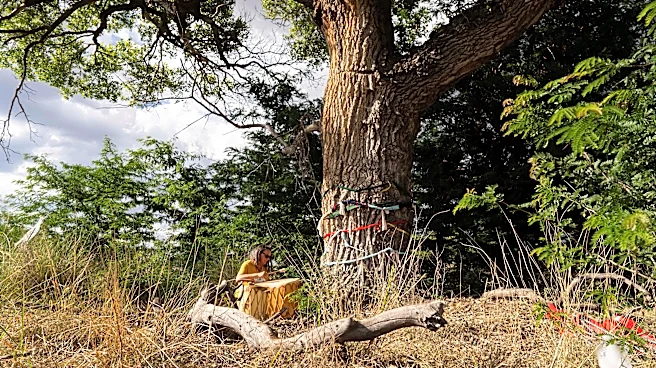





In the early morning hours of Oct. 5, Border Patrol officials came for the protesters who were opposing border wall construction through Lochiel, a tiny town in the San Rafael Valley of southern Arizona. And construction workers came for the last "Grandmother," a cottonwood tree the activists were protecting.
Four giant cottonwood trees had stood at the U.S.-Mexican border, their limbs splayed into the airspace of both nations. For their vast size and their century-long ages, they were dubbed the “Grandmothers.”
The Trump administration announced plans last year to erect a double wall in Lochiel to beef up security in this section of the barrier spanning the border from Texas to California. The four trees were in the middle of what would become
that second wall.
In July, three of the four trees were removed. To stave off that fate for the last Grandmother, protesters resorted to tree sitting and camping under the canopy. They watched over it night and day on the parcel of private land next to the easement where construction would begin.
The activists held out for 71 days before the authorities escalated their response. Border patrol agents broke up the encampment and tussled with protesters, arresting 10 of them and reportedly inflicting injuries on others.
Despite protesters’ best efforts to stop them, construction workers from the company Fisher Sand and Gravel toppled Grandmother 4. Even on the ground, its broken limbs and thick foliage still towered over border patrol agents, witnesses said, a reminder they said that the giant tree refused to go quietly.
Border wall will destroy wildlife habitat
Protesters said the violence descended without warning.
The day before, a "call-of-action day” had taken place in Lochiel to demonstrate against the border wall and celebrate what the protesters said Grandmother stood for — life and community. Under a festive air, participants walked along the Roosevelt easement from Lochiel’s former customs building, past the last Grandmother to the site of the active construction.
Protesters gave speeches while dressed as the wildlife the wall would threaten. They climbed onto piles of steel bollards, using them as a stage to recite poems and sing. Patagonia resident and attendee Mary Sky Schoolcraft said one speaker in a spotted owl costume declared, “Migration is an Earth right.”
“It was joyful and a celebration of solidarity,” she said. “These young people have come from all over the country, feeling drawn to take a stand and protest what’s happening.”
Protesters say they oppose the border wall for the vast ecological damage it would wreak. The structure knifes through the grasslands of the San Rafael Valley, what would have been an unbroken migration corridor for pronghorns, jaguars, ocelots, American porcupines and bears.
Construction activity would likely drain the aquifer, experts say. The wall design includes a base of concrete, a thirsty material. During Trump's first term, wall construction activity guzzled as much as 700,000 gallons of groundwater per day. Environmental advocates worry that it could lower the water table, damage agricultural productivity of farmers in the area and jeopardize the rest of the cottonwood habitat there.
A double wall also brings double the destruction, protesters said. The 60-foot gap between the two barriers means more pristine habitat lost. Even if smaller creatures could wriggle through the four-inch gap between the steel bollards, they’ll likely be put off by the stadium lightning that will flood the dead zone between the two barricades.
The cottonwood tree belongs to the imperiled ecosystem of riparian forests. Giant cottonwood stands grow near rivers or above aquifers, finding ways to carve out an existence on an otherwise arid landscape. They provide food for insects and shelter for nesting birds. In the past 200 years, Arizona has lost 95% of its cottonwoods forests to overgrazing, river modifications and climate change.
Protesters accuse the Trump administration of rushing construction on the border wall project without regard for the environmental consequences.
"What do you call a culture that destroys the places where water sustains life in an arid ecosystem?” said Russ McSpadden, a Southwest conservation advocate for the Center for Biological Diversity. "I can only think of one thing — it’s a death cult.”
Protests against wall will continue
Less than a week ago, the U.S. Forest Service quietly announced that it would close off the border wall construction site in the San Rafael Valley until Jan. 20, 2029.
The festival of protest on Oct. 4 was one last quiet before the storm, organizers said. Border patrol agents arrived the next morning just as demonstrators were performing a sunrise ceremony to honor the last Grandmother.
Law enforcement personnel obscured their badges, cut the fence and raided the encampment without a warrant, the protesters said. Outnumbering the dozens of protesters present, the officials formed a human shield to block access to the tree. Border patrol officers kept the activists from accessing their tents for more than four hours.
The Department of Homeland Security has not yet responded to requests for comment from The Arizona Republic over the manner of the arrests and whether agents had a warrant.
Witnesses said scuffles broke out between the agents and the demonstrators. Activists reported injuries from being pushed into the fence and stomped on by border patrol. Ten protesters were arrested and taken to the Sonoita Border Patrol station. Six were cited and released in Nogales, and the remaining four were taken to Tucson for a hearing.
“We had an incredible call of action day of parade and events. Community people came, Patagonia people came, family members came,” said Kate Scott, a long-time organizer of the Lochiel protests who witnessed the entire incident.

What started as an act of hope for the future was in hindsight a ceremonious farewell to the last Grandmother, Scott said. “They're going to hear the news just today that what they saw yesterday is now gone.”
Around 9 a.m., the last cottonwood fell. Its limbs creaked and groaned, audible above the screams from protesters, video recordings showed. Its boughs arced through the air before smashing into the ground. All that was left was a tangle of woody debris and a crater of upturned earth.
Schoolcraft said her heart sank when she caught wind of the tree's death from community messages. She’s disappointed but far from surprised.
“Everybody who was involved was aware that it was David versus Goliath,” she said. “But it was important to take a stand.”
Few legal challenges have succeeded
Most legal challenges to stop border wall construction have been unsuccessful. The REAL ID Act of 2005 exempts the Department of Homeland Security from adhering to environmental and historical preservation laws for the border wall project.
Environmental groups landed a rare victory when a federal judge paused the expansion of the border wall in Big Bend National Park, Texas. So far, lawsuits by the Center of Biological Diversity and the Tohono O’odham Nation to block the construction activity in Arizona have yet to achieve similar results.
Rep. Adelita Grijalva condemned the the tree's destruction and Border Patrol’s treatment of the public.
“The damage the Trump administration is inflicting on our irreplaceable borderlands cannot simply be undone,” Grijalva, D-Ariz., wrote in statement. “This is what the militarization of our borderlands looks like — and it’s all because (the Department of Homeland Security) has more taxpayer dollars than it knows what to do with, and is wasting them on a reckless and useless second border wall.”
Lochiel’s protesters say they aren’t giving up as long as the skyline is still free of a wall. Protests and encampments are still ongoing in Lochiel.
“We’re not going anywhere, Scott said.
The cottonwoods were not the end point, but the spark to the broader anti-border-wall movement in Lochiel, activists said.
It was never just about the trees. “It's what they represent,” McSpadden said. This includes the broader riparian ecosystem that could disappear if the border wall construction drains the aquifers dry.
Protests are continuing: In August, a tree sitter climbed a different cottonwood on the Mexican side of the border. The protester backed down after border patrol and Mexican officials threatened to revoke the grazing rights of the rancher operating on that parcel of land.
The rancher built a corral at the base of the tree for the business's calves and yearling cows. The livestock are still there, taking over the duty as guardians of the cottonwood from which people have been barred.
Shi En Kim covers environmental issues for The Arizona Republic and azcentral. Send tips or questions to shien.kim@arizonarepublic.com.
Environmental coverage on azcentral.com and in The Arizona Republic is supported by a grant from the Nina Mason Pulliam Charitable Trust.
Follow The Republic environmental reporting team at environment.azcentral.com and @azcenvironment on Facebook and Instagram.
This article originally appeared on Arizona Republic: Workers destroy the last cottonwood tree at Arizona border wall site