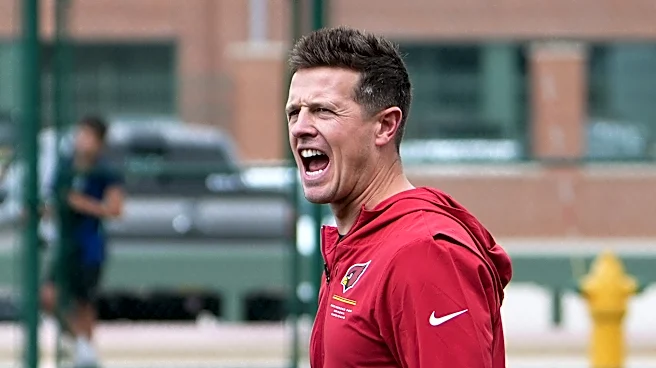


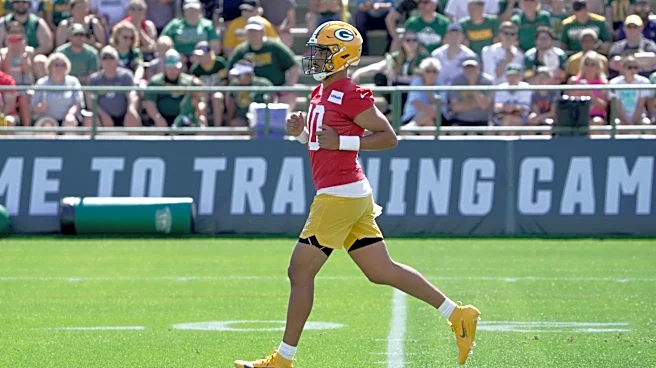

GREEN BAY, WI— Before the Arizona Cardinals’ joint practice against the Green Bay Packers, head coach Mike LaFleur laid out a simple ambition for the afternoon ahead.
“See how we respond to some challenges,” LaFleur said. “Some adversity.”
If that was the goal, LaFleur’s Cardinals passed with flying colors.
The first half of practice looked like everything expected of the Cardinals externally: A sloppy team that couldn’t move the ball on offense or slow Green Bay on defense. Then, as if a switch flipped, the second half was what the Cardinals expect of themselves. Suddenly, they found success with the downfield passing game, while their defense began to make life uncomfortable for Jordan Love and the Packers’ offense.
It was exactly the response
LaFleur had envisioned, even if the early struggles were jarring. Here are five more takeaways from a mixed afternoon in Green Bay.
Offensive line bounces back after poor start
At one point midway through the Cardinals’ third offensive series, quarterback Jacoby Brissett had completed 5 of 12 passes, with three sacks and an interception.
And somehow, the run game was even worse. In that same span, the Cardinals took six carries — five for Tyler Allgeier, one for Bam Knight. Each ended with the running backs met in the backfield or at the line of scrimmage by a would-be tackler.
It was ugly, in every way. Even the good plays — the five completions — offered little room for optimism, as each went for short yardage.
The struggles fell largely on the offensive line. In addition to the sacks, they were whistled for two pre-snap penalties and allowed a barrage of pressure from all sides. Brissett’s incompletions were rarely his fault; no one was open, and he had little time to scan the field.
But in the second half of practice, the offensive line responded. On Brissett’s final 25 dropbacks, the line allowed just one sack. And with improved protection, the entire passing game began to click. Of his final 24 passes, Brissett completed 21, including downfield connections to each of his top three weapons: Trey McBride, Marvin Harrison Jr. and Michael Wilson.
The running game, too, became untracked as the day went along, with both Allgeier and Knight finding more room to work.
It was a reminder of what has been evident all training camp: This Cardinals’ offense may be surprisingly potent, if only its offensive line can hold up.
That equation may rest largely on the shoulders of right guard Isaiah Adams and right tackle Elijah Wilkinson, the two least-proven pieces of the unit. Adams, it should be noted, missed this practice with a knee injury and is “day-to-day,” according to LaFleur.
Offense again reliant on Trey McBride
With the offense struggling early, McBride served as Brissett’s safety blanket. Five of his first seven completions went to the tight end, who finished the day with a team-high eight receptions on 11 targets.
When the offensive line eventually started to hold up, Brissett was able to work downfield more often, incorporating Harrison and Wilson. But the ball continued to find McBride, as it always does. On the final play of practice for the Cardinals’ starting offense, he beat safety Kitan Oladapo on an out route, converting a two-point conversion.
None of this will come as a surprise to anyone who has watched McBride over the past three seasons, but with so much attention on the uncertainty of the Cardinals’ wide receiver room, it’s worth remembering that McBride remains their most important offensive player.
Encouraging day for both receivers
Harrison provided the biggest highlight of the day for Arizona’s offense, reaching above rookie cornerback Brandon Cisse to secure a goal-line fade, then somehow getting both feet down in the back corner of the end zone.
It was a reminder of how talented Harrison is — and what he can be at his best.
“That was beautiful,” Wilson said. “There's not a play that Marv can make that surprises me.”
It wasn’t Harrison’s only big play. He started that drive — in Arizona’s two-minute drill — with a nice catch on a curl route. Earlier, he produced the Cardinals’ first explosive play of practice on a comeback route.
But from a statistical perspective, Wilson was the Cardinals’ receiver who stood out most. Here’s how the numbers shook out:
- Michael Wilson: 13 targets, 7 catches
- Trey McBride: 11 targets, 8 catches
- Marvin Harrison Jr.: 6 targets, 5 catches
Wilson had one drop early but, like the rest of the offense, bounced back well. He had a touchdown on a slant route, a chunk gain on a corner route and moved the offense downfield by drawing a pass interference penalty in the two-minute drill against Kei’Sean Nixon — who jawed with the typically mild-mannered Wilson all afternoon.
“Me and him got a little bit of beef going back to my second year in the league,” Wilson said. “… I'm not too fond of him, and I don't think he's too fond of me.”
Defense starts ugly
The rough start wasn’t much better for the Cardinals’ defense.
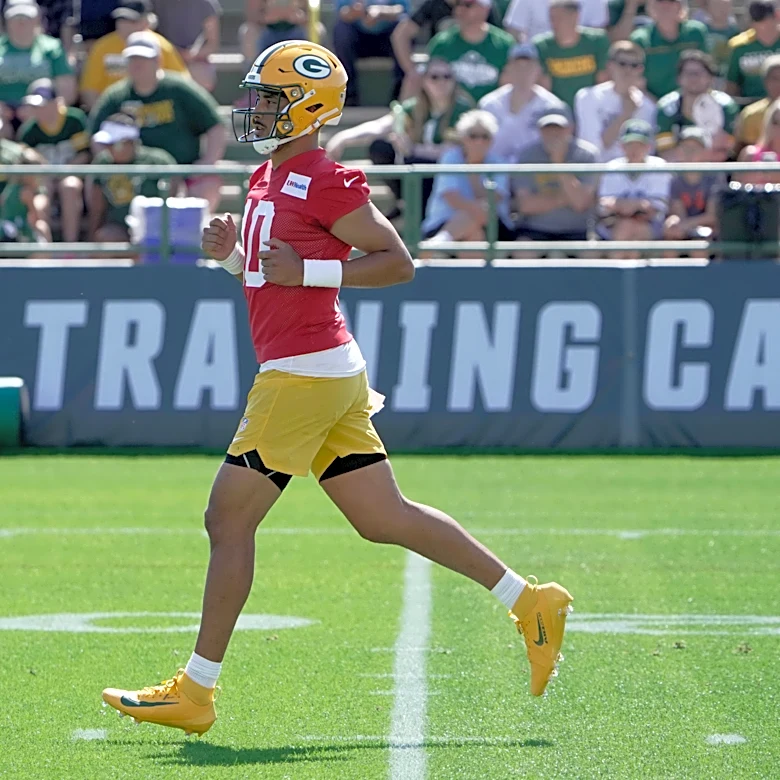
Packers QB Jordan Love completed eight of his first 10 passes, including a long touchdown to Matthew Golden over the heads of Budda Baker and Denzel Burke. The run game may have been even more concerning, as the Cardinals gave up a slew of big gains to Josh Jacobs.
“Early on in the scripted, they were kind of gashing us a little bit,” edge rusher Zaven Collins said.
But by the end of the day, the Cardinals had the upper hand. Both Collins and Andrew Wingard came up with interceptions, while the run defense began to solidify.
Afterward, players on both sides of the ball attributed that to the way these practices are set up.
“The first part is scripted plays,” Collins said. “It's a benefit for both because then the coaches know what it is and how we should fit things. They have it all scripted. And then it turns into real football, where it's just on the ball, call it. … I thought we did a really good job in the second half.”
Young players key to defensive turnaround
Other than the two interceptions, the Cardinals’ biggest defensive contributions came from their young players.
Walter Nolen offered a rare early spark by tearing into the backfield on the Packers’ first play from scrimmage. Later, as the run defense improved, he made himself a nuisance in that area, stopping a few carries for short gains.
“Walt had a really good day, I thought, getting off the ball, striking and then getting low when he had double teams,” Collins said.
Jordan Burch, the Cardinals’ second-year edge rusher, also made a consistent impact up front.
In the middle of practice, he had multiple pressures on Love, helping the Cardinals' defense find its footing. And on the final play of the day for the starting defense, he got home for a sack with a power rush, forcing a turnover on downs in the red zone.
Burch finished his rookie season with a paltry 6.8% pressure rate and just one sack, but he may be the Cardinals’ best hope to alleviate some pressure from Nolen and Josh Sweat, their two most impactful players along the defensive front.
The picture is clearer in the secondary, but one cornerback spot remains open, opposite Will Johnson. Throughout camp, Denzel Burke and Max Melton have competed for that role. And with Johnson missing the joint practice, both players had an opportunity to stake their claim to the job.
On this day, Melton had the upper hand. He was the star of the two-minute drill, getting his hand in for multiple pass breakups and helping slow down Green Bay’s offense before Burch ended the drive with his sack.
“I don't really get targeted in practice like that,” Melton said. “I get targeted but not like how I want to. So for them to throw the ball my way a couple times today, I think I got three or four targets today, it felt amazing, honestly.”
This article originally appeared on Arizona Republic: 5 takeaways from Arizona Cardinals, Green Bay Packers joint practice