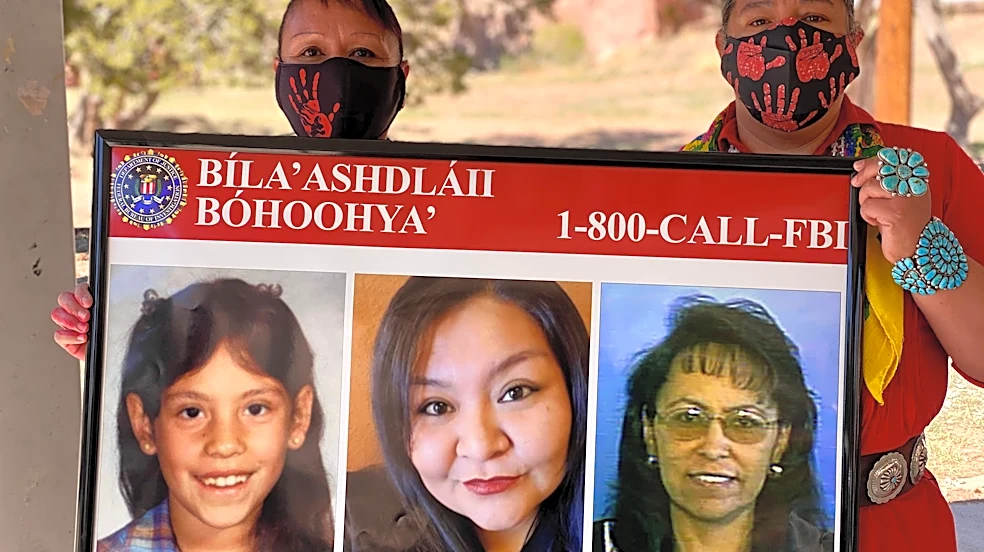




Laverda Sorrell disappeared on July 4, 2002, from the Navajo Nation community of Fort Defiance. Her husband claimed he dropped her off at her office that night after the two of them had gone out to dinner.
More than two decades later, Sorrell’s disappearance remains unsolved.
The Federal Bureau of Investigation is offering a $25,000 reward for information leading to the arrest of those responsible for her disappearance. She is also on the Navajo Nation Police Department's missing list, which includes 66 individuals who have been reported missing across the Navajo Nation, including 16 females and 50 males. She's also listed on the NamUs website, the central database of missing, unclaimed and unidentified persons cases.
But she's no longer on the
Bureau of Indian Affairs Missing Murdered Unit website.
"It's devastating, really devastating to hear something like that," said Velina Guy, Sorrell's sister. "Especially because we have been so proactive and trying to get her story out to wherever and whenever anybody could listen, just so that we could bring awareness and try to find out what actually happened to my sister."
Removing her case from the website eliminates a valuable resource for families, a family attorney said, raising questions about how the BIA closes cases and notifies families when investigations are declined or closed. She questioned how the BIA determines which cases remain active, how often families should expect updates and where the agency's policies and procedures can be accessed. Without a victim specialist to keep families informed, she said, the families are left without clear answers or consistent communication throughout the process.
Combined with the existing BIA case backlog, these issues raise concerns that efforts by the BIA, FBI, and tribal police to locate missing and murdered Native Americans may be falling short of their intended goals, advocates say, creating the appearance of progress without delivering meaningful results.
"Three years ago, we met with the FBI and the U.S. Attorney's Office and they were supposed to conduct a search. I just heard that that FBI agent is no longer on the case," said attorney Darlene Gomez, who represents Sorrell’s family. "I've never been contacted by that agent in three years, never contacted two years prior when there was another agent, never had a victim service advocate contact me. It's these constant, consistent roadblocks, and advocates throughout the country are saying, 'Hey, look, this is an issue.' Nobody listens."
In September, an audit report by the U.S. Department of the Interior's Office of Inspector General found a backlog of cases within the Missing and Murdered Unit. In November 2024, the MMU had 83 open cases and 394 pending referrals. Of those, 284 referrals, or 72%, were received between 2020 and 2023, with the remaining 110 received in 2024.
The MMU focuses on solving unresolved homicide, long-term missing persons and human trafficking cases involving American Indians and Alaska Natives. Former Interior Secretary Deb Haaland, now a candidate for New Mexico governor, announced the formation of the unit on April 1, 2021.
But five years later, referred cases remain unsolved and pending, with persistent challenges within the unit including unmanageable workloads, a lack of established assessment timelines and staffing shortages contributing to the backlog.
The ongoing staffing shortages hindered the unit's ability to fulfill its mission the audit found, while agents also failed to consistently contact victim specialists as required by its own procedures.
Gomez said Sorrell’s case is not the only one highlighting problems with the BIA’s Missing and Murdered Unit. She recently encountered another issue involving the unit’s failure to give a case update and establish a point of contact involving a Laguna Pueblo woman named Brittany Starr Waconda who went missing in May 2026, underscoring the ongoing concerns concerns about accountability and communication.
"These families never really know what's going on with their cases," said Gomez.
The Arizona Republic contacted the BIA with questions but has not yet received a response.

A mom goes missing, with few clues
American Indian and Alaska Native women and men experience high rates of lifetime violence, at 84% and 82%. As of June 2023, some 820 of the 23,300 missing persons listed in the National Missing and Unidentified Persons System were Indigenous, despite representing just 1.1% of the U.S. population. The BIA estimates approximately 4,200 missing and murdered Indigenous cases remain unsolved, often due to limited investigative resources.
Sorrell, a mother of three, and her husband were headed for divorce in 2002. Guy said the family was well aware of the toxic relationship. Sorrell would leave her husband but return after he threatened that she could not take their children with her. Sorrell's husband was described as an avid hunter and scout who knew the Chuska Mountains near Crystal, New Mexico, well.
On the night of July 4, 2002, Sorrell went to dinner with her husband in Gallup, New Mexico. The family lived in the Navajo community of Navajo, New Mexico, near Fort Defiance, Ariz., where Sorrell worked for the Window Rock Unified School District. At the time, Guy lived in Fort Defiance, less than a mile from her sister’s workplace.
After Sorrell’s disappearance, her husband has always said he dropped his wife off at her office that night around 11:30 p.m. It was a peculiar story for those who knew her, one that never made sense to her family, because Sorrell's office keys were later found at home. Since Guy lived nearby "there's no way she (Sorrell) wouldn't have walked over."
"We were told that he was a primary suspect in the whole case, initially," said Guy. "Because we had so many different jurisdictions that we were working with, because of where she lived, because of where she disappeared...there was a lot of confusion as to who was going to be the lead on that case. It was a lot of fumbling on their (authorities) part, because I think it was very limited education on how to handle those kinds of disappearances at that time. There was a lot of victim blaming from police."
Guy said that early in the investigation, authorities from various agencies were “passing the buck,” making it difficult to determine who to contact about her missing sister. The family has since gone through at least five or six FBI investigators. It's common that the complex network of tribal, state and federal agencies has posed challenges for families seeking answers about missing Indigenous relatives, to the point that it's usually the family, attorney and advocates who do most of the work in trying to locate the missing.
"A lot of what we're bringing out and sharing and talking about...we're doing all of that ourselves," said Guy. "By sharing her story and putting the information out there and getting on these podcasts, getting on these news reports...we are trying to say, 'Somebody please hear our voice. Please hear our story.' We really want to get her case resolved, and we really want to get closure. We really want to know what happened to her. We want someone held accountable."
Guy said the family’s frustration stems from authorities overpromising and underdelivering. Investigators have assured them they were interviewing Sorrell’s husband and others who might have information, and that they were conducting searches, but the family has little insight into the investigation’s progress. Guy said the family also passed along tips to authorities that they believed were credible, including contact information for potential witnesses, but they never learned whether investigators followed up or what the outcomes were.
"We've never been part of these searches," said Guy, who has also wondered when the investigations actually happened. "We have come to the FBI saying, 'What can we do to help? What can we do to support?' Because we are doing all of this on our own? We're searching for monies to fund search dogs to get out into these areas, people who use drones to search these areas, all of those things cost money."

'They want us to fail'
Gomez said the FBI is a separate issue but faces similar shortcomings as the BIA. She has represented at least five families whose cases appeared on the BIA's MMU list. Recently, she discovered that Sorrell’s case had been removed from the BIA MMU website without notification to either her or the family. Guy confirmed she was never notified. Sorrell's isn't the only unsolved case that has been taken off without Gomez and other family members' knowledge. Gomez said her last contact with a BIA agent was a year and a half ago.
"When I look at the audit, every single thing that I've been going through since 2021 is contained in this audit," said Gomez. "The problems, and one of my biggest fear, is now they're (BIA) just seeing a case and they're closing it. Instead of taking the time to do the full process, to review it. I think in order to become compliant... we're going to see a lot of cases that were immediately closed."
The lack of communication from the BIA and other departments is nothing new for Gomez, she said, but a reflection of the ongoing challenges she has faced while representing and advocating for missing and murdered Indigenous women.
In 2021, Gomez exchanged emails with former Navajo Nation Police Chief Daryl Noon and Deputy Bureau Director Bartholomew “Bart” Stevens about the MMU process and cases such as Jaime Yazzie, a Navajo mother who went missing in 2019. Yazzie’s boyfriend, Tre C. James, was sentenced to life in prison in 2023 for her murder. Gomez also sought clarification about which agency was investigating the disappearance of Ranelle Rose Bennett, a Navajo woman who has been missing since 2021.
"I was also informed that BIA did get involved, they did send investigators, they did conduct an investigation and they were in contact with the family," emailed Noon to Gomez. "However, the district is telling me they have not shared their findings. I know this information doesn’t help the family. I’ll try to get a hold of the BIA investigator to find out if they are pursuing the case and ask that they keep in contact with the family or allow me to update them on BIA’s findings."
Bennett’s case remains listed on the MMU website, with no real change in the case. Gomez said she has spent the past five years urging tribal nations to unite to address the crisis of missing and murdered Indigenous people and support their families. She said this lack of unity makes it difficult to hold the federal government accountable for its treaty obligations.
"They want us to fail. They want all of these advocacy groups to fight one another, fight for dollars, fight for the press, because then it weakens us as a whole," said Gomez. "It makes me want to inspire our tribal leaders to put all of the pressure on the U.S. Attorneys Office, and the FBI, and the BIA and demand that they investigate the cases. Same thing with the National Congress of American Indians. Can you imagine, from 2024 to 2026, how many cases are still just pending? Because this was only cases related to 2020 to 2024."
The lack of training is also an issue for Gomez. The Inspector General recommended training MMU staff to ensure only potentially solvable cases meeting the unit’s criteria are assigned to agents. BIA reported conducting mandatory training on referral screening, evaluation, closure and the solvability matrix on April 17, 2026, with plans to repeat it annually and include it in onboarding.
"One day training for all of these complicated issues," said Gomez. "That training should be a two week training minimal."
Another recommendation from the inspector general's office was for BIA to develop and implement a staffing plan for the Victim Services Program to ensure compliance with MMU procedures and provide victims and families with the support they may be entitled to under the Victims’ Rights and Restitution Act.
The report noted that, although BIA said it addressed the recommendation, it did not demonstrate that it developed a staffing plan or assessed whether staffing levels were sufficient. Despite claiming that all necessary MMU positions were filled, the report found that the victim service program’s understaffing continued to hinder critical victim services.
Gomez represents at least 20 Navajo families and doesn't receive any type of funding from the tribe to help victims families. The Navajo Nation has its own Missing and Murdered Diné Relatives (MMDR) Task Force and when asked about the BIA MMU audit, the task force said they did not have a comment but had discussed the issue.

Law enforcement fails to work with families
Victor Rodriguez, a law enforcement veteran with nearly 30 years of experience, previously served as police chief for the Pueblo of Isleta and the New Mexico cities of Truth or Consequences and Belen. Now running for sheriff in Sandoval County, Rodriguez said he has prioritized missing and murdered Indigenous people issues throughout his career. As police chief at Isleta, he implemented a policy ensuring every missing persons case was assigned a detective. He also conducts training through Fox Valley Technical College's Amber Alert training program.
"I was very disappointed to see an actual federal government Inspector General report that detailed what I was hoping wasn’t true because, being in Indian Country, as a chief of police, I noticed that the MMIP unit wasn’t exactly what it was being made out to be," Rodriguez said.
"When you see that they had somewhere close to almost 400 pending referrals as of the end of November 2024, and that nearly nearly 75% of those referrals occurred between 2020 and 2023, it was disappointing."
The audit report found that despite BIA’s recruitment and funding efforts, MMU continued to face staffing challenges and operate below full capacity.
It also found that MMU did not consistently provide victims with services required under its own procedures and potentially under the Victims’ Rights and Restitution Act. Additionally, BIA's Office of Justice Services used carryover funds originally allocated to MMU to purchase law enforcement vehicles for other agencies.
The office funds MMU through its Law Enforcement Special Initiatives and Criminal Investigations & Police Services sub activities. Funding for these programs, which OJS considers part of its MMIP Initiative, nearly tripled from $5.9 million in fiscal year 2020 to $16.9 million annually in fiscal years 2022-2024. In fiscal year 2022, Congress allocated an additional $5 million to hire 20 investigators for MMU. According to BIA, the unit had 27 agents as of October 2025.
"There is a huge need from families who wanted their missing loved one's cases to be looked into and it wasn't happening," said Rodriguez. "Then, to add insult to injury, the funding intended for law enforcement or victims was being diverted to other resources or areas within the department. It was just heartbreaking."
Rodriguez recounted an interaction with the BIA after a constituent sought answers about a missing loved one from a Pueblo who was later found dead in Belen, New Mexico. Believing the BIA’s Missing and Murdered Indigenous People unit could help, he contacted the unit himself, explained the situation and was shocked by the response.
“I was told, ‘That’s not what we do. We are more like a liaison,’” Rodriguez recalled. “‘If you have a situation that happens, we will connect you with the people investigating it, but we can't take over the jurisdiction. We don't get involved because it happened off the Pueblo.' I thought to myself, 'Well, what good is this unit, then?' Because most Indigenous people, unfortunately, aren’t reported missing off the nations. As a law enforcement officer who thought, this is a great idea, this is exactly what this means. I was just shocked that that's not what it was."
Rodriguez said if elected as sheriff for Sandoval County, his first priority is to ensure every missing-persons case reported to his agency in Sandoval County is assigned a detective who actively follows up. His long-term goal is to establish a countywide investigative task force involving municipal, tribal, state and federal law enforcement agencies to dedicate resources to solving missing-person cases.
"I suggested this to one of our attorney general candidates and our current attorney general as well," said Rodriguez.
"I said there should be an investigative arm either through the Attorney General's Office or the Department of Public Safety for the state that is an investigative unit just for missing persons."
Sorrell was 'the glue of the family'
Guy described Sorrell as the glue that held their family together, saying "after she disappeared, our family kind of fell apart because she wasn't there." One of 10 children, Sorrell was caring for her parents at the time and was a devoted mother to her own children.
"She planned all of our birthdays. She'd always planned something during the holidays...her home was that gathering and she took really good care of my parents," said Guy. "She was always there for my parents, and she was that aunt, that family member who just gravitated to the babies, and the families. She loved children. She was present as a mom."
Guy said the family last spoke with an investigator about three years ago, when they were told new efforts would be made to solve her sister's case. The MMU's shortcomings are yet another disappointment in a long series of letdowns for the family, as well as other MMIP cases.
"It's a real slap in the face, that after all these years we just get wiped off the board like that without real consideration," Guy said. "It's hurtful and honestly I'm just really hurt. After all the work that we've put forward, after all the things that we've done, this is what it's come down to. We still don't have answers, and they're fine with that."
Arlyssa D. Becenti covers Indigenous affairs for The Arizona Republic and azcentral.com. Send ideas and tips to arlyssa.becenti@arizonarepublic.com.
This article originally appeared on Arizona Republic: Audit finds failures, backlog in Indigenous missing persons cases