






A recent op-ed in this paper asked for the science that justifies reducing the population of horses along the Salt River.
In response, here is both the science ― and the history ― from those of us from the Salt River Horse Collaborative.
The area occupied by the Salt River horses used to be grazed by cattle. In 1979, the Forest Service determined that the area could sustainably provide approximately 150 Annual Unit Months (known as AUMs) of forage per year, enough to support only about 12 to 13 cows.
But even with that modest population of cows, the damage was severe.
In 1981, the Salt River Recreation Plan identified that "an unacceptable level of conflict exists between yearlong livestock use and recreational values, as well as with soil, watershed
and wildlife habitat."
Instead of building costly fencing to keep cows out of sensitive portions of the river, the federal government acquired the grazing permit and the cows were removed.
At that time, there were no horses in the Salt River area, "except for occasional strays," coming from the nearby Salt River Pima-Maricopa Indian Community and the Fort McDowell Yavapai Nation.
After the grazing allotment was closed, its boundary fencing was no longer maintained, and horses from the adjoining Tribal lands moved in.
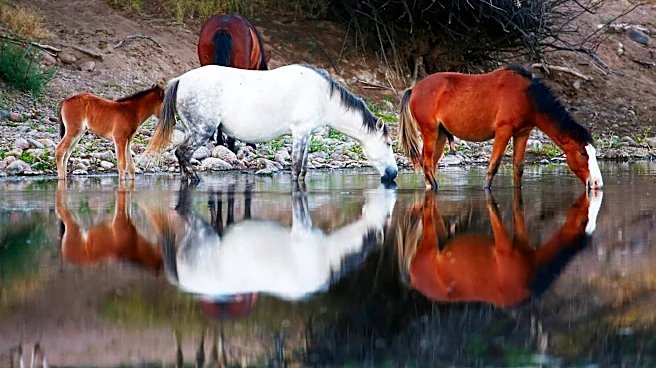
Today, about 300 horses live in the area the Forest Service once found could not even accommodate 12 cows without unacceptable damage to soil, water, wildlife habitat and recreation.
And now for the science.
Forest Service range scientists have estimated that the lower Salt River produces enough forage to sustainably support just 20 horses per year.
USDA Rocky Mountain Research Station range scientists independently calculated a sustainable population of between 28 and 44 horses per year.
While there's some discrepancy between those estimates, they point to the same conclusion that the land can naturally support just a few dozen horses, not several hundred.
University of Arizona College of Agriculture range scientists have documented the consequences.
In a 2018 forage assessment, researchers "failed to document a single perennial continually reoccurring grass plant" in the study area.
This isn’t just bad for the ecosystem. It’s unhealthy for the horses as well.
Recent University of Arizona research found that annual forbs (which are plants the Salt River horses forage on) "are likely to lack the nutritional quality necessary to maintain horse body condition, particularly for lactating mares."
The researchers also concluded that "current production levels are insufficient to sustain the existing horse population without supplemental feeding."
To prevent mass starvation, the Arizona Department of Agriculture and the Tonto National Forest have authorized supplemental feeding of the Salt River horses since 2018. That authorization underscores that the Salt River horses are not a self-sustaining population.
While Arizona enacted legislation declaring that a Salt River horse is "not a stray animal," the state denies ownership of the horses and denies responsibility for any damages they cause.
The legislation does not change the fact that the horses reside on federal public lands, where federal land-management laws and Forest Service decisions also apply.
According to the federal government, any cattle, sheep, goat, hog, or equine not defined as a wild free-roaming horse or burro is designated as "unauthorized livestock."
The Tonto National Forest determined in 2015 that the Salt River horses are not federally protected "wild free-roaming horses," as the area is not a designated Wild Horse and Burro Territory.
It’s important to keep in mind that the lower Salt River isn't just home to an unsustainable population of struggling horses.
It’s a biodiversity hotspot and an increasingly rare, watered desert riparian ecosystem. It provides habitat to federally protected animals including the yellow-billed cuckoo and southwestern willow flycatcher and an important recovery habitat for the endangered Yuma clapper rail.
These embattled native species are suffering habitat loss across the Southwest, including in the lower Salt River.
In order to ensure their continued presence along the river, and that of the horses, a substantial reduction in the horse herd can and must be accomplished humanely.
The science supporting this reduction has been in front of us for years.
Robin Silver, M.D., is a co-founder and board member of the Center for Biological Diversity and a member of Maricopa Bird Alliance. Co-authors Tyler DalMolin, Ph.D. (RD Land and Cattle), Robby Richardson (Limestone Ranch), John Koleszar (Arizona Sportsman for Conservation), Jacquelyn Hughes (Rail Lazy H), and Jeffrey Wilms, John Whitney and Scott Meyer, DVM (Salt River Horse Collaborative), contributed to this piece.
This article originally appeared on Arizona Republic: The science is clear: Salt River horse numbers must drop | Opinion