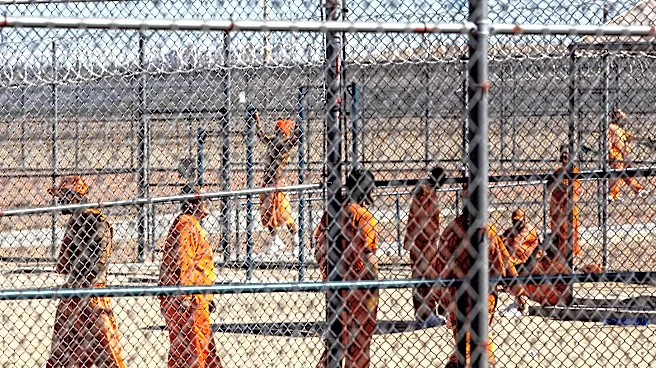






Arizona leaders are asking the U.S. Supreme Court to block a federal takeover of the state's prison health care system.
Lawyers with the Arizona Attorney General's Office argued in a Sept. 16 filing that the state has made progress since the courts decided health care failures were subjecting inmates to cruel and unusual punishment.
They asked the justices to halt the receivership ordered by a lower court judge while the state appeals the decision.
A receivership places a court-appointed official in control of an institution's operations when a judge determines that less intrusive remedies have failed. It's designed to be a "remedy of last resort," Arizona's lawyers argued in the filing.
The state's prison health care system should "remain in the
hands of state officials answerable to the people of Arizona" rather than under the control of a "politically unaccountable individual," Arizona's lawyers wrote.
"The gravity of that action and the costly and disruptive consequences for the Department and the State are hard to overstate," they wrote.
Going into receivership would escalate the decades-long, expensive and politically sensitive conflict that has pitted Arizona against the case's plaintiffs and the federal courts.
The orders from U.S. District Judge Roslyn Silver would give former Ohio prisons chief Annette Chambers-Smith sweeping powers to establish the agency's health care budget -- a power usually reserved for the governor and Legislature -- at a time when the state's finances are stretched thin. Arizona would also pay her an annual salary of $500,000 for the duration of the receivership, which would last five years or possibly longer.
Her decisions would be subject to the court's review.
Civil rights groups and the plaintiffs had celebrated the prospect of a receivership, saying it will speed up the state's efforts to address issues like staffing shortages and underfunding.
"Over the life of this case, hundreds of incarcerated people have suffered grievously because of inadequate medical and mental health care," said Corene Kendrick, deputy director of the ACLU's National Prison Project.
The lawsuit began in 2012.
Arizona's elected leaders have fought to keep the prison health care system under state control.
Liliana Soto, a spokesperson for Gov. Katie Hobbs, argued the court order gives Chambers-Smith "essentially a blank check" to spend taxpayers' money and represents "an impractical use of Arizona tax payer dollars with zero accountability to tax payers."
"Arizona’s elected officials–not a federal court–should be making decisions about our prison system," Soto said in a written statement to The Arizona Republic on Aug. 13.
The receivership is scheduled to begin Oct. 19, but that timeline could change if the justices intervene.
House GOP spokesman Andrew Wilder confirmed that Republican legislative leaders intend to file an amicus brief supporting the state's appeal.
Arizona's Department of Corrections, Rehabilitation & Reentry declined to comment.
Receivership would advance yearslong lawsuit
The receivership fight is the latest development in a lawsuit that has dragged on for more than a decade.
Silver ordered the receiver in February after finding that nearly 14 years of settlements, monitoring, court orders and other measures had failed to end violations of prisoners' constitutional rights.
Arizona's lawyers have successfully delayed the takeover as they appealed Silver's decision.
The state's legal team argued the prisons department has taken steps to address the problems identified by the judge, like chronic understaffing, failing to enforce contracts with its private health care vendor, inappropriately assigning complex patients to nurses rather than physicians, and inadequately funding inmate health care.
The state argued Silver didn't give officials enough time to make progress, and that she could have used other options before placing the department under a receiver's control.
Arizona has struggled to live up to the plans laid out by a court monitor. Lawyers said in September filings they had gaps in "mandatory" positions at several prison facilities across the state, falling short of a requirement to keep them 100% staffed.
State leaders argue Silver saddled Arizona with impossible demands.
"The court is imposing unrealistic demands and timelines that fail to account for the complexity of these challenges or the significant progress that has already been made," Soto said.
Silver decided the state’s concerns about cost and loss of control were outweighed by the continued harm to incarcerated people receiving unconstitutional health care.
She sided with civil rights groups that brought the case, saying the receivership will bring relief to Arizona prisoners.
“While we welcome this order, it does not erase the decades of suffering that many have endured in Arizona’s prisons. This order would not have been possible without the brave, incarcerated people who have testified and shared their experiences with the federal court,” Lauren Beall, a senior staff attorney with the ACLU of Arizona said in a written statement after the July 17 order appointing Chambers-Smith.
Receivership would reshape prison health care budgeting
Chambers-Smith's appointment would be a sea change in the way the state determines its prison health care budget.
Previously, those finances have been decided as part of the high-stakes annual negotiations between lawmakers and the governor.
The court's order would delegate that power to Chambers-Smith, directing her to "engage in essential efforts" to secure the necessary prison health care funding in coordination with the department, the governor's office, the state Legislature, and other stakeholders.
In her first six months on the job, Chambers-Smith would be tasked with developing a measurable plan to address the constitutional violations.
The court orders also give her sweeping powers to hire, fire, discipline and set compensation for health care employees and contract workers. She can establish policies, and negotiate, enforce, rewrite or terminate contracts with vendors.
Arizona lawmakers and local leaders have grated against other court-imposed oversight. Republican legislative leaders in June appealed a Maricopa County judge's order to reform the state's public school funding system, arguing it illegally intruded on the Legislature's authority to write the state's education policies and budget.
This article originally appeared on Arizona Republic: Arizona asks US Supreme Court to block prison health care takeover