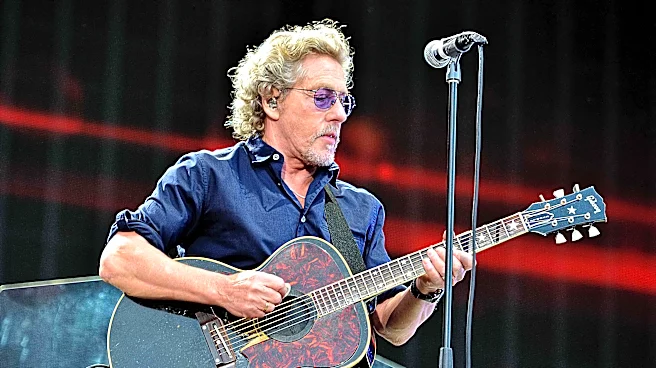


It hasn’t quite been a year since Roger Daltrey and Pete Townshend brought the final concert of The Who’s The Song Is Over North American Farewell Tour to a bittersweet conclusion with an unplugged “Tea & Theatre,” the tale of two old friends reflecting on their lives together, “a great dream derailed" that's left them feeling sad.
On Sunday, Aug. 23, Daltrey brings a nine-piece touring band, which also features Townshend’s brother Simon on guitar, to Mesa Arts Center to launch what he believes will be his final U.S. solo tour.
As he was packing for the road, Daltrey checked in by phone for a very personable conversation, laughing often as he spoke about the tour, the special bond he shares with Townshend, the loss of bandmates he loves dearly
— drummer Keith Moon and bassist John Entwistle — to deaths by misadventure, why that farewell tour in 1982 never felt like the end, and the prospect of making new music with Townshend again.
He also spoke about The Who's most recent album, 2019's "Who," and "As Long As I Have You," the solo album he released a year prior to that, which featured Townshend playing guitar on seven songs.
What to expect from Roger Daltrey on his latest US solo tour
What can fans expect from this tour you're set to launch in Arizona?
Well, it's my solo band, which I formed in — I think about 2019, before the pandemic. I formed a band mainly to do charity shows because I'm just a singer, you know. I can play guitar and just strum along, but it's not enough to do a whole show and I've got a lot of mates that are struggling to get work. Musicians are having a really hard time at the moment. So I put nine of them together for my band, all top-rate guys.
And we go out and we have fun. We've got incredibly varied instrumentation. We've got mandola, we have a violin, we have a keyboard player who also plays squeeze box, a great guitarist, a drummer, a bass player and, of course, Simon Townsend on rhythm. It makes a very, very different sound.
I do some Who songs, but I try to get away from Who songs and find songs that I loved from right through the late 70s, 80s, that period. There were some great bands back then. And I listen to the hits they had and think, ‘How would this work with the band that I have, with the instrumentation I have?’ And it ends up to be a lot of fun and people seem to love it.
I've done a couple of dates on the East Coast with this tour and I found out that the more you get people to laugh and have fun and sing along because they also kind of know the songs, the better the night ends up. I've been in a serious band. You don't get more serious than The Who (laughs). It was nose-to-the-grindstone stuff. So this is just a great night out. I did want to call it A Bloody Great Night Out, but unfortunately, you're still religiously tied in America.
You mentioned doing songs by other artists of that era. Are you doing solo stuff as well?
I do some solo stuff, yeah. Of course I do “Giving It All Away.” I can't get away from that. But I just look at the songs and I think, 'Well, how can I approach this differently?' We do “Won’t Get Fooled Again,” but there’s no synthesizers, no tape, no anything. We just do it on instruments. And it works out. We can stretch the song. We can make the solo longer. "Baba O'Riley," same thing. We can really pull the stuff apart and put it together within a 6-minute period.
It's just wonderful to do. People have commented that they hear the song again for the first time, because it's different. It's the same, but different. So they listen a little harder, you know?

Roger Daltrey on how it feels to still be on the road at 82
That's great. You recently turned 82. How does it feel to still be doing this at that age?
(Expletive) old (laughs). It ain't easy, but then again, the reason I'm still doing it is because my voice is possibly the best it's ever been in my life. I can still hit a top D above a high C. It's ridiculous. In full voice. So I just want to use the gift I was given as much as I can, because it's done me so well through my life. It was my dream just to be a singer.
I didn't want to be a glamorous rock star, although that’s the vehicle that made me. It happened. I don't know how. I was the ugly duckling when I was a kid. I'm reverting back to it now, of course (laughs). It's been an absolute dream of a life.
And I just feel I should use the gift I was given because it is an extraordinary voice. It's incredibly powerful, incredibly strong, and I can still hit the notes. So why not? There’s enough people out there half doing it. I can still do it properly (laughs). Why not?
So how does the experience for you of a solo tour compare to touring with The Who?
Oh, I find The Who an awful lot of pressure because so much of The Who identity on stage is down to the vocals and the lyrics, and they have to be felt. There is no way you can cheat a Who song when you're on stage with The Who.
We've had tribute nights with other singers that got up and sang a range of Who songs. They all come off saying, ‘How the (expletive) do you do this?’ It suddenly hits them how hard they are to sing and how demanding they are because of the lyrics. There's something in the way Townsend wrote that you cannot cheat those lyrics. You can't half sing them. You have to really mean it, and they're tough lyrics.
Roger Daltrey reflects on The Who's North American Farewell Tour
Yeah, I get that. What was the experience of doing that Who farewell tour like for you?
Bittersweet. I mean, we had to come to the end of touring. It's not to say that we're at the end of doing shows in America. We might do the occasional one-off. We will always be there if you have any more disasters and you're putting on a charity show. The Who have always been there for you and we always will, as long as we can do it.
We had a rehearsal recently to make sure we can think about doing some shows next year in Europe because we've still got to say goodbye to them and goodbye to some other countries in the world that we had success. And the rehearsal went extremely well and sounded fantastic. So, I mean, it's not over by any means. It's just that was the last tour of America for the Who.
This will be my last tour of America, unless something unforeseen happens. I can't see myself doing another long tour of America, even solo. The road is incredibly hard on anybody, you know. It's an isolated life in a lot of ways, but again, you get the two hours in the evening where you're doing everything you've ever loved in life, which is making music, trying to make people smile.
Singing is the most wonderful thing. When people sing together, there's something that happens biologically within that crowd. Their heartbeats all start to beat at the same rhythm. It's an extraordinary thing. And you feel that as an artist. You feel it when it's good. And you also feel it when it’s bad.
Have you had many of those nights?
Well, I had a period where I had pre-cancer in my vocal cords, and yeah, I wasn't singing real well through the 2005 period. I was singing alright, but not great. Then I sorted it out with a bit of surgery and, like I say, since then, my voice has just gotten better and stronger.
I'm finding it harder to keep the fitness levels up that you need because it's an athletic job, being a singer. The little part of our body, our vocal cords, it's like any other muscle in the body. It needs a lot of exercise. That's another reason I'm doing this tour. If I sat around for a year waiting for The Who to work again, who knows whether my voice would be there at all? I have to keep working it.
Roger Daltrey on the 1982 farewell tour: 'I knew it wasn't the end'
That makes sense. You guys were all so young when you did the farewell tour in 1982. Did that feel like the end for you?
No. I knew it wasn't the end. But it was the end of a period. We were basically lost. Pete, being the songwriter, felt incredibly pressured. We had lost Keith Moon. We tried to replace him with Kenney Jones, who incidentally is a fabulous drummer, but he was just quite obviously the wrong drummer for The Who. He'd come out of a band that played happy-go-lucky, good-time dance music, and The Who wasn’t that.
So it was kind of clunky and Pete was starting to get into very heavy drugs and drink. And I thought. … It was me that called it the last tour because I thought the only way to stop this without losing another member of the band, because they're all my mates and I love them all dearly, was to call it the last tour and say, ‘Well, that's it. And let's see what happens. Throw the (expletive) at the wall and see what sticks.’
And as it was, we came back. We found Zak Starkey and his drumming suited the band far more. And then, of course, we lost John Entwistle, which was another bridge to cross.
That was heartbreaking.
Yeah, it was. We were ready to go on the beginning of a tour. I mean, it was the day before the start of a tour. I can't believe it. Chicken! (laughs).
Daltrey says he and Pete Townshend have discussed a new Who album
Does it feel like the door is still open for you and Pete to record new music together?
Yes, we're talking about it now, but in this incredibly divisive, kind of deconstructive world we live in, it's kind of hard to find the direction in what we do. I felt the last two albums we've done have started to get a bit pretty, and The Who were best when they were gritty, not pretty. I'd like to get back to that — more guitar, bass and you know.
But then I don't know. Where would the audience be? I have got no clue of modern life. I hate computers. I think they’ve destroyed civilization. I really do. They've made it feel like we're doing loads of things when we're actually doing less than we were as a society. It's making us fall apart.
You said the album from 2019 was too pretty. Was it a good experience making that album?
Pete had a load of demos and they were very, very deconstructed. I really had to work on melodically changing the top line of the songs, and I think it worked out really well. But like I say, although the songs have got to carry a lot of meaning, I think in some ways, it's just a touch pretty for me, you know? But it was very different, a departure.
I don't think it's a bad album by any means. But if I could’ve made the album I would like to make now, it would be very, very different than that album.
Well, I hope you get to make that album.
Well, so do I. So do I (laughs). But there you go.
There's something 'in the ether' when Daltrey works with Townshend
You and Pete also worked together on that latest solo album you released a year before that Who release. What do you recall of the making of that album?
I couldn't find a guitarist. I had a song I'd written. And I just couldn't; I don't know. I had tried about three guitarists putting a solo on it and they were all good. But I thought, ‘It’s just not.’ ... Pete just phoned me up and said, ‘I hear you're looking for a guitarist to do a solo on your album. Let me hear it.’ So I sent it to him (laughs). And he sent it back with a solo that was just perfect.
We have this kind of relationship. It's very strange. There’s an understanding. Something goes on in the ether. We pick each other up, what kind of works between us. It was weird. I enjoyed doing that album. It was great to revisit all those songs we used to do back in the clubs in the early 60s. It was good fun. Whether it's a success or not, I don't really give a (expletive) about that.
Well, I mean, it sounds great. That's a success, right?
Well, that's the main thing. If it sounds great. And if people like that kind of music, they'll like that album. But equally, when you pitch an album out there today, who knows what the hit is? There's no such thing, is there?
Roger Daltrey looks back on his favorite era of The Who, 1966-1973
Do you have a favorite era of The Who?
Oh, no doubt. No doubt. Between 1966 and 1973, we were at our peak. I mean, if you had seen The Who in those days, people used to be just open-mouthed. The energy of the band was extraordinary and everybody was firing on all cylinders.
We'd had our fights about the drug-taking and everything else, and everybody had kind of learned that the best shows they did was when they took nothing before a show. They could do what they like after a show, but all those gigs were done straight and it was a fantastic period. So creative.
I love that performance of ‘A Quick One’ at The Rolling Stones Rock and Roll Circus.
Yeah, I mean, that's a band that is tight. I mean, it's extraordinary, isn't it?
It really is, yeah.
That was a one-take performance, you know.
It’s amazing. I watch the video of that performance all the time.
What do you feel the Who's most lasting impact has been?
I can't see it from here. I'm in it. A lot of people say we were the first punk band. I was talking to the drummer of Deep Purple the other day. He said, ‘If it hadn't been for you, there wouldn't have been any heavy metal’ (laughs). That kind of threw me on the floor. You know, there's so much rock history; when you trace it back, the Marshall amps, all that, it all goes back to Townsend and the Who, trying to get this sound to blow people's heads off.
Yeah. Mission accomplished.
Well, it's been a great ride. Anyhow, I have to cut you off because I've got more people queuing up for bloody interviews. It's been a joy to talk to you. Come along to the gig because it really is a lot of laughs. I've learned that mistakes are never the catastrophe you think they are. If you make the most of them, they can be some of the best moments of the night.
This newsletter goes to 11. Sign up for weekly music news.
Roger Daltrey: A Great Night Out!
When: 7:30 p.m. Sunday, Aug. 23.
Where: Mesa Arts Center, 1 E. Main St.
Admission: $71.50 and up.
Details: 480-644-6500, mesaartscenter.com.
Ed has covered pop music for The Republic since 2007, reviewing festivals and concerts, interviewing legends, covering the local scene and more. He did the same in Pittsburgh for more than a decade. Follow him on X and Instagram @edmasley and on Facebook as Ed Masley. Email him at ed.masley@arizonarepublic.com.
This article originally appeared on Arizona Republic: The Who isn't done 'by any means,' singer says on eve of solo tour