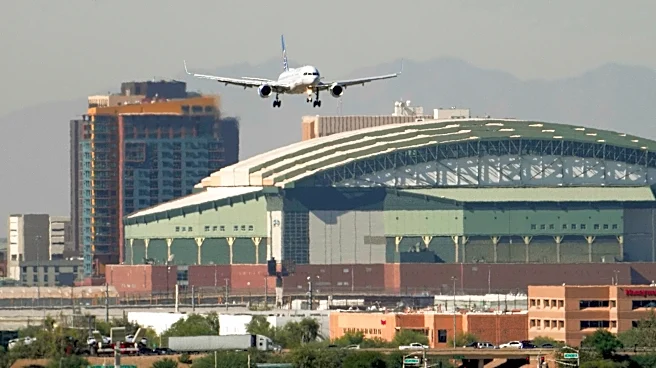









The Federal Aviation Administration wants to modernize flight paths to improve air traffic around Phoenix Sky Harbor International Airport and surrounding airports by next year.
Its proposal, however, has been met with public outcry, with elected leaders and local officials noting that tens of thousands of Valley residents could be exposed to additional aircraft noise.
The proposal comes more than a decade after Phoenix and some historic communities fought the FAA for not properly analyzing the impact of flight path changes, which resulted in a barrage of public pushback after taking effect.
After receiving “substantial feedback” over the latest proposed changes, the FAA has opted to delay its plans until at least next summer, it recently announced.
Flight procedures around metro Phoenix are more than a decade old, the agency said.
“Aviation forecasts indicate that both commercial air travel and general aviation operations will continue to increase, reinforcing the need to modernize the system to enhance safety, increase capacity, and reduce delays at busy airports located near one another,” the FAA stated.
By next February, it intended to start using new satellite-based navigation, which it said will improve safety and air traffic efficiency by allowing planes to fly precise routes rather than being guided by ground-based equipment.
Doing so, though, means flight procedures, such as arrival and departure routes at Sky Harbor and other Valley airports, need to be updated.
Under the FAA's current draft that was presented to the public this spring, an additional 86,384 people in north Phoenix, Scottsdale and Chandler would be placed under flight paths where aircraft noise reaches at least 45 decibels.
That’s up from the 864,459 Valley residents who already live in areas that are exposed to noise pollution from airplanes.
Jordan Feld, Phoenix’s deputy aviation director, called that 10% increase “untenable.”
“The North Phoenix area is well known for its reputation for outdoor recreation, excellent schools and overall quality of life,” Feld stated in a letter to the FAA in June. “Numerous public health studies have shown the detrimental impacts of increased aircraft noise on student learning and individual health.”
In a separate letter to the FAA this month, Arizona’s two U.S. senators, Mark Kelly and Ruben Gallego, echoed Feld’s concerns.
While they support the agency’s overall goal to improve the area’s traffic “overload,” they don’t believe the FAA has rationalized its proposed routes to the public.
“Geometric airspace changes should only ever be made as a last resort, and any proposed changes must be clearly justified and accompanied by robust public engagement,” they wrote.
Feld and the senators encouraged the FAA to modify its proposal to include noise mitigation measures like rotating flight tracks, which they believe would distribute aircraft traffic across multiple areas.
“The goal being that the total volume of traffic is divided among several geographic corridors, ensuring that no single community shoulders the entire noise load,” Feld stated.
They went on to slam the FAA for ignoring its experience in a lawsuit over flight path changes in 2014.
When the agency changed flight paths at Sky Harbor as part of the national NextGen program to improve safety and efficiency, air traffic over some city parks and neighborhoods increased by 300%.
Phoenix and a coalition of historic neighborhoods sued the FAA. An appeals court ruling in 2017 struck down the flight paths, finding the agency’s biggest misstep was a lack of public and city input.
It also resulted in a settlement agreement, requiring the FAA to redesign westbound flight paths at Sky Harbor by imposing noise abatement procedures.
“Regrettably, rather than learn the lessons from this experience, the FAA’s proposed Phoenix Area Modernization Project fails to address long-standing concerns raised by key regional stakeholders (and) ignores requirements of the 2017 Court of Appeals ruling,” the senators wrote.
In mid-July, the FAA announced that it would delay its plans until June 2027.
When asked for a response to the officials’ concerns and the feedback it received from the public, the FAA said it’s continuing to review the comments and input. It did not state how many comments it received, nor outlined the chief concerns.
Shawn Raymundo covers Scottsdale. Reach him at sraymundo@gannett.com or follow him on X @ShawnzyTsunami.
This article originally appeared on Arizona Republic: Public outcry over FAA plan for new Phoenix Sky Harbor flight paths