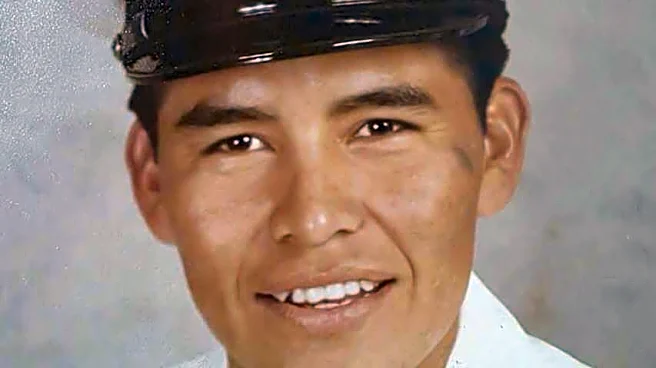



When she was growing up, Febyrika Benally had a tight relationship with her dad, Timothy Benally, who worked in construction, enjoyed carpentry, and loved to laugh and joke around with everyone.
He used to take Febyrika and her brother, Febyruss, four years younger, to a park in Mesa, where he'd let them run around on a playground and, ironically, climb on old trains.
Then one day around 1986, when Febyrika was about seven or eight, her father left home after her parents separated. He was supposed to come back and pick up some stuff but never returned. No one in the family ever saw him again.
After several attempts in the early and mid 1990s by her mother, Ilene Benally, to find Timothy, the family gave up hope.
But on Tuesday, Sept. 22, after the
family had recently begun trying again to find Timothy, the Benallys received a phone call at their home in Chandler from an officer with the Navajo Police Department. He had some grim news.
Through DNA testing and fingerprints, investigators had determined that the remains of an unidentified Navajo man struck and killed by a train in Flagstaff back on Oct. 20, 1989 belonged to Timothy Benally, Febyrika's long-missing father. Benally, who served in the U.S. Navy, was 32 years old when he was killed.
How the discovery affected Timothy Benally's family
After four decades of anguish not knowing what happened to Timothy Benally, the family is now focused on bringing his remains from the Coconino Medical Examiner's Office in Flagstaff, where they are stored, back to the Navajo Nation to be buried next to his parents in a tiny cemetery in the village of Rough Rock in the northeast corner of Arizona, Febyrika Benally said.
But the discovery also has torn up the family emotionally, as anguish turned to grief and anger turned to guilt, Febyrika, 47, said.
"When we first heard, we were, you know, shocked. Everybody was shocked," Febyrika said. "My mom took it pretty hard, and we just all hugged each other and said, 'You know, at least we know.' We don't have to wonder anymore."
Febyrika told her mother, "I know you probably already mourned him when he first left, and it's okay to mourn him again."
But for Febyrika, the hardest part was letting go of her anger, and then her guilt. "I wasn't angry when he left," Febyrika said.
But she became angry when she had two children of her own, a daughter, Deondra, now 30, and a son, Jesse, 22. Now her daughter has two children, ages five and three. Febyrika questioned why her dad didn't want to see his children or meet his grandkids or great-grandkids. So when her brother, who lives on the Navajo Nation, told Febyrika in December he wanted to try and find their dad, Febyrika didn't want any part of it.
"As a young girl growing up, you look for your dad. You try to look up to a father figure. And when he left and never came home, I just kind of questioned, like, okay, you know, he'll come home one day, one day he'll come home," Febyrika said. "But when I had my two kids and he wasn't coming home, I got mad. I said, I want nothing to do with this search, because we have unique names, and if he wanted to contact us, he could easily go on Facebook and type in our names and we're right there."
But when she found out he'd been struck and killed by a train so many years ago, "a whole lot of anger left my body," Febyrika said, fighting back tears. "And now I'm just filled with guilt that I was so mad at him. And it wasn't his fault."
"I'm really filled with guilt that I was so mad for so many years, but also relieved," Febyrika continued. Relieved, "that we don't have to wonder anymore. And I'm sad that my kids and my grandkids will never meet their grandfather or great-grandfather because he was gone and we never knew it."
How investigators linked unidentified remains from 1989 with missing husband and father
Febyrika's mother first contacted the Navajo Police Department in 1992 seeking help finding Timothy Benally, Febyrika said.
The Navajo Police Department tracked his last known address to a pastor in Mesa, Febyrika said. The pastor confirmed he had hosted Timothy Benally and he had done work for him around the house. But the pastor said he hadn't seen him in a couple of years, Febyrika said.
After talking to the pastor, Ilene Benally contacted the Mesa Police Department, but "they kind of just gave us the cold shoulder," Febyrika said.
Febyrika said someone from the Mesa Police Department told her mother, "You know, if he doesn't want to be found, then he won't be found."
Ilene Benally later also tried researching death certificates from 1989 to 1996 through the vital records departments of Maricopa County and the Arizona Department of Health Services, but there were no matches.
"We came to a dead end," Febyrika said.
In December, decades later, Febyrika's brother, Febyruss, decided he wanted to give searching for Timothy Benally another shot. He contacted the Navajo Police Department. Meanwhile, at the urging of Febyrika's daughter, Deondra, Febyrika's mother also filed a missing person's report in January with the Chandler Police Department.
"With all the new technology" and new initiatives to find missing and murdered Indigenous people that have been created to address a severe, long-standing crisis of disproportionate violence, disappearances, and homicides faced by Native communities, the family believed they finally might be able to find him, Febyrika said.
The Navajo Police Department's Missing Persons Unit then reached out for help from the University of North Texas Center for Human Identification, according to Israel Tsosie, a detective in the unit.
In May, the Navajo Police Department Missing Persons Unit sent officers to obtain DNA samples from family members, including Febyrika, Tsosie and Febyrika said.
Using DNA analysis, the University of North Texas team was able to positively identify the remains as Timothy Lee Benally, Tsosie said.
The identification brought an end to a case that had persisted nearly 40 years and restored Benally's name after decades as an unidentified decedent, Tsosie said.
"For us to be able to identify their loved one, that's the most important thing, but it also brings resolution to the family," Tsosie said in a statement.
The Flagstaff Police Department also had a role in helping link the unidentified remains to Timothy Benally, Sgt. Jerry Rintala said.
Flagstaff police reviewed historical case materials and partial fingerprints connected to the original 1989 investigation, which were still on file with the Department of Public Safety's Northern Regional Crime Lab, Rintala said in a statement.
The fingerprints were re-examined using current identification technology, which confirmed a match to the remains associated with the DNA provided by the Navajo Police Department, Rintala said.
"The successful identification closes a 37-year-old case and provides long-awaited answers" to Benally’s family, Rintala said. "Our department is grateful for the diligent work conducted by the Navajo Nation Police Department and for the advancements in forensic technology that made this identification possible."
Timothy Benally's family seeks to return his remains to Navajo Nation
The family still has many unanswered questions surrounding the circumstances of Timothy Benally's death, namely what was he doing in Flagstaff and what was he doing on the railroad tracks when he was struck by a Santa Fe Railroad train, Febyrika Benally said.
Timothy Benally was six feet tall and weighed nearly 300 pounds when he disappeared. But he had apparently lost a lot of weight when his body was found, which makes the family wonder if maybe he had become homeless, Febyrika said.
His body was originally buried on the Navajo Nation, but the remains were exhumed in 2017 as part of a different missing person's investigation, Febyrika said.
The remains have been in Flagstaff at the Coconino County Health and Human Services Medical Examiner's Office ever since.
The family is trying to raise $10,000 through a GoFundMe account to cover the costs of transporting Timothy Benally's remains to Rough Rock, as well as funeral and memorial expenses, and lodging for family members who plan to travel from Chandler to the Navajo Nation for a final celebration of life, said Febyrika, who works in logistics and as a pharmacy tech.
Her mother says Timothy Benally took her everywhere, Febyrika said. But since she was just a little girl when her dad disappeared, she doesn't have many memories of him.
One small memory she has is telling him she lost her key on the playground when he walked over from a neighbor's house to pick her up at school.
He took her back to the playground and they searched for the key together. But they didn't find it. Febyrika thought she was in trouble. Instead, he made her feel at ease.
"I was crying and he was like, 'It's okay. We'll call mom and she'll open the door for us when she gets off work,'" Febyrika said.
Have a news tip? Contact The Arizona Republic and azcentral.com at newstips@arizonarepublic.com.
This article originally appeared on Arizona Republic: Timothy Benally disappeared 40 years ago. His family finally knows why