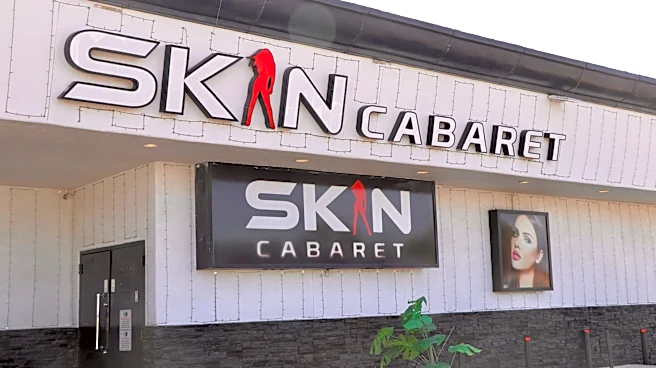







Dozens of customers who claimed to have been drugged and defrauded of thousands of dollars at some East Valley strip clubs may soon have their day in court.
The jury trial for the class-action lawsuit against Skin Cabaret and Bones Cabaret in Scottsdale and Dream Palace in Tempe was set to begin in mid-January and last through late May, according to Maricopa County Superior Court filings.
It comes years after about 40 men accused club operators of conspiring with dancers and other employees to collectively bilk them out of more than $2 million.
Skin and Bones owner Todd Borowsky — Scottsdale Mayor Lisa Borowsky’s brother — has denied any wrongdoing in the case.
His legal troubles, however, don’t end there. He’s currently at the center of a handful
of lawsuits, most of which were filed against him and his clubs.
He's faced lawsuits from business partners, dancers and customers.
Here’s a rundown of ongoing legal battles Borowsky is facing.
Skin, Bones customers allege fraud against clubs, dancers
Since 2022, 41 customers have separately sued Borowsky’s two clubs — both located near Scottsdale and McDowell roads — as well as Dream Palace. Their cases were recently consolidated into one class-action lawsuit in Maricopa County Superior Court.
In their complaints, the men claimed that they were "unwittingly drugged or otherwise incapacitated" at Skin, Bones and Dream Palace while dancers there ran up thousands to tens of thousands of dollars in credit-card charges.
Some men claimed in court they were charged between $103,000 and about $179,000 in one night.
The men asked the court for the contested credit-card charges to be refunded, as well as for punitive damages and attorneys’ fees.
Borowsky has denied the accusations. His attorney, Dennis Wilenchik, argued the claims were "simply ludicrous” and that the customers “received what they sought and bargained for.”
Barring any settlement agreements — which the customers’ attorney, Rod Galarza, said were unlikely — the civil lawsuit was headed for a roughly four-month-long jury trial now set to begin Jan. 11.
Borowsky wasn’t facing any criminal charges despite the Scottsdale Police Department’s investigation into the allegations.
Last year, the Arizona Attorney General’s Office decided to close the case after determining there wasn't enough evidence to lead to a conviction.
Borowsky accuses Scottsdale police of ‘sham’ probe of clubs
Facing customers’ complaints, Borowsky went on the offensive last spring, filing his own lawsuit against the Scottsdale Police Department.
At issue is whether the department’s investigation was part of a yearslong retaliation campaign to discredit and financially attack Borowsky’s businesses after a botched undercover operation at Skin during the 2020 pandemic.
In the federal complaint filed in U.S. District Court in Arizona, Borowsky accused local authorities of violating his Fourth and 14th Amendment rights, in part, by altering and exaggerating reports to build a “sham investigation” against the clubs.
The Fourth Amendment protects against unreasonable searches and seizures, and the 14th Amendment guarantees equal protection under the law.
Scottsdale police called Borowsky’s civil rights claims “meritless.” It also argued in court filings that the “lawful investigation” stemmed from customers’ complaints and that the businesses haven’t been deprived by the case as they’re still operating.
“All of plaintiffs’ claims can be reduced to a false belief that plaintiffs have a constitutional right to be free from a criminal investigation,” the department stated.
Citing the lawsuit, a Scottsdale police spokesperson declined to state whether that investigation remained open.
The federal lawsuit was ongoing, but no hearings were scheduled as of Sept. 15.
Former business associate fights Borowsky for ownership stake
Back in Maricopa County Superior Court, Borowsky faced another lawsuit.
Dimitris Kompos, Borowsky’s estranged business associate and investor, sued him over an ownership stake in Skin.
For years, the two have battled in court over whether Kompos owned 10% of the club and was entitled to his fair share of profits.
Kompos’ latest complaint stems from a jury’s 2016 verdict, which found that Borowsky breached his contract and violated his fiduciary duty to Kompos. It also found that Kompos didn’t suffer any damages because Borowsky previously paid the investor over $412,000.
In December 2023, Kompos filed a new lawsuit, this time alleging that Borowsky refused to accept the previous verdict that Kompos was a minority owner of Skin.
Meanwhile, a company claiming it had loaned Borowsky $800,000 in 2024 came to collect in spring 2026, adding another wrinkle to the decade-long dispute.
1 Stop Companies, LLC sent Borowsky a notice of default letter on May 12, demanding that he fully repay the loan or risk losing the 100,000 shares of company stock that he pledged as collateral.
The company pointed to Kompos’ lawsuit to note that Borowsky misrepresented his ownership interest in Skin, which violated the terms of the loan.
1 Stop’s attorney declined to comment and provide an update on the matter.
Kompos’ attorney was not immediately available for comment on Sept. 14.
Wilenchik, Borowsky’s attorney, said the issue remained unresolved in court as the sides argued over whether Kompos knew of the loan agreement before asking the court to appoint a receiver, or third party, to manage the club.
Doing so, Wilenchik claimed, prompted the default notice, “placing the business in jeopardy.”
The next court date, an order-to-show-cause hearing, was scheduled Dec. 19.
Borowsky faces dancers' complaints
In July 2021, a couple of dozen former Skin and Bones’ exotic dancers filed a federal labor-rights lawsuit against Borowsky.
They alleged that he misclassified the entertainers as independent contractors to avoid paying them Arizona's then-hourly minimum wage of $11, or $8 for tipped employees.
One of those women was Ingrid Alatorre, who had worked at the clubs at varying times between 2018 and 2020.
During the nearly 3-1/2-year lawsuit, she reached an arbitration agreement with Borowsky.
However, she sued Borowsky again in Maricopa County Superior Court in late 2025. This time, she alleged he hadn’t paid the legal fees and costs she had incurred.
According to her court filings, an arbitrator sided with Alatorre in October 2024, finding Borowsky had misclassified her role in the clubs and failed to pay her wages and overtime. She was awarded $14,477 in damages and later awarded $33,740 in attorneys’ fees.
She asked the court for an order confirming the arbitration award and to compel Borowsky to cover the legal costs she’s owed, as well as any interest.
Borowsky, however, was never served with the latest lawsuit. Process servers couldn’t locate him because he had moved to Costa Rica, according to court records.
Process servers are hired to track down a defendant, typically at their home, and personally present them with legal documents.
Alatorre’s attorney asked the court to approve what’s called alternative service, which would allow process servers to, among other things, tape a court summons to the individual’s front door or garage, or to publish it in a newspaper.
Because Borowsky lived outside the United States, the court denied Alatorre’s request in April.
Like this story? Get more East Valley news straight into your email inbox by signing up for our free weekly East Valley Newsletter, which comes out Wednesdays.
Shawn Raymundo covers Scottsdale and Maricopa County. Reach him at sraymundo@gannett.com or follow him on X @ShawnzyTsunami.
This article originally appeared on Arizona Republic: Jury could hear claims AZ strip clubs drugged, defrauded patrons