




CHURCHROCK, N.M. — In a community where the deadly legacy of uranium mining persists, residents are protesting a plan that could restart ore extraction.
At an Aug. 6 public hearing, Laramide Resources Ltd. and its subsidiary, NuFuels Inc., presented an application for a groundwater discharge permit that would be needed for the proposed Churchrock Section 8 in situ uranium recovery project, 7 miles north of Churchrock.
The project requires the permit because groundwater would be circulated through uranium-bearing rock formations during uranium recovery. The proposed discharge would release up to 4,000 gallons per minute, or 5.76 million gallons per day, of a lixiviant-leaching solution through an injection and extraction system. The New Mexico
Environment Department is accepting public comments.
"By the time someone gets sick again, they'll be gone," said Leslie Begay, a Marine veteran and former uranium miner who has advocated for the extension and improvement of the Radiation Exposure Compensation Act.
"You won't get help from nobody," said Begay, who had attended a RECA event before the hearing on the same day. "It's so sad. You could've started off with something like a cancer center. A hospital. These kinds of stuff we need first."
Begay, who has advanced lung disease due to his time as a miner, described life after mining, the health issues he has endured and the financial cost it's taken to stay alive. A Vietnam veteran, he said resources depleted quickly and he wasn't able to get assistance after he became ill.
"Can you imagine that? When you're told you only got a month left," said Begay. "And nobody cares. Nobody. To tell you the truth, I take 23 pills a day. People! We don't need to go through this again. They contaminated the whole water. Has anyone ever investigated? Did any government come to look at this. Nothing!"
What is 'in situ' uranium extraction?
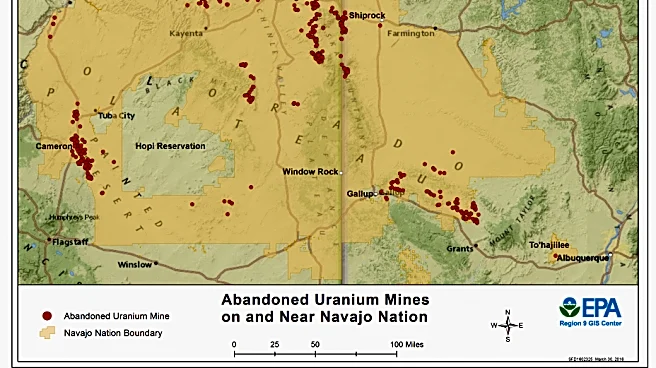
The legacy of uranium mining extends far beyond the hundreds of abandoned mines scattered across the Navajo Nation. It lives on in the people who continue to grapple with its lasting health and environmental impacts, even as new mining proposals seek to return to an area that have yet to recover from a catastrophe nearly 50 years ago.
"Why is uranium being discussed today? It's to support our national security," said Josh Leftwich, vice president of NuFuels, as the crowd at the hearing began to voice loudly their disapproval. "The Churchrock Section 8 project... We are using ISR technology, it stands for in situ recovery technology."
After Leftwich cited national security as a reason for pursuing uranium, Begay pointed out that many veterans have served their country, including those who worked underground in the name of national security.
But, unlike uranium mining of the past, Leftwich said in situ recovery technology extracts uranium without digging an open pit or constructing an underground mine. Instead, in situ recovery uses wells to circulate a water-based solution through uranium-bearing rock underground, dissolving and extracting the uranium.
The uranium is captured on resin beads at an ion exchange plant, while the treated solution is returned underground for reuse. The uranium-laden beads are then transported off-site for processing.
NuFuels holds the only Nuclear Regulatory Commission license for uranium mining in New Mexico. The company plans to produce 3 million pounds of triuranium octoxide, commonly known as “yellowcake,” annually for up to 20 years, according to the New Mexico Department of Justice.
Unlike historic mining in the area, NuFuels plans to use “in situ recovery” methods—also known as in situ leaching or solution mining—at the Crownpoint Uranium Project, which spans four sites across Bureau of Land Management, Navajo Nation, and private lands.
Leftwich emphasized that the in situ process does not involve open pits, underground mines, blasting, waste rock piles or tailings on site.
Representative for Laramide assured the crowd that what they are doing is intended to be very progressive and responsible use of modern technology.
The project is undergoing NRC review after years of regulatory review, with a groundwater discharge permit application submitted this year. The company also received a groundwater restoration grant from Los Alamos National Lab to help coordinate restoration efforts with the project’s operations. Studies are examining the site’s natural fractures to determine how groundwater can be effectively managed and restored, said Leftwich.

'We don't need any more uranium'
Aside from Stephan Etsitty, director of the Navajo Environmental Protection Agency, no Navajo Nation leaders were present to speak for or represent the community as the company outlined plans to revive what opponents see as a destructive and deadly industry that the Navajo Nation has become known for.
The Navajo Nation has endured decades of uranium contamination and its lasting consequences, much of which residents attribute to federal and corporate negligence. Many affected residents have since died, while those still living continue to fight for cleanup and to prevent further uranium mining on Navajo Nation lands.
Although audience members loudly questioned where Navajo Nation leadership was, they took it upon themselves to voice their concerns throughout Leftwich’s presentation.
Leftwich had not gotten far before community members took the microphone to express their objections and describe the lasting effects uranium mining has had on the people, land and animals and what it will do when and if this Section 8 project moves forward.
"The place that these people are talking about, I live in the immediate vicinity just a few hundred feet from this project," said Larry King, a resident of Churchrock. "We been talking about this for the last 30 years. If you look at the environmental impact statement, all of these monitors that they are talking about are recommending that me and my sisters relocate."
As King told the crowd they were going to “push them out of there," boos erupted from the audience. He went on to say that he is carrying on the legacy of his late father by raising cattle. In 2005, the Navajo Nation enacted the Diné Natural Resources Protection Act, legally banning all new uranium mining and processing on Navajo lands.
"We don't need any more uranium," said King. "Conventional or this ISR. Navajo Nation law bans uranium mining on the reservation. They say there's a ban, but then they are going to do some of the processing on Section 17 tribal trust land. So they will be doing some activity on tribal trust land."
King may argue that uranium is no longer needed, but the Trump administration has signaled otherwise. In 2026, the Department of Energy awarded $2.7 billion to revive U.S. uranium enrichment over the next decade. Trump also signed an executive order in May 2025 to speed the testing and deployment of advanced nuclear reactors. By July 2026, the DOE was celebrating what it called a “Golden Era of American Nuclear Energy,” after four advanced test reactors reached zero-power criticality ahead of schedule.
Mine cleanup continues 50 years later
On July 23, the U.S. Environmental Protection Agency, Navajo Nation, United Nuclear Corporation, and General Electric broke ground on the cleanup of the Northeast Church Rock Mine, one of the highest-producing uranium mines on the Navajo Nation.
EPA Regions 6 and 9 are working with the Navajo Nation Environmental Protection Agency and the State of New Mexico to oversee cleanup work being performed by UNC and GE to excavate and remove approximately 1 million cubic yards of mine waste from the Northeast Church Rock Mine site.
"The Red Water Pond Community has been advocating since 2007 for clean up in their back yard and they finally see a light at the end of the tunnel," said King. "Right now they are established by two abandoned uranium mines."
This cleanup comes nearly 50 years after an earthen dam owned by United Nuclear Corp. broke on July 16, 1979, releasing 1,100 tons of radioactive uranium tailings and 94 million gallons of toxic wastewater into the Puerco River. The contamination flowed across state lines into Arizona, affecting at least 80 miles of the river and about 11 Navajo Nation communities.
In May, the U.S. Environmental Protection Agency designated the Old Church Rock Mine as a “time-critical removal action.” The designation calls for the excavation of approximately 6,000 cubic yards of abandoned uranium mine material from four areas of the site. NuFuels Inc. acquired the Old Church Rock Mine in 2016.
The Navajo EPA has proposed incorporating a controversial remediation technology known as high-pressure slurry ablation. The technology would allow for the permanent removal of up to 1,500 cubic yards of contaminated material from the site.
'This is my family. This is my home'
While Leftwich tried to explain the proposal, the frustration from those in attendance was expressed as people began to yell things such as "Keep uranium in the ground" or "Łeetso Dooda" (no uranium).
When Jenn Nez approached the microphone to speak, Leftwich told her it was “our program.” Audience members pushed back, reminding him that he was a guest and urging him to let her speak. Reluctantly, he handed her the microphone.
Throughout the presentation, Leftwich and his staff could do little but stand by and allow Begay, King and others directly impacted by uranium mining described the devastating toll it has taken on their lives.
"I just want to say you said 'this is our program,'" said Teracita Keyanna, vice president of the Red Water Pond Road Community Association Executive Committee. "Well, guess what? This is my community. This is my family. This is my home."
Leftwich was told about babies "being born with uranium in their blood," and asked how he would address this. Federal research has found detectable uranium levels in some Navajo mothers and newborns. The Navajo Birth Cohort Study found that 26% of Navajo mothers had uranium concentrations above national norms, placing them among the highest-exposed 5% of the U.S. population, according to Navajo Birth Cohort Study and Environmental Influences on Child Health Outcomes.
"This young lady was born with uranium in her body," said Keyanna of her daugher. "We had her tested. It was in her urine. She's overcome five different locations where she's had something removed and four different surgeries, and this started when she was three years old. When you find someone who has doubts that uranium contamination is not real, this young lady is living and she is still dealing with it."
A day after the presentation, New Mexico Attorney General Raúl Torrez announced that the New Mexico Department of Justice filed a petition to intervene in a licensing renewal matter before the Nuclear Regulatory Commission that could restart uranium mining and processing at Crownpoint and Church Rock, New Mexico.
In its petition to intervene, the state agency argued to the NRC that NuFuels’ license application must demonstrate that long-term remediation from in situ recovery mining is technically and scientifically feasible. Specifically, the NMDOJ argued that NuFuels must:
- Explain more completely how it will abide by and comply with all relevant federal, state, and tribal law, regulations, and agreements.
- Show they have the financial capital to cover future costs including remediation and cleanup.
- Comply with New Mexico’s high water-quality standards and state permitting processes.
The NMDOJ also highlighted in its petition that NuFuels is relying on an environmental justice impact analysis that is over 25 years old and it has failed to adequately explain the impact of historic mine workings on the flow of groundwater through the Westwater Canyon aquifer and the efficacy of monitoring wells.
Arlyssa D. Becenti covers Indigenous affairs for The Arizona Republic and azcentral.com. Send ideas and tips to arlyssa.becenti@arizonarepublic.com.
This article originally appeared on Arizona Republic: Navajo residents reject mine project: 'We don't need any more uranium'