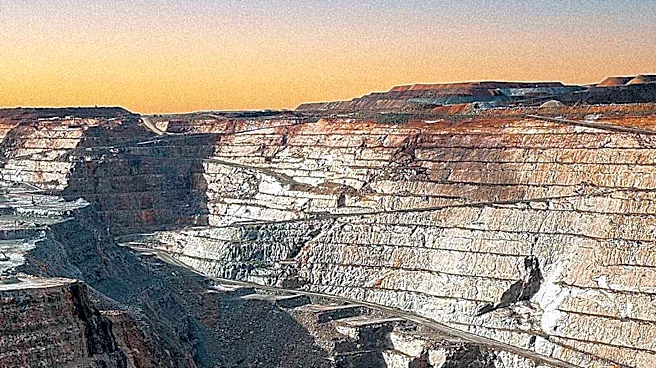







Tribal-owned Navajo Transitional Energy Company could stay in the surface coal mining business until 2136 and could expand its Navajo Mine operation area size, even though a power plant that uses coal from the mine is slated for closure.
On Aug. 31, the Office of Surface Mining Reclamation and Enforcement said it approved a permit application to add approximately 11,526 acres to the Navajo Mine permit area, known as the No Name Permit Area. The application would also allow mining at the Navajo Mine to continue through 2136, with permit renewals occurring in five-year increments
NTEC submitted an application for the changes a little less than a year ago. The surface mining office reviewed the permit and issued a 401-page Environmental Impact Statement
for the project. The total amount of coal mined would be about 503 million tons.
The controversial decision comes eight months after NTEC and the mining agency held a public meeting at Burnham Chapter, the community, near Farmington, New Mexico, expected to be most affected by the decision, where they outlined NTEC’s plans to expand its operations and extend the life of the Navajo Mine. Coal from the mine supplies the nearby Four Corners Generating Station.
"This is not a new lease or new mine," Andy Hawkins, community relations senior manager for NTEC, said in an email to The Arizona Republic. "It is part of the ordinary and regular permitting process for mining on the Navajo Mine lease. The approval followed a multi-year federal environmental review with the Navajo Nation as a cooperating agency."
Although plans call for the Four Corners power plant to shut down by 2031 — and no later than 2038 — a presentation by the mining enforcement agency at the January hearing indicated that the plant's lease extends through 2041. Based on that, it is anticipated that NTEC intends to continue supplying coal to Four Corners until 2041. After that, it's unclear where the coal would be sold during the remaining 95 years of the mine’s proposed life.
The questions about where the coal would go for the remaining 95 years has been one of many issues that the community and environmental advocacy groups have raised. Over the past few months, community members have been trying to get the attention of their Navajo leaders. The most recent demonstration was in July, when community members expressed concern that the decision on the permit appeared rushed.
"We want our Navajo Nation Council to revoke the permit," Dailan Long, with his relatives and other members of the Navajo community in Burnham, said during a news conference held in front of the council chamber. "It's 110 years of a permit that they are asking for. Our family has five generations living within the area, and 110 years is basically selling off and committing the Navajo tribe to 110 years of coal mining."
Dust particles could create health risks for nearby residents
Community members have also raised concerns about a lack of transparency, saying no actual health studies on coal mining in the region have been provided despite repeated requests.
Joni Lapahie, Burnham community member, said in a previous interview that friends and family members were diagnosed with different illnesses, which makes her question if it is the result of living close to the coal mine and the power plants.
The environmental review addresses potential health risks from the plan, including fugitive dust, which would be the largest source of air pollution from the proposed mining project. The dust can carry valley fever, a fungal disease found in soils across the Southwest, including San Juan County. NTEC says it plans to reduce dust by limiting soil disturbance, using water or soil stabilizers, covering spoil piles, and cleaning equipment before it leaves the site.
The main pollutants of concern are fine particles (PM10 and PM2.5), which would be produced by blasting, excavation, coal extraction, transportation and mining equipment. The health risk assessment found that short-term risks would remain below federal thresholds. Under the low-demand scenario, long-term cancer and non-cancer risks would also remain below thresholds, according to the impact statement.
Under the high-demand scenario, however, long-term non-cancer health risks could exceed thresholds for homes within 2,300 feet of active mining. The review considers this a major long-term impact and recommends relocating homes within the permit area before mining comes within 2,300 feet and using additional dust-control measures for homes outside the lease area.
"We have been transparent with the community throughout the No Name SMCRA Permit Application process, including presentations to the Navajo community," said Hawkins, who also noted that through this process, NTEC has obtained six resolutions of support from the Navajo chapters and districts that are adjacent to the mine, including from Burnham Chapter.
Mine could force residents to relocate
Gilfred Hogue, who lives in the Burnham community, could be directly affected by the project and may ultimately have to relocate. Hogue still lives in the home his father built, near a family cemetery where several of his relatives, including his mother, are buried.
Hogue is a member of the American Indian Movement and said his late mother fought against Desert Rock, a proposed coal-fired power plant in the community that residents, including Hogue’s relative Long, successfully opposed and helped stop in 2011.
"She'll cry," Hogue said about what his mother would think of the new development. Noting that his mom did an "excellent" job fighting Desert Rock, with Long and others, he said after the fight she put up against Desert Rock, he couldn't believe "they came back with these plans. It hurts me."
Hawkins wrote that the permit does not immediately remove anyone from the land or eliminate grazing.
"If relocation ever becomes necessary as future mining progresses, it will be governed by long-standing agreements that were put in place years ago in anticipation of the mining that would occur in this area," Hawkins said. "We welcome the decision to approve the No Name Permit."
Arlyssa D. Becenti covers Indigenous affairs for The Arizona Republic and azcentral.com. Send ideas and tips to arlyssa.becenti@arizonarepublic.com. Follow her on Bluesky at @abecenti.bsky.social.
This article originally appeared on Arizona Republic: Feds approve plan to expand Navajo Mine, extend life by 110 years