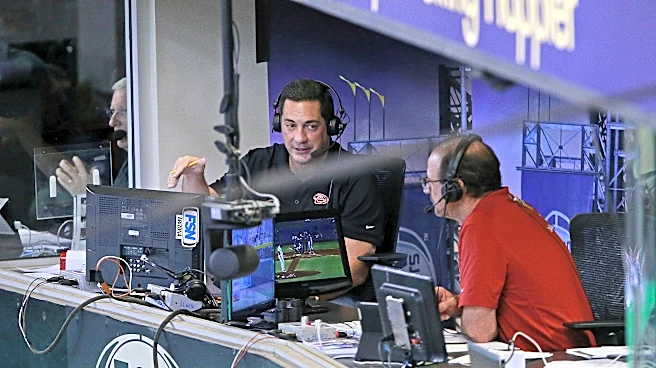


The Diamondbacks parted ways after the season with broadcaster Steve Berthiaume, opting not to renew his contract after 14 seasons as their television play-by-play voice.
The decision caught most everyone off guard, including Berthiaume, who was the longest-tenured TV broadcaster in team history. Berthiaume followed Thom Brennaman (1998-2006) and Daron Sutton (2007-12).
Berthiaume took time for The Arizona Republic this week to look back on his experience with the organization and on working alongside analyst Bob Brenly.
Question: I know you said the other day you were surprised by the news. Have you processed it any further and where are your thoughts at the moment?
Answer: The number of calls and messages I’ve received from friends, from coworkers
in my ESPN days, from colleagues within the baseball world — it has been overwhelming and deeply gratifying. So, in that regard, I really feel blessed.
It occurred to me the other day that you spent more time with the Diamondbacks than you did at ESPN, where you worked for 12 years. That surprised me. Does that feel right to you?
It feels right. They’re two very different jobs and two very different roles I kind of look at it as one career path, having come first from local news and then CNN, where I worked for three years. It followed a path I was really excited about and really enjoyed just because of the differences in hosting a studio show like SportsCenter or Baseball Tonight and then having to go into a booth and learn that craft. It feels connected because it’s all part of the same path.
Before you got the Diamondbacks job you had only called a handful of games as a play-by-play guy. When did you feel like you hit your stride in the role?
I think in that transition it takes much longer than one thinks it might to get the mechanics down. I think it took, honestly, 500 games before I felt like I was in total command of everything. There’s a lot going on. Anybody that thinks baseball is a slow game should try it because suddenly a guy hits the ball in the gap and there are runners running around the base and relays and cutoffs and it feels like the game is moving 1,000 miles an hour. But the biggest adjustment wasn’t so much the feel of the game as it was the mechanics of the broadcast. It’s a very different set of skills going from a studio role to live play-by-play. It took me a while to figure that out and that’s where (analyst) Bob (Brenly) was enormously patient and generous with me. I have thanked him profusely for that over the years. He was very gracious while I figured out what I was going.
You and Bob grew to clearly enjoy working together. What was it like calling a game with him?
We developed a tremendous mutual respect for each other – I for his baseball knowledge and for the ease with which he broadcast a game and observed and pointed things out and I think he had a lot of respect for my television background and being able to be involved in the production side of things and know what makes good television, what works and what doesn’t. We were able to build off his knowledge and my experience and put together a product that I thought these past several seasons was really good. I was really proud, particularly since MLB Local Media joined up. We had a lot of resources and they were very supportive.
I’m getting off track, but in terms of Bob, it’s funny because we have very different taste in music. He’s very into ‘70s music and I love ‘80s music and those things tend to always be in direct conflict. We always found humor in that. We always have to remember that it’s a game, but it’s a TV show and it has to be entertaining. But the entertaining parts and the funny jokes can’t get in the way of the balls and strikes and I think that’s where we did a really good job. We had fun, but we didn’t get in the way and it was never about us. It was about the game and it was about the Diamondbacks. I always saw my job as to sell tickets and generate enthusiasm for the team and the organization and I think I did a good job of that.
It must be fun working with Bob. It seems like he has stories and anecdotes for every moment.
He’s an endless resource that you can tap into at any point. His observational skills are always what most impressed me. He’ll say, "I think the catcher is using a different glove," or, "I think the shortstop has changed his shoes," or, "This particular player is playing this hitter differently." What he’s able to observe constantly amazed me. He’s a rare bird in that regard, for sure.
Do you have any favorite moments? Favorite games? Or maybe things you’ll miss the most?
When I see a David Peralta "Freight Train" bobblehead or I see Gabriel Moreno wearing a "Gabi Lane" T-shirt that’s available for sale in the team shop or I see a fan in the stands holding up an "Answerbacks" sign, those are things we created in the booth and I look at those things as tangible evidence of a connection with the fan base and that’s really what all this is about. I feel really good about that. In terms of favorite moments in games, Bob and I along with everybody in our production truck raised millions of dollars for the Arizona Diamondbacks Foundation and there were nights when we set records — we went over half a million in our 50/50 raffle one night and then earlier this year we went over $700,0000 and we did it in lockstep with the Diamondbacks fan base. Those were the games that were the most fun because it created a real sense of community with the team, with the broadcasters and with the fans and that was something we all did together and that’s way more important than any baseball game. Those are the nights of which I’m most proud and those were the nights that were the most fun.
I’m not a big moments guy. I don’t live for those moments, I live for the ride. For me the thrill was 162. That’s why I tried to never miss a game. Those great moments are great, don’t get me wrong, but to me the joy is the full season and the ups and downs. A baseball season is a living, breathing thing and to me that was the fun part, going on the ride.
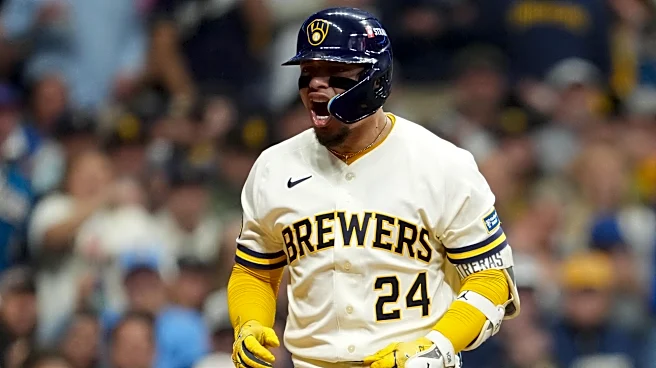
I got to meet Nick Offerman twice at Wrigley Field. I’m a "Parks and Recreation" nut and I twice got to meet him when he sang "Take Me Out to the Ballgame." I also got to meet my boyhood baseball idol, former Milwaukee Brewers third baseman Don Money. He came in to watch Buddy Kennedy, his grandson, play. He came up to the booth. That’s as nervous as I’ve ever been getting to meet Don Money. Having spent part of my youth in Wisconsin and getting got meet Don Money was a thrill.
What do you want to do next?
I’d like to keep going. I’d like to hook on with another club. I love baseball. I love televising baseball. I still have a lot to contribute, and I hope to do so.
This article originally appeared on Arizona Republic: Steve Berthiaume reminisces on his time with Diamondbacks | Exclusive