




A restless night was inevitable.
It was Nov. 3, 2001, fewer than four weeks removed from the 9/11 terrorist attacks.
It was the eve of Game 7 against the New York Yankees in the World Series. Diamondbacks pitcher Curt Schilling was on the phone with a psychologist practicing visualization, a tool to rehearse success and temper stress.
He saw images of the attacks, knowing that first responders were still recovering bodies. He pictured Roger Clemens, a man who warned him early in his career not to waste his talent, and who would be on the mound against him the next day. He thought of his high school career at Phoenix Shadow Mountain, just 10 miles away from then-Bank One Ballpark, the site of Game 7.
How tightly wound was he?
“I fell asleep on the
phone,” he told me in late July 2026. “I literally woke up the next morning with the phone lying next to my head, and I mean, that’s how relaxed I was.”
That was Schilling. As opinionated and divisive as he could be, the noise muted his all-business brilliance on the mound. It wasn’t just his command or dominant fastball-splitter combination; it was his preparation, his competitiveness and his postseason dominance. It was a career worthy of Baseball Hall of Fame placement, and it’s a mistake he isn’t in it.
And this comes from a person whose longtime profession was mocked by Schilling when he shared a photo of someone wearing a shirt that said, “Rope. Tree. Journalist. Some assembly required.” Funny? Not to me. But I’m also confident he didn’t mean it literally.
“I speak from the heart and I know that cost me at times during my career,” he said.
We all have different lines of tolerance, of understanding, of forgiveness. I feel bad for the communities he has hurt with some of his memes. We have different opinions on many things, and we have discussed it. But I also think of his charitable work with ALS, cancer research and other organizations. I think of his farm in Tennessee, where he continues to rescue dogs, alpacas, llamas, goats, ducks and more.

I think of the kind message he sent me when my mother died. I think of his accessibility during the many years I covered the team for The Arizona Republic. I think of the big picture.
And I think of exactly 25 years ago, when skeptics began questioning the tenacity of the Diamondbacks. Although the team was 61-49 on Aug. 4, 2001, it had lost seven of its previous nine games. Owner Jerry Colangelo’s bold vision of a World Series title in the franchise’s early years began to feel misguided.
And then Schilling stepped in with another touchstone of success in a season full of them. The next day, he struck out 13 in a 2-1 victory over the Mets and became the first 16-game winner in the major leagues. His dominance on the mound steered the team to a World Series title, with Schilling going 10-1 the rest of the way.
And I think of the day he woke up with the phone still by his ear, and he turned that day into a memory etched in the minds of baseball fans everywhere.
He approached that day as routine.
“I would always tell young pitchers, 'My first start in spring training, the day went exactly the same as Game 7 of the World Series,'” he said.
It’s true. On Nov. 4, he did his normal stuff. He ate Ellio’s Pizza for lunch, his pregame routine before every start. He was so committed to the frozen pizza from the Northeast that he famously had it shipped to him, packed in dry ice, when he relocated to Arizona.
In the dugout before the game, he started having a conversation in his head with his dad, Cliff Schilling, a onetime U.S. Army master sergeant who had died eight months before Curt made his major league debut in 1988.
Cliff: “What are you nervous about?”
Curt: “What do you mean? It’s Game 7 of the World Series against the Yankees.”
Cliff: “You’re going to go out and do what you’ve always done. And then tomorrow, you’re going to wake up and take the kids to school.”
The visualization led Schilling to chuckle, much to the confusion of Diamondbacks bullpen catcher Jeff Motuzas, who was sitting next to him in the dugout.
“Oh my God, what are you doing?” Motuzas said.
Understand that Motuzas didn’t rattle easily. To complement his bullpen catcher salary, he was known for accepting money from players for dares. He would snort wasabi, he would eat disgusting things, including some that came out of teammates’, um, noses. He even let players shoot him with a BB gun.
Yet on that day, Motuzas was “sweating like he’s in a sauna,” Schilling said.
Schilling asked him, “Why are you sweating?”
Motuzas looked at him in disbelief. “Oh my God, dude, it’s Game 7.”
And then Schilling walked to the mound.
He looked around the stadium, saw the white pom-poms, and made eye contact with Yankees shortstop Derek Jeter on the field.
“We both smiled, smirked, like, ‘This is going to be fun,’” Schilling said.
As he threw his first pitch, he closed his eyes.
The cameras. He anticipated a barrage of flashes, “and I didn’t want to get blinded and have a ball come back to me.”
He wasn’t one to soak in the moment, but he did this time.
“I remember looking around on the mound and thinking, ‘Oh my God, there’s 100 million people in the world watching this right now.’ And just thinking how cool that was.”
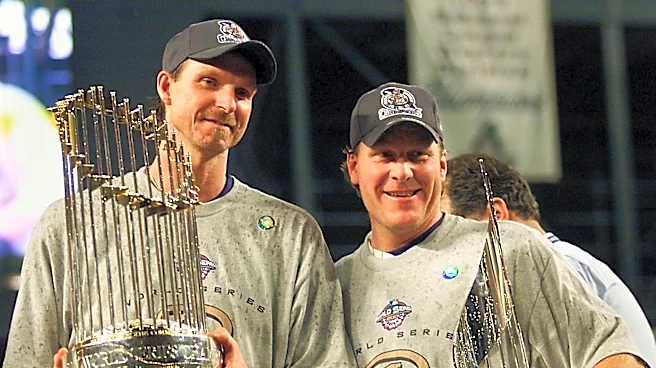
And he delivered, as he often did in the postseason, with 7⅓ dominant innings on three days' rest, allowing two runs and striking out nine before Luis Gonzalez’s bloop single drove in the winning run and gave the young franchise a World Series title.
He was brilliant during the series, with three starts and a 1.69 ERA in 21⅓ innings.
Those weren’t the only times Schilling stood out during the series. In between Games 2 and 3, six weeks after the terrorist attacks, the Diamondbacks toured a local firehouse and spoke with rescue workers at the command center.
It was there Schilling noticed a giant site map on the wall that showed where bodies were recovered. Blue pins for police officers, red pins for firefighters and yellow pins for civilians.
There were many. So many.
He was caught off-guard when someone with the team asked him to talk.
“I just spoke, and my only goal was to make sure that when we left, that they remembered us,” he said. “That they remembered how much we truly felt about them. … I tried to make them understand that …’You guys might be excited that we’re here … but it doesn’t come close to how proud we are to be from the same place as you. Because what you’re doing is God’s work.’”
His words were impactful, several teammates said.
Sometimes they were impactful. Sometimes they were divisive.
But his baseball? It was consistently great.
Paola Boivin is the director of the Cronkite News Phoenix Sports Bureau at Arizona State's Walter Cronkite School of Journalism and Mass Communication. She is a former sports-talk host and award-winning reporter and columnist who spent four terms on the College Football Playoff Selection Committee.
This article originally appeared on Arizona Republic: Curt Schilling, loud and strong, a big key to 2001 Diamondbacks' title