








Mexico City is a place filled with history, myths and legends that have been passed down from generation to generation. Its streets are home to buildings known for apparitions, tragedies and unexplained events that spark the curiosity of those who visit them.
Despite the horror stories and apparitions associated with some of these places, they are major tourist attractions.
A select list includes iconic places such as La Casa de los Azulejos, Café de Tacuba, La Casa de las Brujas, Gran Hotel Ciudad de México, La Casa Negra and Salón París: places and buildings steeped in mystery and history that perhaps one day you will dare to visit. Here, we tell you their legends.
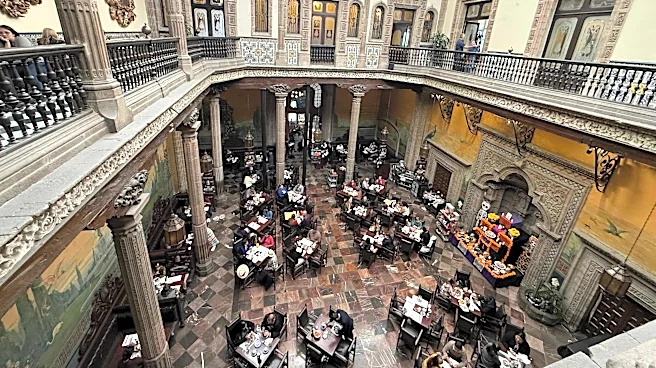
La Casa de los Azulejos
La Casa de los Azulejos, located at the corner of Madero Street and Callejón de la
Condesa, is one of the most iconic buildings in Mexico City’s Historic Center.
Since 1919, it has been home to the Sanborns de los Azulejos restaurant, but the history of the building, which was constructed in the 16th century, is surrounded by tragedy and mystery.

One of its legends says that in late 1828, officer Manuel Palacios, taking advantage of the chaos of the Motín de la Acordada, broke into the house, which at the time belonged to former Count Andrés Suárez de Peredo, to take revenge over a romantic disappointment, stabbing him on the stairs.
For generations, Sanborns employees have claimed that in the early morning hours, the shadow of a man can be seen walking along the building’s staircases, lamenting that he was stabbed. Some have said that they have seen more than a shadow and that they've seen a bloodied person wandering through the beautiful building.
Café de Tacuba

Since 1912, Café de Tacuba has been one of the most traditional Mexican restaurants. It is located at 28 Tacuba Street in Mexico City’s Historic Center, but the building dates back to the 17th century.
Before becoming a restaurant, the building housed a viceregal-style residence and was later donated to charity to house a women’s mental asylum called Hospital de la Canoa, or Hospital del Divino Salvador, which was staffed entirely by devoted cloistered Poor Clare nuns.
According to legends that took shape over the centuries, the screams of the mentally ill patients could be heard every night, even after the hospital was gone.
Another legend, the best known and one that Café de Tacuba itself acknowledges in its history, is the apparition of “La Monja del Café,” a Poor Clare nun who is still seen wandering, floating, suspended above the steps of the staircase in the Salón Mexicano.
Although employees say the apparition no longer frightens any of them because they have learned to coexist with this kind and helpful spirit, just as the Poor Clare nuns were, the truth is that someone confessed to us that they do sometimes get scared. It is not only the apparition: a long, plaintive sigh can also be heard, one that penetrates straight to the heart.
Some say the nun sighs because she is saddened by the patients’ mental illness. Others claim she cries because all the patients burned to death when a fire consumed the hospital. Still others say she wanders about lamenting, seeking justice because she was murdered by a man who loved her and was desperate because she would not see him, as she was certain of her vocation.
It is not known which version of the legend is true, but most agree on the apparition.
La Casa de las Brujas

Located on Río de Janeiro Plaza in the Roma neighborhood, La Casa de las Brujas was built in 1908 as a government hotel in the English style, commissioned by President Porfirio Díaz as the centennial of Mexico’s Independence approached and he wanted to accommodate his European guests there.
In 1942, the property was sold to private owners and turned into an Art Deco residential building.
By the middle of the 20th century, it was already known as La Casa de las Brujas because its main façade resembles a witch, complete with her classic hat.
Home to painters, writers and upper-middle-class residents, the building also drew attention because Bárbara Guerrero, a shaman better known as Pachita, lived there. She was known by many for her healing rituals, during which she “performed psychic surgeries.”
They say she could operate on anything: the appendix, kidneys, heart, everything, without opening anything up. It was all spiritual, and people were healed. But they say someone could not be saved and the person’s family had her killed. Over time, her figure became associated with stories of strange energies, rituals, screams, wails, crying and unexplained presences, including Pachita herself, who, people say, continues to wander the hallways of La Casa de las Brujas to this day.
The apparitions of Pachita became so frequent that for many years the building fell into severe disrepair. No one wanted to live there, and its owners did not want to renovate it. It was finally restored in the 1990s, and today it looks imposing. No one pays much attention to Pachita’s apparition anymore because, they say, “she doesn’t hurt anyone,” and the building has a prime location, so now no one wants to leave.
Gran Hotel Ciudad de México

Located on 16 de Septiembre Street at the corner of Mexico City’s Zócalo, this building was constructed as a department store in the late 19th century in the Art Nouveau style, with an impressive Tiffany stained-glass ceiling and a cast-iron elevator that was unique for its time. It was a place where only the city’s wealthy residents shopped. It closed in 1958, and many women lamented the closure because it was so exclusive. Some even dressed in black when they witnessed it shutting down.
The building reopened 10 years later, in 1968, as the Gran Hotel Ciudad de México, and it remains in operation today. But its legend cannot be overlooked: at night, guests who come to stay for a few days or simply visit the restaurant on the upper floor have reportedly encountered silhouettes of elegant women dressed in black levitating through the hallways.
Shadows can also reportedly be seen peering out from the balconies. Even the elevator activates on its own, so some nights it continues operating without anyone pressing the buttons.
They say that one day they tried cutting the power so it would stop working, but even without electricity, it continued going up and down. Some say it may be the women who are angry because their exclusive store was closed.
La Casa Negra

Located at the corner of Álvaro Obregón and Insurgentes in the Roma neighborhood, the so-called Casa Negra was built as a residence in 1906 and donated to charity in 1934 to be converted into a hospital where typhoid patients were admitted for treatment.
The screams and wails of the sick made neighbors extremely nervous and frightened. Out of ignorance, they decided to burn the place down to put an end to what they believed was the disease’s curse, which many considered “demonic possession.” They set the building on fire, killing several patients and doctors.
Some time later, the house was renovated and purchased by the Mondragón family, consisting of a married couple and their three children.
The beauty of the house attracted attention, as did the elegant parties the family used to host. But one day, neighbors stopped seeing people coming and going, and the lights never came on again. Finding it strange that the house had suddenly gone silent, they reported the situation to the police.
When police arrived, they found all five members of the family dead. There were no signs of violence and no smell of gas. Everything was a mystery.
Since then, the house has been impossible to sell or rent. In fact, whenever squatters have tried to move in, they have left after spending their first night because they say they constantly hear voices whispering in their ears, along with wails, screams and crying. Some even claim that unseen forces push them out into the street.
Today, the building has been expropriated by the Mexico City government, but strangely, authorities have never been able to demolish it to build affordable housing because, for some reason, they have been unable to secure budget authorization.
There are food businesses surrounding the house, as well as the Rojo restaurant and bar, which, they say, draws people in the afternoon. But once night falls, customers flee the place because cries for help and the weeping of a little girl believed to be the daughter of the Mondragón family can be heard.
Salón París, 'José Alfredo Jiménez is still there'

It is said that Salón París, a cantina located on Torres Bodet Street in the Santa María la Ribera neighborhood, was Mexican singer-songwriter José Alfredo Jiménez’s favorite place.
He would seek refuge there to mourn his heartbreak and write his songs at a table that became his favorite. Once he achieved a certain level of fame, the waiters would reserve it for him so it would be available whenever he arrived.
According to stories passed down from waiter to waiter over the years, after he finished singing at venues such as Teatro Blanquita, José Alfredo would go to Salón París for a drink and to enjoy the bohemian atmosphere, whether alone, with his artist friends or with friends from the neighborhood.
His gatherings were so well known that, at times, the cantina would close its doors so he could relax. Dozens of photographs on the walls attest to these stories.
According to these accounts, he composed a large number of his hits there. He was a very sensitive man and could not hide his mood. Whether he was angry, happy, sad or disappointed, it showed. He always found a reason to write.
His presence left such a profound mark that some people say that in the early morning hours, when passing by the cantina, even when it is closed and no one is inside, José Alfredo can be heard singing and the atmosphere of an old-fashioned bohemian gathering can be felt.
More than a proven fact, this story is part of the cantina’s and the neighborhood’s collective memory and oral tradition. Longtime residents are proud that José Alfredo “never left,” that he remains in their neighborhood, where he lived for so many years.
For that reason, after Salón París was remodeled, the space that belonged to José Alfredo was recreated. As a tribute, a fiberglass representation of him was also installed to keep the composer’s connection to Santa María la Ribera alive.
This article originally appeared on Arizona Republic: Chilling tales behind Mexico City's most haunted restaurants and bars