





Three years after ecologist and researcher Ganesh Marín installed 100 cameras at a nature reserve in Sonora, he witnessed something unexpected.
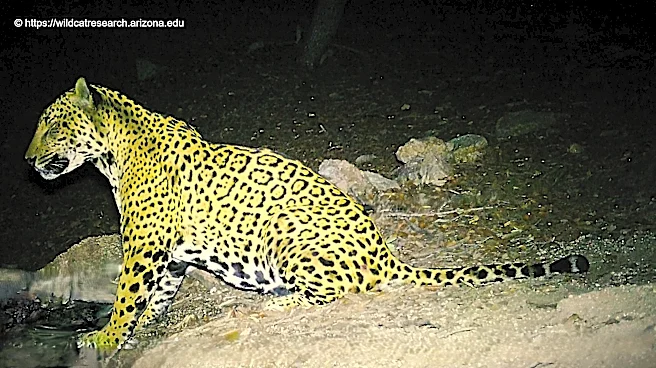
A jaguar stalking through desert scrub just a few miles south of the border.
Marín, who is now a conservation strategist at Borderlands Restoration Network, was working on his PhD and documenting wildlife biodiversity in the region. A few years earlier, in 2020, he captured two other jaguars on camera.
But there was something different about this particular big cat beyond just the unique rose-shaped spots on the animal’s coat.
He suspects the jaguar was female, the first in 70 years to be spotted as far north as the U.S.- Mexico borderlands. The footage was made public in the New York Times on Aug. 17, generating
excitement and some controversy around the jaguar’s sex.
“There’s an 80% chance or greater likelihood that she’s female,” said Brett Dickson, the president and chief scientist at Conservation Science Partners, and emeritus professor of conservation biology at Northern Arizona University, who worked with Marín on the findings.
There’s room for uncertainty, like the chance the jaguar was a juvenile male. The footage of the cat, nicknamed Lola, shows the animal's rear-end as it sauntered into the darkness beyond the camera’s reach. While it’s a good look at the reproductive anatomy "it's not conclusive,” Dickson said. “But it made it more clear than ever in my experience that we were likely looking at a female jaguar.”
Not all researchers are ready to agree.
“Preliminary and exciting observations can be shared, but they should be clearly identified as preliminary, probable, or confirmed," said Susan Malusa, a researcher and director of the University of Arizona’s Wild Cat Research and Conservation Center.
Jaguars are endangered in the United States, and the presence of a female jaguar at the border would be especially meaningful, Malusa said. The UA wild cat center hasn’t reviewed the original evidence behind the story that made headlines in the Times.
“The presence of any jaguar in the borderlands is good news,” she said. In Arizona, five jaguars have been spotted since UA began monitoring them in 2011. All of them were male. One, nicknamed Cinco, was seen roaming the borderlands as recently as Aug. 18.
Over the last six years, Marín has also documented five jaguars, including the potential female, on camera at the Sonora nature preserve Cuenca Los Ojos. The sightings are the culmination of decades of conservation work in both countries, he said, and proof that jaguars are “knocking on the doors of the United States,” a part of their historic territory that they were once nearly eradicated from, even as remaining border passageways are being walled off.
How do researchers tell jaguars apart?
No two jaguars look quite alike. Each has individual spots, called rosettes, that make up a distinct pattern on their coat.
“They are unique like a fingerprint,” Malusa said.
Those markings are an asset to researchers who are trying to estimate the abundance and density of endangered species like jaguars by comparing video footage or pictures to determine who is who.
Typically, researchers collect multiple detections, Dickson said, including photo and video at different angles from motion-sensor cameras out in the field.
That data can be used to track how jaguars are moving across a landscape. At the UA wild cat center, Malusa and others have been collecting information on where and why jaguars move from place to place. They account for vegetation, water and prey and use those indicators to predict where a jaguar like Cinco might go next.

Photos and videos are also used to differentiate males from females, who look different, not just in terms of their reproductive anatomy but also in body size. The footage from 2023 is one of the first jaguar detections Dickson has seen with a relatively clear look at the animal’s rear-end. No testicles were visible, he said.
Dickson shared the footage with eight other wild cat experts. Six agreed with Dickson that it was female, one was unsure and another leaned male.
Over the last decade, jaguars have been venturing farther north, back into parts of Arizona they once nearly disappeared from. Data from the wild cat center collected in the past showed jaguars appearing every few years, but lately they’ve been showing up more often.
“For the most part, those are all likely to be males,” Dickson said. That’s because males roam larger areas looking for mates, prey and places to establish their own territory.
No female jaguars have been documented as far north as the border since 1963, when the last female jaguar seen in the United States was killed by a hunter in Arizona’s White Mountains. In 1998, a female was shot in Sonora.
Unlike their counterparts, female jaguars don’t disperse as widely. In 2013, ecologist Peter Warshall predicted we wouldn't see them establish themselves in the United States again for at least another 30 years to 50 years, optimistically.
That’s why the possibility of a female jaguar just two miles from the border is so hopeful. For the population to recover, it needs to be sustainable — and sustainability requires the presence of both males and females, Malusa said. If detected, a female jaguar at the border could indicate female dispersal beyond the currently known breeding population farther south.
But she cautions that while an image or video can show that a female was in a particular place at a particular time, it wouldn’t necessarily mean that female jaguars are currently present along the border. Marín’s footage was captured in 2023.
“The most conclusive evidence would be another video of this individual with cubs at heel,” Dickson said. “That’s the evidence everybody really wants.”
Every jaguar detection is important, Malusa said, especially as researchers work to understand the effects of habitat fragmentation and the border wall.
Two countries, both alike in felines
Growing up in central Mexico, Marín never expected to see jaguars so far north, traipsing through desertland scattered with prickly pear and cholla cactuses.
Arizona and Mexico’s shared borderlands pass through isolated mountain ranges that transition from temperate forests to low grasslands. Called the Sky Islands, the region is one of the most biodiverse on the continent and home to a varied cohort: pumas, ocelots, coatis, bears, beavers and jaguars among them.
The rugged landscape makes for good habitat and an important passageway that connects the northern Rockies to the southern Sierra Madres, researchers say.

Long ago, jaguars’ range extended far beyond the present-day border, nearly as far north as the Grand Canyon. As settlers moved west in the 19th and 20th centuries, many jaguars were hunted, their habitats fragmented by development. These days, southern Arizona is the farthest reach of their northern territory.
Jaguars like Cinco, who first appeared on camera last November, are now part of fringe populations that are important for long-term adaptation and survival, Malusa said. The recent sightings help map movement corridors to better understand where conservation efforts can be most effective and how the landscape is interconnected.
The big cats haven’t just appeared out of nowhere, Marín said. They are coming back because of decades-long efforts to restore their populations. In Mexico, conservationists work with ranchers to mitigate conflict with cattle, and preserves like Cuenco Los Ojos restore critical ecosystems. In the U.S., 764,000 acres in Arizona and New Mexico were set aside as designated jaguar habitat in 2014 (though in 2021 and 2024 U.S. Fish and Wildlife Service scaled back that land by a total of 110,000 acres after a court ordered it to make room for copper mine.)
“ We eradicated jaguars in this country, in the United States. We eradicated jaguars in northern Mexico. But when we change the attitude, when we give them space, when we value them, they can bounce back,” Marín said. “That's what we're seeing.”
That work doesn’t just benefit one species, he said. The presence of jaguars indicates that the ecosystem is healthy. For every video of an elusive jaguar, Marín has 500 videos of other wildlife living near the border.
'The border wall is a scar on the landscape'
Whether the jaguar called Lola is female or not, there is a growing threat to the big cat’s ability to cross into Arizona: hundreds of miles of 30-foot tall steel columns between Mexico and the United States.
Since taking office again last year, the Trump administration has picked up where it left off in the president’s first term, installing a wall across more than 1,500 miles of the Southwest’s border. Some places will even get a double barrier. In Arizona, a secondary border wall will cover 80% of the state’s southern boundary, including parts of the San Rafael Valley, where Cinco has been spotted.
Jaguars use three primary corridors to cross over the border as they roam the Sky Islands, a region that stretches from Nogales to New Mexico’s bootheel.
“They’re essential for jaguars and other wildlife,” Malusa said.
All three passageways will be walled off under the president’s plan. In a statement to The Arizona Republic, John Mennell, a Customs and Border Protection spokesperson said the agency works with the U.S. Fish and Wildlife Service to minimize impacts to wildlife and sensitive habitats.
“Wildlife passages have been part of border wall designs since 2007, and CBP will continue collaborating on their placement,” he said. “Drainage gates in the barrier can be left open to allow large animal movement when operational conditions permit.”
Big mammals are not able to fit through the four inches between each impermeable bollard. There are some small openings in the existing border wall, including passageways that are 8.5 inches wide and 11 inches tall, but larger animals are unable to fit through, according to a 2024 study.
Earlier this year, CBP moved forward with plans to construct a portion of the wall across 62 miles of the border that the Tohono O’odham Nation shares with Mexico, previously left open.
”The border wall is a scar on the landscape,” Marín said, “but it should not define the beauty of the borderlands.” Corridors left open along the border could allow jaguars to traverse back and forth between the two countries as they did for millenia.
“ This is not just for jaguars,” he said; biological corridors protect ecosystems that benefit bears, pumas, javelinas, deer and even, ultimately, us.
Sarah Henry covers environmental issues for The Arizona Republic and azcentral. Send tips or questions to sarah.henry@arizonarepublic.com.
Environmental coverage on azcentral.com and in The Arizona Republic is supported by a grant from the Nina Mason Pulliam Charitable Trust.
Follow The Republic environmental reporting team at environment.azcentral.com and @azcenvironment on Facebook and Instagram.
This article originally appeared on Arizona Republic: Another jaguar spotted on Arizona border. Is it an elusive female cat?