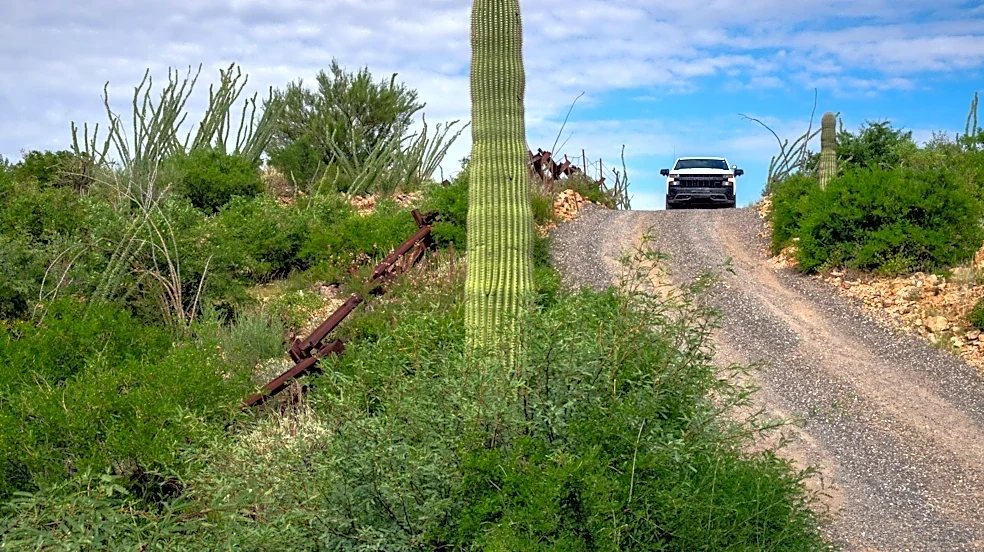





When the Tohono O’odham Nation filed an emergency injunction on Oct. 5 to halt border wall construction on tribal lands, officials described the situation as a “stark emergency,” while the federal government urged the court to deny the request.
The tribe had been informed that work would start on Oct. 12, Indigenous Peoples’ Day. Tribal members and other concerned individuals worried about the intent of relocating thousands of saguaro cactuses to clear a path for the wall. They held a prayer gathering that day near the border.
“As the government recently confirmed, the project would additionally entail the attempted relocation of thousands of cacti, including saguaros,” the tribe said in the Oct. 5 filing. Saguaros are among "the most sacred plants
in O’odham religious tradition," officials said, and its fruits are “as essential to O’odham spirituality as sacramental bread and wine are … in Christian traditions."
But as the day came and went, and while the prayer event was held, contractors slated to remove the saguaros never came.
But it didn't mean the federal government had given up. In an Oct. 15 filing in the U.S. Court of Appeals' District of Columbia Circuit, Homeland Security attorney Christopher Anderson urged judges to deny the tribe’s emergency request, arguing that the lawsuit is unlikely to succeed because federal officials have the authority to use borderlands for security purposes. It also argued that the tribe had not shown irreparable harm and that stopping construction would undermine border security and public safety.
Federal officials argued that the Nation is unlikely to succeed on its trespass claim, stating that, to the government’s knowledge, no court has ever recognized a federal common law cause of action for trespass against the United States with respect to tribal trust property.
The federal government also argued that the Tohono O'odham Nation’s lawsuit is barred by sovereign immunity, which generally prevents the United States and its officials from being sued without congressional approval. The tribe had not identified a law waiving that immunity, the government said, and instead relied on a legal exception that allows lawsuits against federal officials who act beyond their legal authority.
“The Tribe does not assert that the Tucson 5 project is unconstitutional, and Congress indisputably authorized the Secretary to construct barriers at the border,” according to the U.S. government's Oct. 15 filing.
The federal government has long used the 60-foot strip of land known as the Roosevelt Reservation, including land within the Tohono O’odham Nation's reservation, for border security. The tribe argued that the exemption does not apply to the area in question because the land was not public land in 1907. The government disputed this claim, arguing that it conflicts with historical records and legal precedent.
“The Tribe insists that those lands were not “public lands” because the O’odham held aboriginal title to those lands in 1907. That argument is a non-sequitur. Even if the Tribe had aboriginal title to the lands within the Tohono Reservation in 1907, federal law allowed Congress to open or reserve lands subject to claims of aboriginal title,” Anderson wrote.
Tribe says government's wall is 'act of trespassing'
Tohono O’odham Chairman Verlon Jose is attending the Nation Congress of American Indians convention this week and emphasized the need to build support among other tribes.
“If the federal government can do this to this nation, they can do it to any other tribe,” Jose said. “That's why we must stand in solidarity with each other against the attack on tribal sovereignty.”
In its Oct. 5 filing, the tribe argues it is likely to win its case because the planned border wall construction would trespass on its sovereign lands. It maintains that the legal basis for its claim is clear and that the district court’s procedural ruling conflicts with binding legal precedent.
“An assertion by federal officials that they can blast, bulldoze, and permanently dispossess a federally recognized tribe of reservation lands absent Congress’s assent is unprecedented in the modern era," the tribe's attorney, Riyaz A. Kanji, wrote. "Across other portions of the southern border, the Secretary has paused wall construction in response to concerns raised about environmental devastation.”
The U.S. Supreme Court has affirmed that Native American tribes have the same common-law property rights as other landowners and can sue to protect their lands. These long-standing rights include control over tribal land and its resources, as well as the sovereign authority to determine who may enter their territory.
“The Secretary’s proposed actions—to enter or cause his agents to enter the Reservation for purposes not authorized by the Nation, alter the landscape, and leave behind at least one permanent wall and associated infrastructure—are quintessential acts of trespass,” Kanji wrote in the Oct. 5 filing.
The tribe further argued that its aboriginal rights to the lands that would become its reservation remained unextinguished in 1907. In 1915, the Commissioner of Indian Affairs appointed a Committee of Eight to recommend a location for the Tohono O'odham Nation’s reservation.
“The lands that became the Nation’s Reservation were not 'public lands' in 1907 because they remained subject to the Nation’s unextinguished aboriginal rights, and the Roosevelt Reservation accordingly did not attach them,” wrote Kanji in the Oct. 5 filing.
Tribe remains watchful and is prepared
Over a week since the saguaros were set to come down, Jose recalled that, when they were informed of the plans to relocate thousands of cactuses, the tribe mobilized its Department of Public Safety and other departments to develop and implement a response plan.
Saguaros are protected under tribal and state law, and saguaro relocation efforts are rarely successful. In the department’s past border projects in Arizona, relocation killed half of the transplanted cactuses, the tribe said.
“Protecting our people, primary focus of the Nation's government is to protect its people,” Jose said as he addressed the public during a Facebook live session.
The Tohono O'odham Nation posted “No Trespassing” signs on tribal lands in April out of concern that federal contractors might enter the reservation without authorization to construct a border wall.
Jose said the tribe removed several contractors for trespassing without authorization, prompting the deployment of armed Customs and Border Protection and Bureau of Indian Affairs law enforcement officers to escort them.
“Rather than escalate the situation further, the Nation continued to monitor the activity,” Jose said.
While awaiting possible contractors to come onto tribal lands to remove saguaros, Jose said several measures were taken to ensure that essential safety resources and infrastructure were in place. Health care personnel established an on-site mobile clinic in case anyone was injured or required medical attention. Sanitation resources were also made available, and the Tohono O’odham police provided protection.
An incident command post was established to coordinate the efforts of multiple agencies. Numerous additional resources were mobilized to help ensure the safety and security of tribal members and supporters, Jose said.
“CBP and the unauthorized contractors have not attempted to remove the saguaros from our land,” Jose said. “But the Nation remains watchful and is prepared for this attempt.”
Solidarity at a prayer gathering
Members of the Tohono O’odham Nation held a prayer gathering on Indigenous Peoples’ Day in preparation for what might happen.
A large turnout near the border by tribal members and others underscored the serious threat to the Nation's sacred saguaros. The crowd celebrated Indigenous Peoples' Day with U.S. Rep. Adelita Grijalva and Pima County Board of Supervisors Chairwoman Jennifer Allen, who attended and participated in the gathering and blessing.
“The county has issued a number of resolutions very strongly in support of the Tohono O’odham Nation, in support of the communities and leadership, and denouncing what the federal government is continuing its attempt to do,” Allen said during the prayer event. “It’s escalating, attempting to divide communities.”
Tribes across Arizona, California and New Mexico, along with leaders from Tucson, Pima County, the state and Congress, have expressed solidarity with the Tohono O’odham Nation.
Navajo Nation Speaker Crystalyne Curley, who is currently running for Navajo Nation president, voiced her support for the Tohono O’odham Nation, making her the first Navajo Nation leader to do so publicly.
“The Tohono O’odham Nation’s fight is centered on the protection of sovereignty. All tribes understand that our ancestral homelands existed long before international and political boundaries were drawn," Curley told The Arizona Republic. "I support the Tohono O’odham Nation in defending their inherent rights, protecting their lands, and ensuring that future generations can continue to maintain their connection to their homeland. Tribal sovereignty must be respected, and Indigenous voices must be heard in decisions that affect our people, our lands, and our way of life.”The Navajo Nation is the largest tribe in Arizona, with its tribal lands also spanning across Utah and New Mexico. It is also considered an influential tribe, as it is one of a few to have its own Washington, DC, office in place.
Arlyssa D. Becenti covers Indigenous affairs for The Arizona Republic and azcentral.com. Send ideas and tips to arlyssa.becenti@arizonarepublic.com. Follow her on Bluesky at @abecenti.bsky.social.
This article originally appeared on Arizona Republic: Border wall on Tohono O'odham land is a 'stark emergency,' leaders say