




MARBLE CANYON — Tim Hauck waited for a radio signal like a starter at a race track.
He held a walkie-talkie up to his mouth. “Ready to go?” Around him, the early afternoon sun bore down on over a hundred eager bird enthusiasts watching a single point in the distance from camp chairs between berms of prairie sunflowers.
“Ready and waiting,” a voice crackled over the speaker.
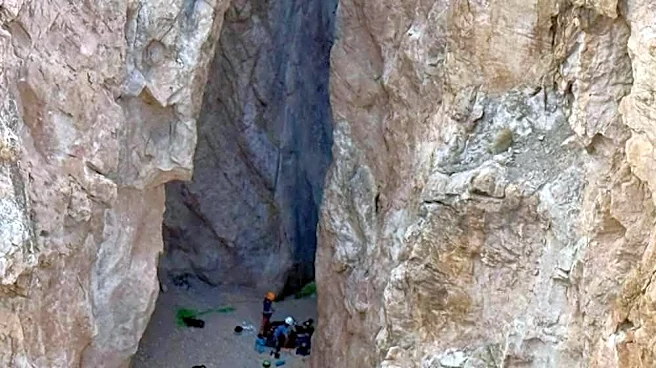
Far above the revelers, avian biologists at the top of a 4,000-foot cliff were poised to release four California condors, the largest birds by wingspan in North America, into a sky filled with streamers of gauzy white clouds.
“Open the doors,” said Hauck, the California condor program director at the Peregrine Fund, a nonprofit for birds of prey.
The endangered birds didn’t emerge
from their cage on cue. Instead, they eyed the open gate and roused their wings. Their wild counterparts circled overhead. A coyote stalked the cliff rim nearby. Twenty long minutes later, Condor 1365 shot out of the cage — the only male bird of the bunch. He took off west toward the Kaibab Plateau, soaring on a thermal updraft.
His flight marked the first of the 30th annual California condor release festival near Arizona’s border with Utah. Since 1997, the Peregrine Fund has been working to bring California condors back from near extinction by releasing captive-born birds into the wild in their native range.
”We have historic evidence of condors in the Grand Canyon,” said Emma Heydenberk, a biologist with the nonprofit. “They've always been a part of this ecosystem.”
On Sept. 26, four new condors joined a flock of 92 in Arizona and Utah, taking on an ancient legacy and an effort to save their species in the rocky reaches of the Vermilion Cliffs.
The deadly risk of lead
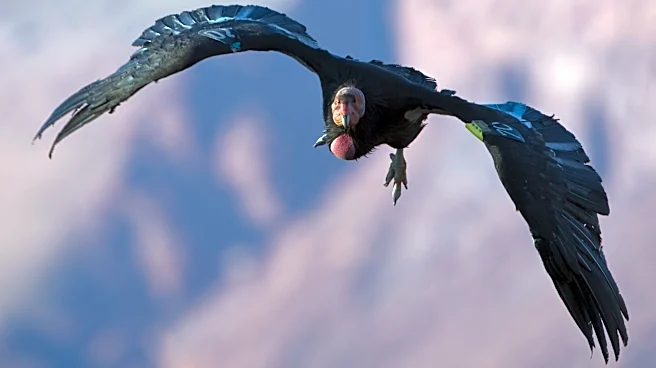
California condors are elegant and slightly ominous. They follow death wherever it goes. With bald heads ringed by scarves of spiky black feathers, their eyes scan the valley below.
With a nine-foot wingspan, they are commanding. Millions of years ago, they patrolled the skies over the continent’s coasts, forests, deserts and grasslands — a species of a bygone, prehistoric landscape once populated by other megafauna like mastodons and saber-toothed cats.
At the end of the Pleistocene epoch, 11,000 years ago, many large mammals went extinct. California condors remained, but their numbers shrank, as did their range. By the 1800s, they lived only along the Pacific coast from British Columbia to Baja California.
Then came another threat to their survival: lead.
“The number one cause of death among California condors is lead poisoning," Heydenberk said. “ The main source of lead poisoning is from spent ammunition.”
Condors, like other vultures, feast on dead animals. When hunters leave behind gut piles, the mix of internal organs cleared out from big game, condors swoop in to clear the mess.
“They're basically nature's cleanup crew,” Heydenberk said. But if lead bullets are used as ammunition, they can fragment into tiny pieces and stay buried in the animals' flesh. When condors feed on those remains, they end up swallowing undue quantities of it. “Lead isn’t good for anybody. It's not good for us, and it certainly isn't good for birds,” she said.
It’s taken a huge toll on the species. Thirty years ago, there were only 29 condors living in the wild. In 2005, the Arizona Game and Fish Department started handing out lead-free ammunition to hunters within the condor’s range.
“Condors are sort of our canary in the coal mine,” said Erin Brown, the lead reduction program coordinator at the state wildlife department. “They let us know that there was a problem. Through that, we've realized that all birds of prey and scavenger wildlife, especially birds, are susceptible to this.”
Much of Brown’s work involves reaching out to hunters and talking with them about the risks of lead bullets, offering alternatives and providing places for them to bring their gut piles where condors can’t reach them.
When the program first started, only about half of hunters in the condor range were participating in the lead reduction efforts, Brown said. That number has now increased to include 85% of them.
Biologists at the Peregrine Fund’s Vermilion Cliffs outpost regularly check the condors for lead poisoning.
“Any bird that comes into our trap, we’ll draw its blood,” said Heydenberk, who has spent four winters monitoring them in Arizona. If a bird tests high for lead, biologists give it a series of injections that help flush the metal from its system. “Otherwise it accumulates in their organs, in their bones and causes long-term problems.”
Once those lead levels have dropped, the biologists release the condors back into the wild. But it’s not uncommon for them to return a few weeks later, full of lead all over again.
While the voluntary hunter’s program has reduced the amount of lead languishing in the environment, climate change is complicating those efforts.
“Right now we're in lead season, or hunting season,” Heydenberk said. Some hunters are leaving animal carcasses shot with lead ammunition out on the landscape.
Usually, winter brings snowstorms that cover those remains enough that condors won’t feed on them. But in the last few years, snowpack in the condor’s range has been minimal. By March of this year, snow cover in northern Arizona was just 20% of its average, according to the National Oceanic and Atmospheric Administration. In states across the West, scientists dubbed last winter a “snow drought.”
With warmer winters, condors are exposed to more carcasses shot using lead ammunition that would otherwise be covered by snow, Heydenberk said.
From Boise to the Grand Canyon
The California condors released on Sept. 26 came to the Vermilion Cliffs by way of Idaho.
“Drove them all the way from Truckee. Drove across all of Nevada,” said Julia Schmidt, a Peregrine Fund biologist who spent the last month traveling with the birds and preparing them for their transition into the wild.
All four birds hatched at a captive breeding facility in Boise last spring, making them a year and a half old.
”Rumor has it one of them is really big and another one is a spitfire,” Heydenberk said.
Each one has a distinct personality, Schmidt confirmed. Condors are really personable and curious, she said. “I have a feeling this particular group of birds is going to do very well.”
Once the condors are acclimated to the wild, the team of biologists at the Vermilion Cliffs will continue to monitor them via radio transmitters and GPS tracking.
“Every morning we go through the data,” Schmidt said. They look at where the birds are congregating, feed them and remove dangerous roadkill. The work isn’t glamorous. Sometimes biologists hike up the cliffs to retrieve a condor that’s died or to “scare the ever-living bejesus” out of them, Hauck said, a tactic that teaches them to be afraid of ground predators like coyotes.
Still, for Schmidt it's a “dream job.” Over the last three decades, the Peregrine Fund has helped sustain the California condor population. The birds have even started breeding on their own in the wild.
“The first wild fledge happened in 2003 in Grand Canyon National Park,” Hauck said. Since then, 74 have hatched in the wild between Arizona and Utah. Near Cliff Dweller’s Lodge, a small inn set against the Vermilion Cliffs, and Marble Canyon Lodge, there are three active nests where four-month-old condors are getting ready to fly.
Since 1995, California condors have made a big comeback. As of last year, 392 lived in the wild. But they are still critically endangered; their population is not yet self-sustaining. Still, the biologists who’ve devoted their lives to their recovery are hopeful.
“This is a very old species,” Hauck said. “They survived the last ice age. Condors are resilient.”
High above, the last of the day's condors flew from the cage. From the moment Hauck signaled his cliff-side team to open the doors, it took just 49 minutes for all four birds to take to the skies.
Sarah Henry covers environmental issues for The Arizona Republic and azcentral. Send tips or questions to sarah.henry@arizonarepublic.com.
Environmental coverage on azcentral.com and in The Arizona Republic is supported by a grant from the Nina Mason Pulliam Charitable Trust.
Follow The Republic environmental reporting team at environment.azcentral.com and @azcenvironment on Facebook and Instagram.
This article originally appeared on Arizona Republic: 4 more California condors take flight near the Grand Canyon