









Chiricahua National Monument is now Chiricahua National Park.
The Chiricahua National Park Act, introduced in Congress by Arizona's congressional delegation, was approved in the Senate on Sept. 30. The White House confirmed that President Donald Trump signed it into law on Tuesday, Oct. 20.
Efforts to redesignate the Cochise County monument famed for its rhyolite rocks won bipartisan support, with the House bill introduced by Reps. Juan Ciscomani, a Republican from Arizona's 6th district, and Greg Stanton, a Democrat from Arizona's 4th district.
Both of Arizona’s Democratic senators, Mark Kelly and Ruben Gallego, introduced the Chiricahua National Park Act in the Senate. Kelly, who championed the redesignation since 2021, described the bill's signing
as "a historic day for Arizona."
“A bipartisan effort from the start, this is a win for the communities in southeastern Arizona and for everyone who worked to protect this extraordinary place so our kids and our grandkids can enjoy it," Kelly said in a statement.
Why Chiricahua is worth visiting
Like the Grand Canyon, Chiricahua was protected as a national monument before it became a national park. President Calvin Coolidge established Chiricahua National Monument in 1924.
An underappreciated southern Arizona treasure, the Chiricahuas are well off the beaten path.
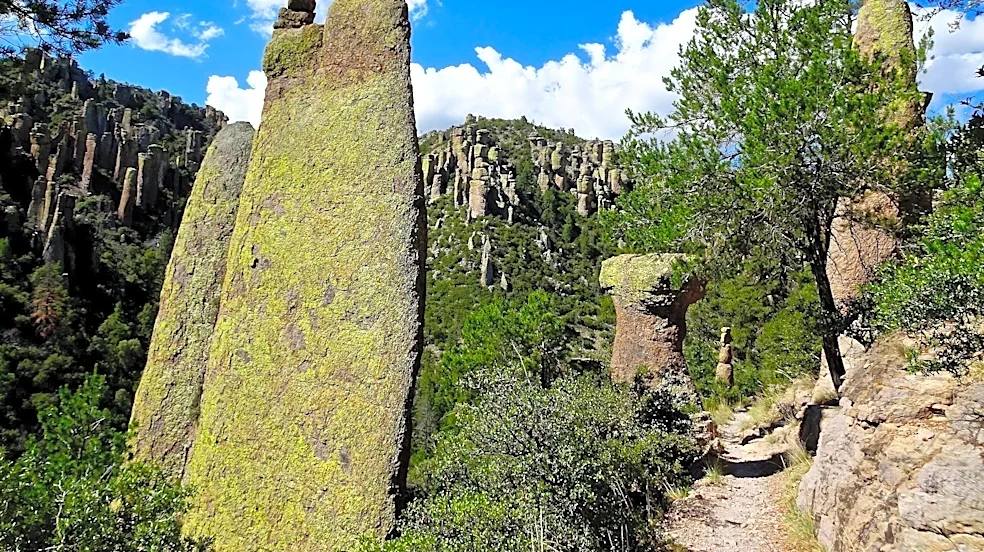
But even before becoming a national park, the 12,000-acre site on a mountain range historically inhabited by the Apache people steadily gained attention. Some social media travel influencers recommended Chiricahua as a travel dupe for Utah's Bryce Canyon National Park because the views are comparable to Bryce Canyon's hoodoos.
The Chiricahuas are one of Arizona's sky islands, isolated mountain ranges above deserts and grasslands.
The eight-mile scenic drive to Massai Point reveals expansive views of the rhyolite rocks; balanced rocks can also be seen along the drive.
There are 17 miles of hiking trails, including the easy Bonita Creek Loop that gives visitors views of wildlife like whitetail deer and birds. Chiricahua is classified as a Dark Sky Place by the International Dark Sky Association, making it a destination for stargazers.
“Chiricahua is one of those places you have to see with your own eyes to truly understand," said Eddy Corona, president of the Phoenix-based nonprofit Outdoor Experience 4 All, which offers outdoor adventures for children with life-threatening illnesses. "Its landscape is breathtaking, and no matter how many times I visit, that feeling never changes. I’m proud that more people will have the opportunity to experience this extraordinary place."
Arizona's 4th national park
Following the Chiricahua National Park Act receiving Trump's signature, Chiricahua joins three other Arizona landscapes to receive designation from the federal government as national parks. The others are:
Grand Canyon: Formed millions of years ago through the uplift of igneous and metamorphic rock and carved by the Colorado River through erosion, the Grand Canyon is one of America's greatest geological treasures. Those who photographed and painted the canyon over the years have inspired generations of travelers with their depictions of the canyon's grandeur and vast scope, but nothing compares to seeing it for yourself. Travelers can do just that from overlooks on the South Rim, such as Mather Point and the popular sunrise/sunset viewing spot Hopi Point, or the less crowded North Rim via Cape Royal and Bright Angel Point.
Saguaro: The crown jewel of the Sonoran Desert is the saguaro cactus. It's the largest cactus in the U.S., growing to more than 50 feet when mature. While the saguaro can also be found in parts of California and Mexico, you have to visit the species' namesake national park in Arizona to see the world's tallest and oldest saguaro cacti. The greatest concentration of saguaros is in the Tucson Mountain District of Saguaro National Park. It's west of downtown Tucson. Catching a glimpse of a saguaro in person is an impressive sight, where you can see their massive arms — which function like branches on a tree — used by birds for nesting. Go during mid- to late spring to see saguaro cactus blossoms, Arizona's state flower.
Petrified Forest: Landscapes of orange, red and pink badlands along the Painted Desert, the rich deposits of petrified wood and the history contained within the remains of ancestral pueblos and petroglyphs make this well worth the drive. Petrified Forest is also the only national park that preserves a section of Route 66. Visitors can see a rusty, abandoned 1932 Studebaker next to the road near the park's Painted Desert entrance, just outside Holbrook. A historical marker inside the park titles this exhibit "Highway of Dreams."
Looking for the best things to do in Arizona? Sign up for our newsletter.
Michael Salerno is an award-winning journalist who’s covered travel and tourism since 2014. His work as The Arizona Republic’s consumer travel reporter aims to help readers navigate the stresses of traveling and get the best value for their money on their vacations. He can be reached at Michael.Salerno@usatodayco.com.
Support local journalism. Subscribe to azcentral.com today.
This article originally appeared on Arizona Republic: Arizona hidden gem officially named state's 4th national park