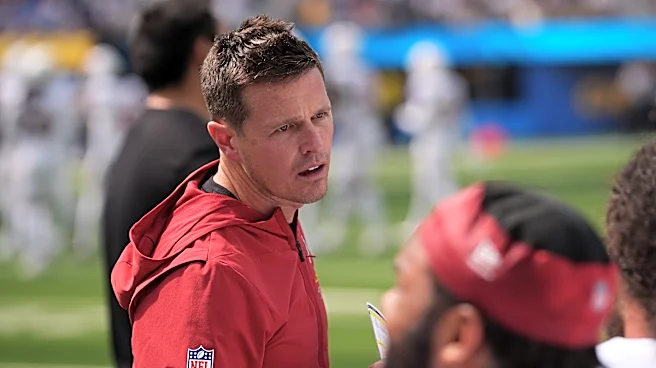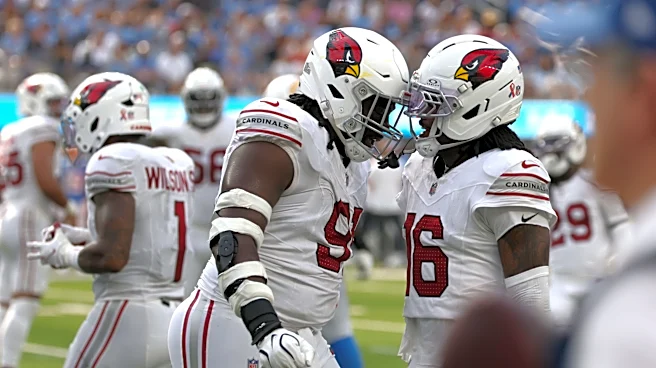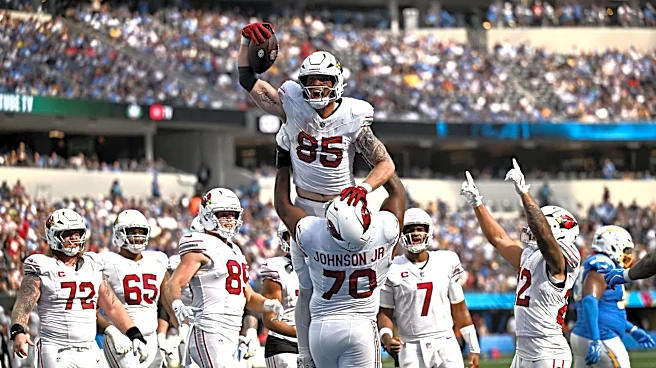


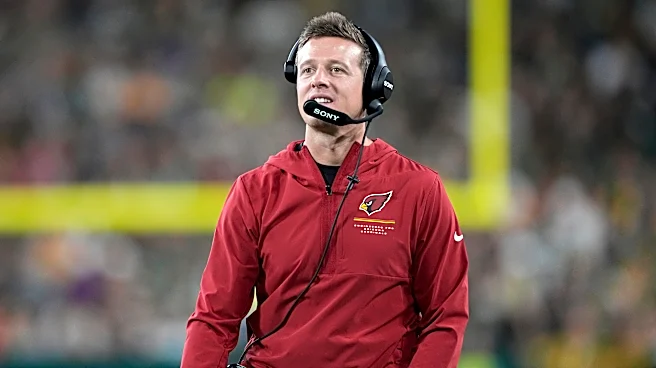
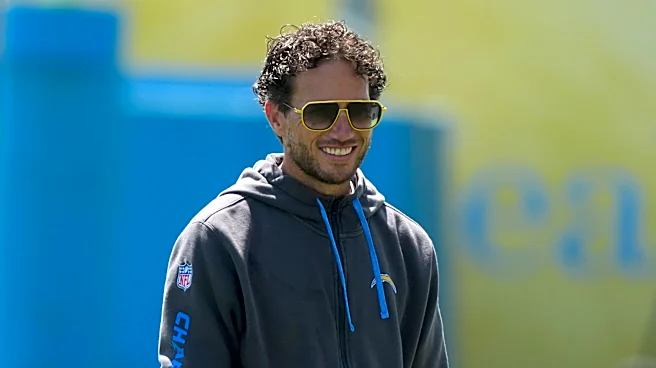
INGLEWOOD, CA — For those dyed in Cardinals red, who spent their springs and summers picturing just what Mike LaFleur’s group might look like on Sundays, reality must have come mighty close to replicating the visions.
This was everything that a modern NFL offense is supposed to look like. There were shifts and motions and complex formations, all designed to confuse an opposing defense. The quarterback, Jacoby Brissett, was asked to be a simple distributor, not a hero.
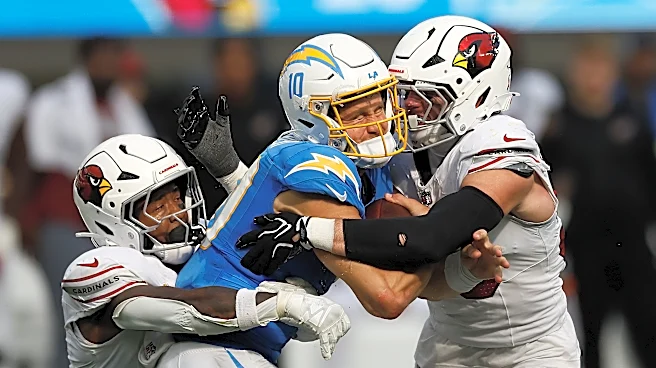
The result was an offense that clicked into gear, not punting until 2:37 remained in the third quarter. And with advantageous field positions, the Cardinals defense was able to keep the score under control, even against Justin Herbert, Mike McDaniel and an imposing Los Angeles Chargers
offense.
The NFL — and, indeed, the country — did not expect much of the Cardinals this season. They were tabbed with the league’s worst Super Bowl odds and began Week 1 as 10 1/2-point underdogs, the largest spread in the sport.
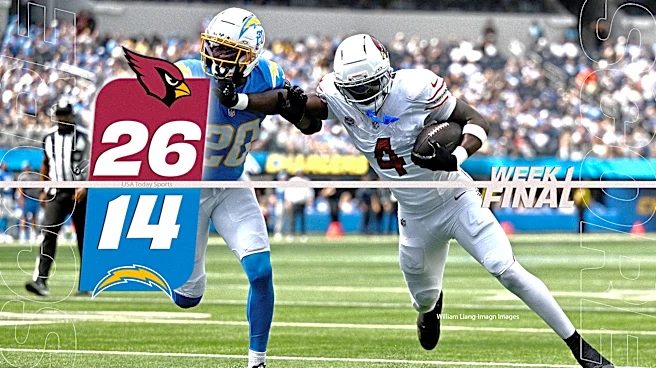
They ended it with a 26-14 victory and renewed hope for what the future could bring.
Here’s what we learned in the win.
Competence was refreshing
The Cardinals’ first trip to the red zone nearly went sideways. With his group facing first-and-goal from the 9-yard line, Brissett couldn’t get the offense in order. The play clock was ticking down, threatening a 5-yard penalty that would put Arizona in a difficult position, back at the 14. Later, Brissett revealed that he had called the wrong play.
So the Cardinals calmly signaled for a timeout. Simple, easy. Except around here, simplicity and ease are new.
Remember last year, when the Cardinals called a run on third-and-8 late in the fourth quarter against the Titans? After that game, head coach Jonathan Gannon and offensive coordinator Drew Petzing both said they wished they had called a different play or a timeout — despite, of course, being the men in control of those decisions.
Having command of their own operation, then, felt refreshing.
Two plays later, Jeremiyah Love punched into the end zone for a touchdown. This, too, was refreshing: Love’s outside lane was created by motion across the line of scrimmage from Elijah Higgins, and by Marvin Harrison Jr. sprinting across the play to engage in his blocking responsibilities.
Last season, the Cardinals had the lowest motion rate in the NFL at 21%, per the CBS broadcast. Under LaFleur, they’re making life easier on themselves.
“It’s a lot of good eye candy,” running back Tyler Allgeier said.
It wasn’t all perfect, of course. The Cardinals committed three pre-snap penalties, missed a field goal and struggled in the red zone. But it was marked progress.
Brissett operated excellently
Sometimes, the stat line tells the story.
For Brissett, this was one of those days. The Cardinals quarterback completed 27 of 37 pass attempts for 277 yards, a touchdown and no turnovers.
And it was, as those numbers suggest, an excellent performance. All game, Brissett took what was available to him, finding the open receiver when that option existed and ripping balls into tight windows when it didn’t.
“I thought Jacoby did a heck of a job getting the ball out,” LaFleur said. “When they were starting to bring some pressure and stuff like that, … there was so much hidden yardage on some of those quick completions.”

Take one play on the second drive of the game, when Brissett rolled out off play action with an unblocked rusher instantly in his face. Rather than panicking, he calmly floated his pass over two defenders into the arms of Trey McBride.
A few drives later, Brissett placed a go ball perfectly into Marvin Harrison Jr.’s outstretched arms for 33 yards. And on the Cardinals’ crucial, clock-eating fourth-quarter drive, he fired a third-down pass into a tiny window to McBride for the conversion.
Even his near-interception was, on further inspection, a smart play. Typically, throwing a pass into three defenders in the red zone would be an awful mistake. But with time ticking down in the first half and no timeouts, Brissett’s decision prevented the half from ending, enabling the Cardinals to kick a field goal as time expired.
Secondary bounced back after rough start
For much of the first half, the Cardinals' secondary looked like the unit that imploded on itself late last season. Ladd McConkey, in particular, found far too much room to operate, whether he was working against Will Johnson or Denzel Burke.
It seemed like the type of performance that could undo the Cardinals’ strong offensive work. On their first defensive drive, they allowed an easy touchdown march. On their second, they were bailed out only by a fluky fumble. And on their third, they allowed the Chargers to reach the goal line in just six plays.
Then, everything changed. On first down, Burke suffocated McConkey’s corner route, forcing a throwaway. After a second-down run, Johnson and safety Andrew Wingard played excellent third-down coverage to force a scramble. And on fourth down, Dante Stills got home for a sack, in large part because of more tight coverage from Johnson and Wingard to take away Herbert’s first two reads.
From that point onward, the Cardinals secondary more than held its own. After averaging 13.1 yards per attempt in the first half, Herbert averaged just 5.1 yards per attempt in the second half.
That shift played a crucial role in the win.
Mack Wilson makes impact felt in return
On one of the Chargers’ first plays from scrimmage, Mack Wilson Sr. spotted a gap in the offense line, spiked through it and ripped running back Omarion Hampton to the ground, shy of the line of scrimmage.
It served as an instant reminder of what the Cardinals lost in Week 9 of last season, when Wilson suffered a season-ending ribs injury. Prior to that point, they had been a top-10 defense by DVOA, a schedule-adjusted metric. After Wilson’s injury, they were a bottom-five defense.
“I think people just feel good when he's the one calling (defensive plays),” LaFleur said. “His confidence.”
That’s not to say Wilson’s absence was the entire cause of the Cardinals’ late-season collapse. But since signing in 2024, he has often been their only reliable inside linebacker, bringing a big-play ability at the position that this defense otherwise lacks.
That showed up again late in the third quarter, when Herbert looked to have a third-and-16 completion to McConkey, potentially for a first down. As McConkey turned downfield, Wilson delivered a massive hit, forcing the ball incomplete — and forcing McConkey out of the game.
Without McConkey, the Chargers’ offense averaged five fewer yards per pass attempt.
Cardinals showcase skill position talent
If there was a reason for optimism entering this Cardinals’ season, it rested with their skill position talent. They have a talented tandem at both running back (Jeremiyah Love, Tyler Allgeier) and wide receiver (Marvin Harrison Jr., Michael Wilson), plus the best tight end in football (Trey McBride). For all the weaknesses elsewhere on the roster, this was a defined strength.
And in the opener, it showed up in a big way.
The running game was far from explosive, with Allgeier and Love combining for just 3.6 yards per carry. But it was much better than it could have been — because of the talent those players have. Of Love’s 41 rushing yards, 38 came after forcing a missed tackle, per Next Gen Stats.
McBride, meanwhile, dominated again, with nine catches for 95 yards and a touchdown, much of which came through persistent double teams. Wilson picked up where he left off last season, catching five passes for 56 yards to keep the offense on track.
And even Kendrick Bourne, the forgotten wide receiver in this starting trio, finished with 75 yards on eight catches, including five for first downs.
“I'm pretty sure none of y'all had him on your fantasy team,” Brissett said.
Bourne’s star role was fitting. For the Cardinals, this was a day about shattering expectations.
This article originally appeared on Arizona Republic: Cardinals takeaways, quotes, analysis in the wake of a stunning win