
The kind of rain that lands like a summer soak in much of the U.S. can be the fuel for disasters in Arizona.
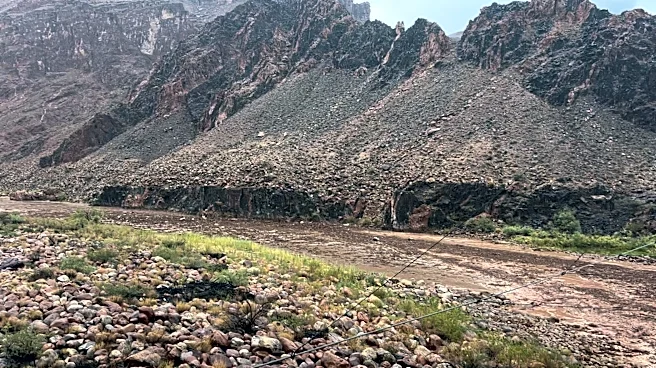
A flash flood that swept through Grand Canyon National Park on Aug. 29 killed at least two people with several others unaccounted for two days later, according to park officials.
The prolonged silence about their whereabouts suggests the storm could join the state’s list of worst flooding disasters
.Here are some of the others.
Perhaps the most infamous storm is the Aug. 12, 1997, flash flood that killed 11 people, most of them foreign tourists, at the Lower Antelope Canyon near Page.
Heavy rains 15 miles upstream sent a wall of water estimated at about 40 feet by the time it tore through the canyon.
Seven of the victims were French, two were Americans,
and one each was from England and Sweden.
Only one person, Pancho Quintana, a tour guide with the group, survived.
Even that came at a cost.
“I was inundated by guilt and responsibility. Fear. Anger. And those are things that I carried around with me,” Quintana told Salt Lake City’s KSL in a 2013 interview.
Afterward, the Navajo Nation closed the canyon to visitors for a year and implemented a series of safety measures.
A generation earlier, the remnants of a tropical storm delivered the deadliest storm in Arizona history, according to the National Weather Service.
In September 1970, 23 people across central Arizona died from flooding triggered by rainfall topping 11 inches.
The worst of it was in Tonto Creek near Kohl’s Ranch, where 14 people died. One of them was Gilbert Andrew Duthie, a state police officer, who drowned in his patrol car north of Sunflower.
On Sept. 28, 1983, another tropical storm dumped heavy rain over Arizona for more than a week.
That storm system, and the severe flooding that accompanied it, led to 14 deaths, 975 injuries and the displacement of 10,000 residents in Tucson, Clifton and Safford, according to the National Weather Service.
An Arizona Republic reporter inspecting the damage with authorities by helicopter noted that a bridge on the Florence-Kelvin highway that normally stood 50 feet over the Gila River was instead under 3 feet of water.
“The town of Marana is literally under water,” then-Gov. Bruce Babbitt said at the time.
Scarcely a month after the Antelope Canyon disaster, two hikers died in flash flooding at Grand Canyon National Park on Sept. 11, 1997. A third person survived after he was swept miles downstream from a storm that dropped only trace amounts at Phantom Ranch but 2 inches near the rim of the canyon.
Six months after that, two Boy Scouts from Gilbert and a man helping chaperone them drowned in a rain-swollen wash near Sunflower on March 28, 1998. The SUV carrying six people stalled in the rising water and all were swept off the roof of the vehicle. Three survived the fast, cold waters; three died.
On Aug. 11, 2001, a 2-year-old New Mexico boy and his parents died in a flood while hiking near the tribal village of Supai, near the south rim of the Grand Canyon.
On July 12, 2008, two undocumented immigrants drowned as a wash near Nogales flooded in a heavy thunderstorm. Three others were rescued.
Weeks later, on Aug. 3, 2008, three people drowned near the Tohono O’odham Reservation when their vehicle was swept away as they attempted to cross a wash. Two people were rescued.
The latest storm striking the Grand Canyon area still falls far short of the worst known disaster there, which had nothing to do with weather.
On June 30, 1956, two commercial planes collided over the Grand Canyon, killing all 128 people on board.
The mid-air collision, involving planes from TWA and United, apparently happened because the pilots failed to keep visual separation from other planes, though the accident happened about 10:30 a.m.
The event generated worldwide attention and helped spur changes to the nation’s air-traffic control system, including the creation of the Federal Aviation Administration.
This article originally appeared on Arizona Republic: Grand Canyon flood joins Arizona's deadly history