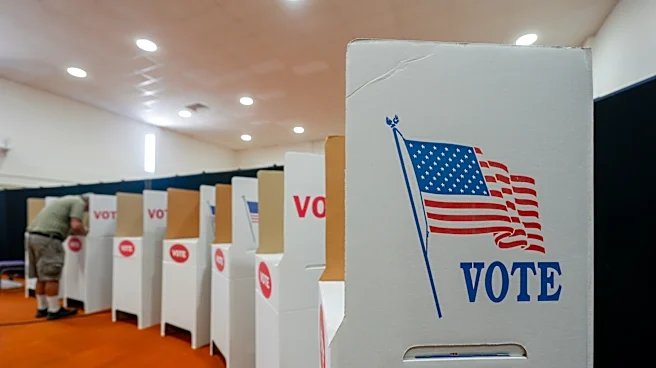



After a series of legal battles, the list of ballot measures that Arizona voters will decide on this fall is finalized.
Two measures offering competing reforms to the state’s universal school voucher program were removed from the general election ballot following separate decisions from the Arizona Supreme Court this month. Another measure faced legal challenges over the way it would be described to voters, but was ultimately left unchanged.
There are eight measures that will appear on the November ballot, each referred by the state’s Republican-controlled Legislature. They include proposals to reform election administration and requirements for school districts to spend a certain amount of funds on classroom instruction. Lawmakers have often
used ballot measures as a way to propose laws while avoiding Democratic Gov. Katie Hobbs' veto stamp.
The battle over the state’s Empowerment Scholarship Account program will no longer play out in November. A citizen-led ballot initiative called the “Protect Education Act” failed to qualify for the ballot after tens of thousands of signatures were disqualified by judges and local officials. Public school advocates pushed for the measure, arguing its proposed income cap and other restrictions were needed to rein in school vouchers.
A competing measure that looked to shield the voucher program also failed to make the ballot after the Arizona Supreme Court ruled that it unconstitutionally combined two changes into a single measure for voters to consider.
Another measure that did make it to the ballot, Proposition 144, was challenged in court over allegations that the description written by Secretary of State Adrian Fontes, a Democrat, was misleading because it omitted key parts of the proposed reform. In a divided opinion, a majority of the Arizona Supreme Court ruled that the description was not "clearly false or misleading."
The complete list of the ballot measures and their descriptions can be found on the Secretary of State’s website. Voters will be mailed more information about the measures later this year, including arguments both for and against each.
Proposition 141: Car mileage tax ban
Voters will decide whether the state will ban taxes based on vehicle mileage. The measure was approved by lawmakers in 2025 as Senate Concurrent Resolution 1004. It would also bar any laws that require car mileage to be tracked without consent.
There are exceptions included in the measure for certain commercial and government-owned vehicles.
Proposition 142: Expanded anti-DEI regulations
Legislators referred Proposition 142 to expand on the state’s existing bans on affirmative action. The proposed constitutional amendment would ban government agencies and schools from requiring employees and students to endorse preferential treatment on the basis of race. Diversity, equity and inclusion training within public agencies would also be barred under the amendment.
Some examples of prohibited conduct would be requiring a job applicant or student to sign a statement supporting race-based DEI or for an agency to spend public funds on race-based DEI training.
Proposition 144: Election regulations
Proposition 144 proposes broad election reforms in Arizona. It would amend the state’s constitution to require all voters to show government-issued ID before casting a ballot in any election, including people who vote by mail. It would also guarantee all Election Day voters have the option to have their ballot tabulated at their polling location.
The measure would also ban all foreign spending from being invested in Arizona’s elections, similar to prohibitions in federal law.
Proposition 316: Grocery Tax restrictions
Proposition 316 would retroactively bar municipalities from increasing grocery taxes from July 2025 through 2027. After that, cities cannot create a new grocery tax or raise a current one by more than 2% without voter approval.
Proposition 317: Drug cartels as terrorist organizations
Under Proposition 317, drug cartels would be designated as terrorist organizations in Arizona. Under the measure, a drug cartel is defined as a formal or informal group of people engaged in human smuggling, drug trafficking or any act of terrorism.
Proposition 318: Transgender student athlete ban
Proposition 318 would require all schools to designate sports teams into three categories: male, female or coed. It defines sex as a person’s “biological status as male or female as recorded at birth on the individual’s original birth certificate,” and stops schools from opening up girls' sports to students who do not align with that definition.
The proposal also bars schools from allowing students to use restrooms or locker rooms that do not align with that person’s sex. Student athletes would be allowed to sue their own school if the school or athletic association fails to abide by the law if passed by voters.
Proposition 319: Photo-radar enforcement restrictions
Under Proposition 319, Arizona’s cities will first need to obtain voter approval in order to use photo-radar systems to enforce traffic laws. Cities that obtain voter approval and have a contract to run a photo-radar system by Dec. 31, 2026 will be able to operate the system for a decade before having to once again bring the issue back to voters.
Proposition 320: School spending regulations
Proposition 320 would require larger school districts and those in certain counties to devote at least 60% of their spending to classroom expenses.
Any school district that doesn’t meet that threshold must increase instructional spending by at least 0.5% each year until it is in compliance. Districts that do not comply with the regulation will see decreased funding from the state Classroom Site Fund, with specific opportunities for short-term waivers that the Superintendent of Public Instruction can choose to authorize.
Helen Rummel covers state politics and higher education for The Arizona Republic. Reach her at hrummel@azcentral.com. Follow her on X, formerly Twitter: @helenrummel.
This article originally appeared on Arizona Republic: Arizona's November ballot is set. Voters will decide these measures