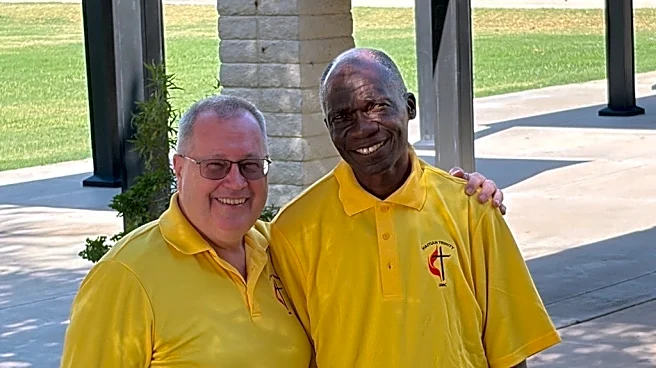



Osny Augustin sat in the library of Trinity United Methodist Church when his cell phone rang.
It was a local immigration lawyer calling. He needed Augustin's help tracking down a Haitian immigrant. The lawyer said the Haitian immigrant had an appointment the next day in immigration court, but her cell phone was disconnected.
Augustin told the lawyer he'd make sure the Haitian immigrant showed up for her appointment.
Augustin's phone has been ringing a lot lately. He's the lay pastor for a congregation of about 200 Haitian immigrants who worship at Trinity United Methodist Church on Glendale Avenue in northwest Phoenix.
Among them are Haitians who came to the United States seeking asylum but are now afraid of being arrested and quickly deported back
to Haiti after the Trump administration on Aug. 5 ended temporary protections for about 330,000 Haitians immigrants in the United States after winning a legal battle.
The Trump administration began the process of ending temporary protections for Haitians after former Secretary of Homeland Security Kristi Noem determined that Haiti no longer met the conditions for its designation for Temporary Protected Status. The decision was made after reviewing country conditions and consulting with U.S. government agencies, U.S. Citizenship and Immigration Services officials said.
Thousands of Haitian immigrants in Phoenix area lost protections
There are about 2,000 Haitian immigrants living in the Phoenix area, Augustin estimated, including several hundred who have lost temporary protections and are at risk of being deported soon.
The Haitians in the Phoenix area who lost so-called temporary protected status also lost their authorization to legally work in the U.S. and now don't have jobs, Augustin said. Many worked in warehouses or in nursing homes taking care of elderly people or keeping the facilities clean, he said.
The Haitians who lost temporary protections are afraid of being sent back to Haiti because the conditions are so bad, said Augustin, himself a Haitian immigrant with relatives still living in the Caribbean country.
Haiti is in the midst of a catastrophic humanitarian, political, and human rights crisis driven by total institutional collapse and near-absolute control of the country by heavily armed gangs, according to the United Nations.
The Haitian Bridge Alliance, an advocacy group, condemned the deportation of 160 people to Haiti, noting according to the United Nations nearly 1.5 million Haitians are internally displaced, and 6.4 million people, half the country’s population, are expected to require humanitarian assistance in 2026.
The security situation continues to deteriorate, the group said. Between March and July alone, the United Nations documented at least 613 people killed, 375 injured, and more than 18,000 displaced in violence concentrated in Cité Soleil and the Plaine du Cul-de-Sac.
The group warned that returning people to Haiti without adequate safeguards, resources, housing, security, and access to essential services such as hospitals and other sustainable infrastructure places lives at serious risk.
“This is not simply a question of immigration enforcement. We are talking about human beings being sent into a country where more than a million people have already been driven from their homes and where there is security and humanitarian crises,” Guerline Jozef, executive director of Haitian Bridge Alliance, said in a statement.
The San Diego-based group is calling for a moratorium on deportations to Haiti.
“The United States cannot claim that Haiti is safe while simultaneously acknowledging the extraordinary security risks that prevent even commercial flights from operating in Port-au-Prince and telling the whole world to not travel there. We are calling for a moratorium on deportations to Haiti. These deportations are unconscionable and will contribute to the continued destabilization of Haiti," Jozef said.
Augustin, the Phoenix pastor, said his cousins in Haiti tell him he should not come even to visit.
"Everything is very, very bad," Augustin said. "They have gangsters everywhere. …They kill people. They kidnap people. They rape people."
Lay pastor helping migrants continue to live their lives in the Valley
Augustin said he receives between 10 and 12 calls a day from Haitian immigrants in the Phoenix area who need help buying food or finding a place to live after losing their jobs.
Others are choosing to stay home out of fear of being picked up by ICE if they leave to buy groceries or go the store, Augustin said.
"People are scared to go out because they can see ICE and ICE" can take them away, Augustin said. "Sometimes it's me who can go to the marketplace to buy something for them and they stay at home."
Earlier that morning, he drove two separate people to the hospital.
He also used a church van to drive 15 family members to a college graduation because they were afraid to drive on their own.
And three weeks ago, Augustin married a Haitian couple that was afraid to have a wedding in public so they held the ceremony in the library. The only people there were the couple getting married and two witnesses.

"Rather than having something be public that would attract a lot of attention we arranged it and did it within 24 hours," said Loye Sekihata Ashton, the lead pastor at Trinity United Methodist Church.
On Aug. 20, the United States deported more than 160 people to Haiti, including former TPS holders and people who has served prison sentences, according to CBS News.They were the first people deported to Haiti after the Trump administration ended Temporary Protected Status for more than 300,000 Haitians in the United States, CBS News reported.
The plane landed in the northern Haitian city of Cap-Haitien because the main international airport in Port-au-Prince is considered too dangerous, CBS News reported. The U.S. government currently has a ban on U.S. commercial flights to Haiti's capital through early September because of ongoing gang violence.
About 2,000 Haitian immigrants live in the Phoenix area, Augustin estimated, including about 200 who have lost temporary protections and are at risk of being deported soon.
Augustin serves as a "kind of living network" connecting Haitians who have lost TPS with groups that can help them, Sekihata Ashton said.
The church has applied for a $20,000 grant from the Desert Southwest Conference of the United Methodist Church to provide food and housing assistance to 10 Haitian families that lost TPS, Sekihata Ashton said.
The conference created a solidarity fundto provide grants to UMC churches to support immigrants facing financial hardship amid increased immigration enforcement, said Rae Lathrop, the conference's justice and community development director.
The Trinity UMC is collecting food to distribute to families, Sekihata Ashton said.
"These are people who, regardless of how they got here and why they came, they have committed themselves to making this country be as good country as it can be for themselves and for us," Sekihata Ashton said, "and they're being discarded as if they don't matter for political purposes."
This article originally appeared on Arizona Republic: Haitians in Phoenix brace for deportations after loss of protections