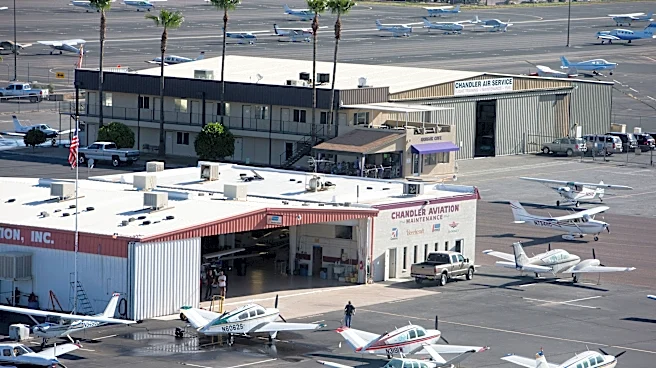






A proposal to extend one of Chandler Airport's two runways is being eyed by the City Council for the third time in 25 years, but any runway extension needs to be approved by the voters, not just the council.
That hurdle has stymied the extension for more than two decades, and now city leaders are considering a move to circumvent the public vote.
According to a 1997 local law, Chandler voters need to approve any extensions to the airport and any extensions have a 5,700-foot cap. They have twice rejected extending the runway: once in 2000 and another time in 2007. Both times, the extension was longer than the latest proposal.
The new plan would lengthen one of the two runways to 5,550 feet. Many aircraft, such as midsize business jets or specific
turboprops, require at least 5,000 feet to land and take off during the heat of summer.
The about $7 million project would not expand the capacity of the airport, city staff said. Rather, the upgrade is needed to enable aircraft to use the airport year-round. Currently, some cannot use it during the summer months when they need a longer runway to take off and land.
The project is also estimated to add more than 400 jobs and increase economic output by $71.3 million, including increasing tax revenue by $1.57 million.
But before the council votes on the project, it is first exploring options to remove the requirement for an election by amending the 1997 ordinance.
What exactly is the Chandler Airport runway extension plan?
The Chandler Airport has two runways, one that is 4,870 feet long, and a second that is 4,401 feet long.
City staff said the goal of the extension is not to expand operations in its entirety. Instead, extending the 4,870-foot runway by 680 feet would allow planes to take off and land at the airport during the hot summer months. The extended runway would fall squarely within airport property, according to city staff.
The Federal Aviation Administration is expected to pay for the vast majority of the project through grants.
Larger aircraft can't use the airport for four months of the year because jets need more space to take off when it's hot, as hot air is less dense, reducing both lift and engine thrust, according to Embry-Riddle University, a Prescott-based aviation school.
Today, the Chandler Airport is primarily used for corporate and self-piloted business flights, sport or hobby aviation, public safety and medical service flights. Many flight schools also operate there.
In 2024, it ranked as the 17th busiest general aviation airport nationwide with around 251,000 take-offs and landings annually. Airports like Sky Harbor International Airport are commercial service airports.
The Falcon Field Airport in Mesa consistently ranks in the top 5 most active general aviation airports in the U.S., while the Scottsdale Airport handles fewer take-offs and landings than Chandler's.

Chandler's capacity would stay the same with an extension, city staff said. The extension would not accommodate any larger commercial planes ‒ the airport would still only serve small to mid-size business aircraft, like a Cessna 172 or King Air 200.
Even with the extension, commercial planes like an Airbus A321 or a Boeing 737 would not be able to fly out of the airport because those planes typically require about 6,000 to 7,000 feet of runway, if not more.
Current and future plans do not call for longer runways. The 1997 ordinance limits the runways to 5,700 feet.
Flight patterns are also not expected to change.
It would still take years before any construction, though. The FAA requires robust environmental review and public input processes, extending the construction timeline by about four to five years.
Will the Chandler Airport extension generate any more noise?
Any noise impacts would be minimal, city staff said. No residential neighborhoods are expected to fall within the FAA's 65 decibel noise contour, according to a study by Chandler.
The 65-decibel threshold is what the FAA considers significant noise impact for residential areas. The majority of the area affected by increased noise is still south of Germann Road and comprised of industrial buildings.
The report also said that it may even reduce noise because aircraft can climb more efficiently.
The extension would also not change or introduce any new flight paths or shift traffic.
So what's holding up Chandler's airport plans?
Twice, voters have said no to extending the runway, despite the proposal dating back to 1982, more than 40 years ago.
On Oct. 12, the Chandler City Council directed staff to explore options to get the extension approved:
- Hold a bond election and pose the question to the voters
- Amend the ordinance to axe the requirement for a bond election
- Do not extend the runway
The majority of councilmembers supported extending the runway to modernize the airport, but some councilmembers, including Mayor-elect Matt Orlando, seemed uneasy with taking away the power from the voters.
But Councilmember Christine Ellis expressed frustration at the fact it has taken so long for the extension to be approved.
The council faces a time crunch if it chooses to pursue an election. Deadlines to submit ballot language are quickly approaching. City Attorney Deryck Lavelle said the most likely date for a general election would be July 20, though if the council chooses a bond election, it would have to occur in November, he added.
Lauren De Young covers transportation and the cities of Tempe and Chandler for The Arizona Republic. Reach her at ldeyoung@azcentral.com.
This article originally appeared on Arizona Republic: Chandler revives runway extension plan, but may not ask voters for OK