





When Mesa’s photo radar cameras snapped John Giles, the city’s former mayor, speeding or running red lights, it wasn't an isolated incident.
Giles was caught five times over the past five years, as were mayors and councilmembers in other cities that depend on photo enforcement.
He and a few others didn't pay their fines. They weren't alone, either.
A year ago this month, another camera in Scottsdale caught the city’s mayor, Lisa Borowsky, traveling 18 mph over the speed limit.
In 2023, a Paradise Valley camera photographed one of the town’s future councilmembers, Karen Liepmann, running a red light.
And back in Mesa, Tempe Councilmember Randy Keating was recorded running two red lights, both in 2024, before his city brought back its own cameras.
All four politicians avoided paying for those tickets, records showed.
Their cases are not unusual for the few Maricopa County communities that have photo enforcement programs.
Nearly half of the photo radar tickets that cities mailed to alleged speeders and red-light runners in recent years were ignored, according to citation data The Arizona Republic compiled.
As a result, municipal courts toss out thousands of cases monthly, including those of the elected officials. Their cities rely heavily on photo enforcement cameras to help make their streets safer.
Drivers can legally ignore mailed tickets, which don't have the force of law behind them unless the ticket is properly served or the driver waives the right to proper service. Without process service or a signed waiver, courts dismiss the tickets about three months after they're entered into the system.
Despite the high rate of tossed cases because drivers ignored the ticket, photo enforcement programs have still been profitable, to varying degrees in different cities.
Chandler barely breaks even after using its citation revenue to cover costs related to the cameras.
But Scottsdale and Mesa usually net more than $1 million each year to support road safety programs.
Critics of automated ticketing systems, like Republican state Sen. Wendy Rogers, believe cities use them to “prioritize fines over fairness."
She and fellow state Sen. Mark Finchem, also a Republican, are behind Proposition 319, the statewide measure that, if passed on Nov. 3, would require cities to get voter approval to continue using existing photo enforcement programs. No new photo enforcement programs would be allowed.
Those against the proposition have argued that the systems are life-saving tools that reduce crashes caused by drivers running red lights.
Federal data has consistently shown that Arizona is one of the deadliest states for pedestrians and one of the most dangerous for fatal crashes involving red-light runners.
In 2024, Arizona had the fifth-highest pedestrian fatality rate in the nation, with 3.3 deaths per 100,000 people, according to the National Highway Traffic Safety Administration.
Using the same data, the Insurance Institute for Highway Safety found that Arizona also ranked 10th among the states with the highest overall traffic death rates. The state had about 16.2 deaths for every 100,000 residents — far over the national average of 11.5.
The Arizona Department of Transportation recently noted that while traffic deaths across the state remain high, they have been trending downward over the past three years. In 2025, it dropped by more than 5% compared to the year before.
Which cities in metro Phoenix use photo enforcement?
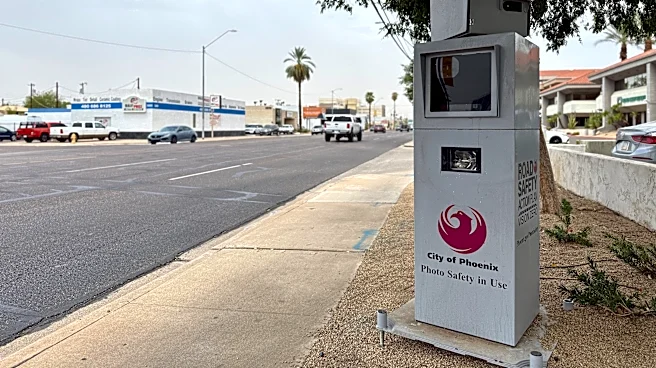
Chandler, Mesa, Paradise Valley and Scottsdale have used photo enforcement programs for years to slow down lead-footed drivers and deter red-light running.
Phoenix and Tempe did as well until they ended their programs in about 2019 and 2011, respectively. Both, however, recently revived their programs.
They brought them back as part of a broader goal called the Vision Zero Initiative, which aims to reduce the number of fatal and serious crashes to zero.
In Phoenix, cameras are currently used to only capture speeding violations, not red-light incidents.
After a camera captures a violation, cities will send drivers a citation in the mail. They can choose to admit responsibility by waiving the right to process service and paying the fine or waive service in order to deny responsibility and request a hearing. As is often the case, they can also ignore the notice and wait for a process server to show up.
Depending on how fast a car is speeding, the driver could face fines ranging between $200 and nearly $500.
Instead of paying the fine, drivers who qualify can attend defensive driving school. Depending on which city you got a ticket from, that could cost between $200 and $223 in fees, and an additional $20 to $70, which is determined by the individual school provider.
Drivers who choose to wait for a process server get a service fee tacked onto the total cost of the ticket if the service is successful.
If police, who review each potential citation, cannot match the captured photo enforcement image to the registered driver, typically by pulling up a driver's license photo, no citation gets mailed.
Instead, police send a violation notice to the address of the registered owner, whether that be an individual, corporation or trust. The entity that receives the notice is asked to identify the driver. No law requires the receiver to comply.
Without a known driver, the ticket can't be served.
What do most people do with their tickets?
One in four drivers who got a ticket in the mail from Chandler, Mesa and Scottsdale paid the fine, according to citation data since fiscal year 2024.
Another 24% of those drivers during the same three-year period attended a defensive driving course to get the cases dropped.
Much of the rest, about 43%, ignored the tickets in the mail and avoided process servers, prompting municipal courts to dismiss the case, the same data showed.
That rate increased to roughly 47%, however, when including data from Paradise Valley. Town officials didn’t share how many drivers paid the citations and how many went through traffic school.
Mesa and Chandler saw lower dismissal rates of about 41% compared to Paradise Valley, which tossed out roughly 55% of its citations over the past three fiscal years.
Phoenix, which began issuing tickets March 25, recorded 16,798 citations paid as of September 30 out of 96,464.
Recent citation data from Tempe, which relaunched its program in June 2025, had similar outcomes.
Since January, it has issued 53,845 citations. Just over a third were dismissed, while nearly a quarter resulted in the driver finishing a defensive driving course.
Only about one in five drivers cited by Tempe pleaded responsible and paid the fine, according to the city. However, Tempe's court data showed 22% of the cases are still pending.
Which city leaders ignored their tickets?
A review of former and current mayors, as well as a handful of sitting councilmembers from the cities that have photo radar cameras, shows that many were caught speeding down roads or blowing through red lights.
Giles, Borowsky and Keating avoided their violations, as did Liepmann before she was elected. Their cases were dropped because the cities were unable to serve them the violations.
Records show that in the last five years, Giles received five citations — three for speeding and two for red light violations. The most recent incident, in February, occurred after he left office.
He recently told The Republic he had paid tickets but "no more or less probably than the average driver," and denied intentionally avoiding the others.
"I've never attempted to avoid responsibility for those, and I'm not aware of any citations that I haven't dealt with appropriately," he said.
As Scottsdale’s mayor, Borowsky was issued one citation from the city in October 2025 after a camera near Thomas and Scottsdale roads snapped her traveling 18 mph over the speed limit, according to authorities.
She denied ever getting the ticket.
According to Paradise Valley Municipal Court, Borowsky received six other citations from the town, all within a two-year period, between April 2022 and April 2024. All occurred before she was elected. Just like her Scottsdale case, the others in Paradise Valley were dismissed over a lack of service.
Keating has been a Tempe councilmember since 2016. He was caught running two red lights in Mesa in April and September of 2024 — roughly a year before his city brought back photo radar cameras — according to court filings.
He told The Republic this week that he didn’t know anything about the tickets.
“I never got a ticket in the mail,” he said. “I never had anyone come to my door, and I have not run a red light, so this is new to me, and I’m surprised to hear it.”
Before Liepmann got elected, a Paradise Valley camera recorded her running a red light in April 2023, according to the municipal court. Records showed that the case was dismissed, also because the town was unable to serve her the violation.
Liepmann couldn’t be reached for comment on Oct. 20 by phone or email.
Which elected officials opted for traffic school?
Since taking office, Liepmann was snapped by another one of the town’s cameras last October, this time for speeding. She took a defensive driving course to get the latest case tossed.
Most other officials who got tickets did the same, municipal court records show.
That includes Scottsdale Councilmember Jan Dubauskas, along with Paradise Valley leaders like Mayor Mark Stanton and Councilmember Julie Pace.
Taking defensive driving school dismisses the civil traffic case, though it comes with a cost and drivers cannot have attended the school in the prior 12 months.
State law requires drivers convicted of running a red light to take traffic survival school, which requires a live, eight-hour online or in-person class. Cities, however, typically allow eligible drivers to skip conviction with the defensive driving school.
Dubauskas opted for traffic school after a Scottsdale camera caught her traveling between 10 and 15 mph over the speed limit in February.
Stanton, then a councilmember, was nearly a month away from winning the town’s 2024 mayoral race when he was photographed speeding in Paradise Valley. He got the case dismissed by taking a defensive driving course.
A couple of other officials, Councilmember Jane Poston of Chandler and Councilmember Scott Moore of Paradise Valley, also got photo radar tickets.
Poston got one in Tempe in January, but it was dismissed by the state, according to court records.
Similarly, Moore got a ticket while driving through Scottsdale in June 2025, but the court dismissed it.
How do cities track down drivers who ignore tickets?
Under Arizona law, a city has 90 days from when a citation is filed in court to formally serve the driver who didn’t respond to the violation notice that was initially mailed.
If the server doesn't show up, or the driver, or someone who lives at the driver's home, can't be served, the ticket will be dismissed.
The vendor contracts shared by Phoenix and Scottsdale state that process service is necessary to make photo enforcement work, and that "effective process service is a critical aspect" of the cities' safety goal.
The cities’ vendors for the photo radar cameras will task process servers to track down the driver, typically at their home, and personally present them with the civil citation.
Process servers video-record their encounters in case they’re challenged. State law allows the tickets to be served to anyone roughly the age of 13 or over who lives in the driver's home.
Generally, the process servers get paid on a per-service basis when they’ve successfully handed the driver the ticket.
Drivers who were served the citations and choose to either pay the fine or go to traffic school must also pay a process service fee to the city, which collects the money on behalf of the vendor.
Verra Mobility, based in Mesa, is the photo enforcement company for Phoenix, Tempe and Scottsdale. Verra Mobility, in turn, partners with the process-serving company AAA Photo Safety.
The process service fee that must be paid by drivers who are served successfully is $48 for service in Maricopa County and $67 for service in other Arizona counties.
No one gets served the tickets outside of Arizona.
The vendor pays the process servers with those collected fees.
Paradise Valley paid an annual average of $125,478 for process servers between fiscal years 2022 and 2025.
In Mesa, those costs were much higher. On average over the same period, it paid roughly $459,161.
If the process server is unsuccessful, city prosecutors could seek “alternative service,” such as letting a process server tape the violation notice to the driver’s front door. Such instances are rare, though, and require a municipal court’s approval.
How much money do Valley cities collect from photo radar tickets?
Mesa, Scottsdale and Paradise Valley each collect an average of nearly $3 million annually from traffic camera violations, financial records showed.
Chandler’s program, however, collects far less, as it receives a yearly average of $922,000, according to the city.
“The program is designed with a focus on safety and aims to be as revenue‐neutral as possible,” Chandler spokesperson Matthew Burdick said.
Much of the communities’ dollars go toward their respective programs’ annual expenses, such as vendor costs, equipment maintenance, process servers, and police and court operations.
What’s leftover, which greatly varies by city, is generally reinvested into other traffic-safety improvements.
“In recent years, those investments have included pedestrian and bicycle safety improvements, enhanced mid-block crossings, traffic signal upgrades, school-zone safety improvements and traffic-calming projects,” Mesa spokesperson Casey Blake stated.
On average, Mesa ends up with just over $1 million in annual revenue for safety programs after spending about $1.9 million on expenses.
For Scottsdale, it spends nearly $1.2 million a year on its photo enforcement program, leaving it with about $1.7 million leftover.
Paid tickets in Phoenix tallied up to $4.2 million over the program's first six months, but after the money was divvied up, including court fees and payments to Verra Mobility, the city had about $850,000 leftover to pay for the program's staffing and administrative costs in the city.
And in Chandler, the city typically has tens of thousands of dollars in remaining cash, though that has fluctuated wildly in recent years. While the city had $271,775 after covering expenses in fiscal year 2023, it ended fiscal year 2025 in a $6,852 hole.
Republic Reporter Stacey Barchenger contributed to this report.
Like this story? Get more East Valley news straight into your email inbox by signing up for our free weekly East Valley Newsletter, which comes out Wednesdays.
Shawn Raymundo covers Scottsdale and Maricopa County. Reach him at sraymundo@gannett.com or follow him on X @ShawnzyTsunami.
Reach Phoenix Reporter Ray Stern at rstern@arizonarepublic.com or 480-276-3237. Follow him on X @raystern.
This article originally appeared on Arizona Republic: Arizona leaders caught on photo radar skipped paying fines | Exclusive