


Arizona investigators identified a suspect in a 39-year-old cold case involving a Glendale man found slain in a cemetery.
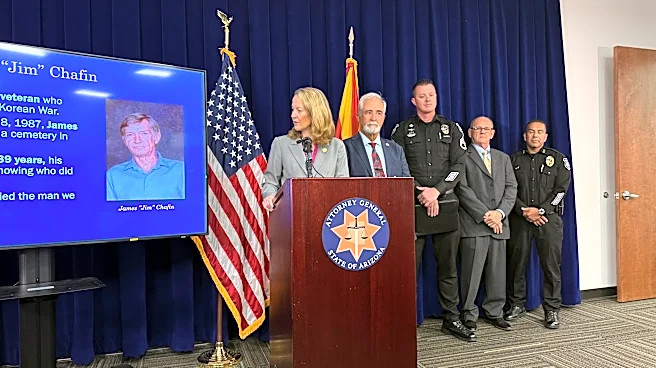
The suspect in the 1987 killing of 54-year-old Orison "Jim" Chafin won't see his day in court. The suspect killed himself after investigators got a DNA sample from him that later connected him to Chafin's death, Attorney General Kris Mayes said on Sept. 15.
Mayes identified the suspect as Gary Billups, 68, of Wittmann.
“I want to be clear about what this means and what it doesn’t mean," Mayes said. "Because the suspect is deceased, there will be no trial. No one will be held to account in a courtroom for what was done to Jim Chafin. I understand that is not the ending anyone would choose. But for the first time in 39 years,
we can be reasonably certain about what happened to Jim Chafin."
Roger Geisler, a former Glendale police detective who worked the case and now leads the cold case unit Mayes launched in early 2025, outlined the evidence against Billups. He said Chafin and three others, including Billups, had been at a nearby bar and arguing in the hours before Chafin was found dead on Aug. 8, 1987.
Several young adults found Chafin's body early in the morning at Resthaven Park Cemetery at Northern Avenue and 63rd Avenue, after seeing another vehicle flee the cemetery. Police were called and found Chafin wearing only socks and with his neck cut.
At the time of the killing, police identified and interviewed two others who were also at bar that night: brothers Willie and Kenneth Mayfield, according to Geisler. Investigators tried to speak to Billups at the time but he could not be located, Geisler said.
But this year, the Attorney General's Office reopened the case and learned investigators were not able to speak to Billups almost four decades ago, though they knew from witness accounts that he'd been at the bar with Chafin.

Geisler said Billups was interviewed this year and claimed he did not live in Glendale at the time of Chafin's death and said he didn't know what investigators were asking about. But Billups agreed to give a DNA sample in June that was a match to DNA found on beer bottles and cigarette butts found near Chafin's body in the cemetery, Geisler said.
In a suicide note, a copy of which was provided by Mayes' office, Billups wrote in cursive, "I did no wrong doing." He also wrote he "can't handle this ordeal, as I don't have anything to save my ass. No paper no memory."
The Mayfields were considered witnesses and have both died, cutting short further investigation, according to Mayes' office.
“We have 3 people there that could be responsible, OK, but based on Mr. Billups' behaviors, his interviews, and note, it’s believed that he took his own life based on what he knew we were investigating," Geisler said.
The latter comment convinced Mayes' investigators that Billups was responsible and "the killer," Mayes and her top deputies confirmed. Criminal Division Chief Nick Klingerman said there was enough evidence to charge Billups with murder, but not enough evidence to charge the Mayfields because DNA results could not distinguish which brother was at the cemetery. Klingerman said that prior to Chafin's murder, Billups had pulled a knife on a police officer, an incident that showed he had access to a weapon.
"When you have a case that is four decades old, there will still be mysteries surrounding it," Mayes said. "All questions will not be answered, but we believe we have enough to lay this blame at Billups’ feet and to tell the public about who else was present."
Billups' family could not be reached for comment.
Chafin was a Navy veteran who lived alone in Glendale.
His nephew, Frank Montgomery of Delaware, welcomed a bit of closure related to his uncle's death. Montgomery was 15 when Chafin was killed, and Montgomery remembered summer visits to Arizona and backyard parties with Chafin and Montgomery's grandparents who also lived nearby.
But Chafin's death, and that no suspect was ever named, grated on Chafin's mother, according to Montgomery.
"My grandmother was devastated, it was horrible," he recalled. She died several years after Chafin, in the early 1990s.
"My grandmother would be so happy" and at peace knowing a suspect had been identified after so many years, Montgomery said. He credited police work and their diligence for giving his family members peace of mind.
"Not enough credit goes to things like this," he said.
"It's really good to know that there's closure to it," he added.
Mental health resources in Arizona
Are you or a friend or loved one experiencing a mental health crisis? How to get help:
Call 9-8-8, which replaced the National Suicide Prevention Lifeline. Callers do not need to be suicidal to get help from 988. Individuals can dial 988 and select options. For example, hit 1 to transfer to a crisis line for veterans or hit 2 for Spanish language.
There's a statewide mental health crisis line available at 844-534-HOPE (4673). Trained crisis specialists are available 24/7, every day. Assistance is also available around the clock via text by texting “hope” to 4HOPE (44673).
Reach reporter Stacey Barchenger at stacey.barchenger@arizonarepublic.com or 480-416-5669.
Have a news tip? Contact The Arizona Republic and azcentral.com at newstips@arizonarepublic.com.
This article originally appeared on Arizona Republic: Arizona cold case homicide from 1987 finally has suspect identified