






Lea la historia en español
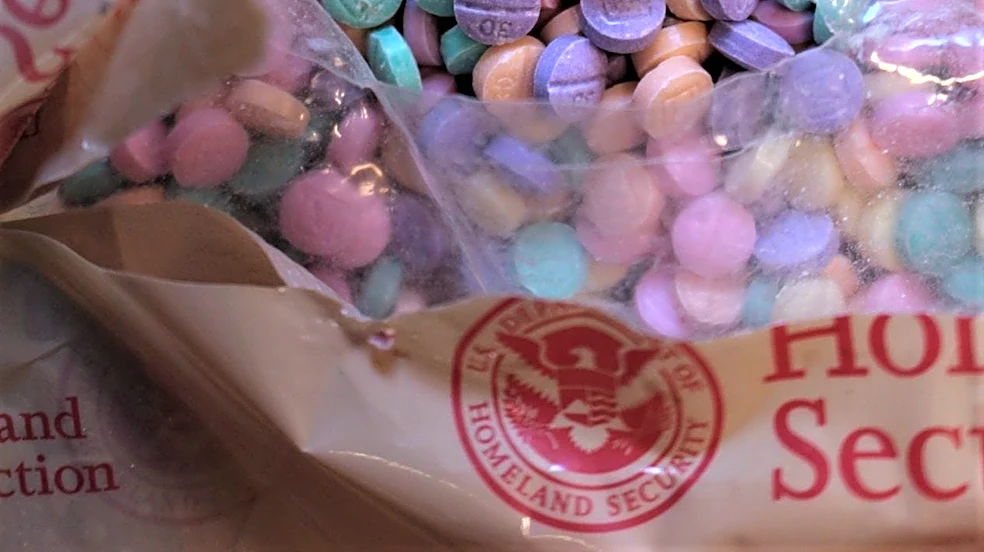
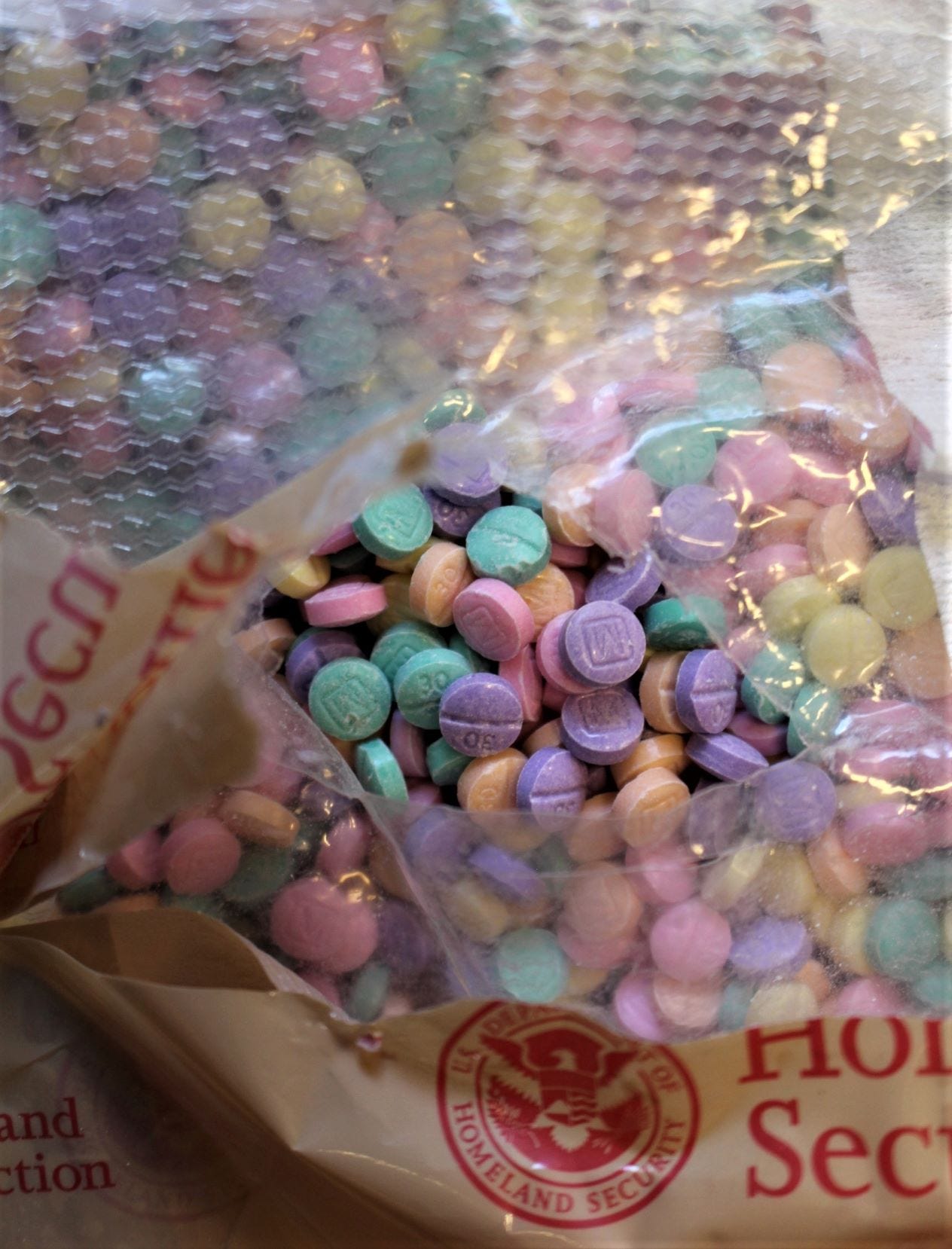
It looks like candy. They call it rainbow. But it kills for what it is: fentanyl, a synthetic opioid up to 50 times more potent than heroin and 100 times stronger than morphine.
“Rainbow fentanyl” is not an urban legend or a seasonal scare tactic. It is a reality that federal authorities have traced back to Arizona, the same state where a woman claims she came up with the idea behind its creation and where, according to a recent investigation, another Arizona resident operated the core of a nationwide distribution network linked to the death of a teenage girl.
The U.S. Drug Enforcement Administration (DEA) has already warned the public about this form of fentanyl, which is being sold in brightly colored pills. The combination
is particularly troubling: the more eye-catching the pill, the easier it may be for it to end up in the wrong hands.
With Halloween just around the corner, fears are growing. Health officials are urging parents to closely inspect the candy their children collect this year amid concerns that “rainbow fentanyl” could appear among Halloween treats.
Although it may resemble a typical Halloween candy, this visually appealing version of the powerful and deadly drug closely resembles Sweet Tarts candy.
The Arizona woman behind a stunning 'Rainbow Fentanyl' claim
Arizona has its own Queen of the South: Amanda Rachelle Miller, the woman who claims she conceived the idea of “rainbow fentanyl.”
Ironically, it was that very nickname, which she used on social media, that an undercover agent used to make contact with her, allowing investigators to identify her network in southern Arizona.
Federal authorities have kept a relatively low profile regarding Rachelle Miller. Even her mugshot has not been publicly released in the statements reviewed for this story.
The Department of Justice identifies her as a Tucson resident and a U.S. citizen, but it does not specify her place of birth.
At age 35, her name became tied to a federal drug trafficking investigation that ultimately ended with a 17-year prison sentence.
Her legal troubles began in late 2020, when federal agents were investigating drug distribution activity at several motels in the Tucson area.
On Nov. 12, 2020, during an operation at a downtown Tucson motel, agents arrested her as she attempted to flee the scene.
Inside one of the rooms, authorities found suspected methamphetamine, heroin and fentanyl, along with more than $25,000 in cash, a digital scale and vacuum-sealing equipment.
She was formally charged on Dec. 1, 2021. After being released pending trial, she fled to Mexico.
She took refuge in Culiacán, Sinaloa. From there, according to federal prosecutors in Arizona, she continued for more than three years to oversee an organization distributing fentanyl, methamphetamine and other drugs across southern Arizona.
Inside the undercover investigation of the ‘Queen of the South’
While a fugitive, Miller used the social media alias “Reina Sur,” translated by authorities as “Queen of the South.”
In late September 2021, an undercover agent posing as a wholesale drug buyer established contact with her through social media.
During their conversations, Miller told the purported buyer that she had a direct connection to the Sinaloa Cartel, according to court documents cited by federal prosecutors in Arizona.
In the months that followed, those communications helped investigators identify drug trafficking operations that prosecutors say Miller coordinated through other members of her organization in southern Arizona.
Rainbow fentanyl, an idea, a network and deaths
According to federal prosecutors in Arizona, Amanda Rachelle Miller claimed she came up with the idea of marketing colored fentanyl to boost declining sales for the Sinaloa Cartel. The DEA has described the tactic as one aimed at children and young people.
From Mexico, according to the Department of Justice, she supervised couriers, organized bulk drug deliveries and managed cross-border money laundering operations.
Federal prosecutors attribute that statement about colored fentanyl to Rachelle Miller, but they do not state that she was the original creator of rainbow fentanyl itself.
The 'Queen of the South', captured in Mexico, sentenced to 17 years in Arizona
Miller was arrested in Culiacán, Sinaloa, and deported to the United States on May 30, 2024, to face three federal indictments.
On Sept. 22, 2026, U.S. District Judge Raner C. Collins sentenced Amanda Rachelle Miller, 35, of Tucson, to 204 months (17 years) in prison, followed by 36 months of supervised release, for leading a large-scale drug trafficking organization that distributed fentanyl, methamphetamine and other dangerous drugs throughout Arizona.
Miller was also ordered to pay a $25,000 fine, $25,000 in community restitution and a $400 special assessment.
Another Arizona fentanyl case ends with a teen's death
Miller's case is not the only recent federal prosecution demonstrating Arizona's role as a source of fentanyl distributed beyond the state. In a separate case, prosecutors identified Pamela Esquivias, of Maricopa, as a supplier of hundreds of thousands of counterfeit M-30 fentanyl pills distributed from Arizona to multiple states.
Pamela Esquivias, 25, of Maricopa, Arizona, known as “Azalea,” pleaded guilty to conspiracy to possess fentanyl with intent to distribute. On Sept. 17 of this year, she was sentenced to 262 months in federal prison.
Esquivias was prosecuted as part of the federal investigation that followed the death of a 16-year-old girl from Flower Mound who ingested counterfeit oxycodone laced with fentanyl in August 2023.
According to the police investigation, Esquivias was identified as a source of supply, distributing hundreds of thousands of blue fentanyl pills, commonly known as M-30s, from Arizona to several states across the country.
The most recent deadly chain of events, which culminated last month, is linked to that nationwide distribution structure headquartered in Arizona.
Why Rainbow Fentanyl raises Halloween fears
The U.S. Drug Enforcement Administration (DEA) has warned the public about this form of fentanyl sold in brightly colored pills that resemble Sweet Tarts candy. Fentanyl is a synthetic opioid approximately 50 times more potent than heroin and about 100 times more potent than morphine.
As Halloween approaches, the brightly colored pills may revive concerns among parents because some versions can resemble candy. But the DEA's warning about “rainbow fentanyl” focused on the appearance and marketing of the pills, not on evidence that traffickers were placing fentanyl in children's trick-or-treat candy.
This article originally appeared on Arizona Republic: 'Rainbow Fentanyl': How an Arizona woman’s idea became a deadly threat