






After Charlie Kirk was killed by an assassin's bullet, his supporters hoped it would usher in a new era of Republican support from the public.
A year later, Arizona Democrats and independents are betting on the opposite.
Candidates are invoking the Turning Point brand on the campaign trail this election season in the belief that the Phoenix-based conservative network that Kirk help found and led is both so well-known and so politically toxic that it will motivate Democrats, independents and even moderate Republicans to go to the polls to vote against its priorities and endorsed candidates.
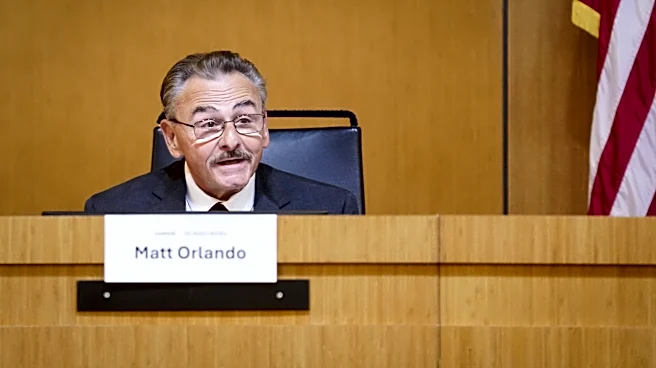
”Hyperpartisanship does not belong in our local government. It's a detractor,” said Chandler Mayor-elect Matt Orlando, an independent who turned his race into
a referendum on Turning Point in July. “I think that's what people are trying to say: Stay out of the local politics.”
It’s a shift from the first days after Kirk was assassinated. Candidates are more emboldened to criticize Turning Point now than they were last fall, and voters don't seem to mind.
Kirk was shot and killed on the Utah Valley University campus on Sept. 10, 2025. The nationwide reaction made voters more aware of Turning Point USA, the network of conservative groups Kirk co-founded as a teenager and built it into a MAGA powerhouse.
“What happened to Charlie introduced Turning Point to a lot of people who hadn't heard of us before,” Turning Point spokesperson Andrew Kolvet said. “Whether or not they have the right impression of us or fully understand us, I think it is the challenge.”
At a time when President Donald Trump's public approval ratings have never been lower, Turning Point is synonymous with him, veteran Arizona Republican consultant Doug Cole said.
Cole pointed to Kirk’s high-profile public memorial service that packed the NFL football stadium in Glendale last fall.
“Just go look to see who showed up this time last year at State Farm Stadium for the memorial service. It was the president. It was the vice president. It was most of the Cabinet. It was, you know, everything in MAGA world,” said Cole, chief operating officer at HighGround Public Affairs Consultants. “They are joined at the hip.”
Turning Point turned off voters in utility race
Candidates tied to Turning Point have lost in races such as Orlando's this election season.
The most prominent example was the Salt River Project, an ordinarily sleepy utility contest that turned unusually partisan after Turning Point got involved. The race pitted Turning Point against a group of climate activists.
The group’s brand became a lightning rod leading up to the April 7 SRP election. It spent large amounts of money on advertising, door-knockers, and other get-out-the-vote initiatives. The group put together a detailed, data-based strategy designed to identify the neighborhoods where their involvement would make the most impact, planning documents show.
The effort backfired. Turnout in the election increased fourfold, and the new voters favored the clean energy slate.
The climate activists doubled their representation on its advisory councils and, for the first time in utility history, flipped control of the power board.
Turning Point backed moderates in the race, Kolvet said in an interview. But some voters didn’t react that way.
Barry Paceley, the vice presidential candidate who was backed by Turning Point, said the group’s endorsement created “apologetics” for him on the campaign trail. He grew accustomed to explaining to supporters that he wasn’t taking the group’s money, and they weren’t taking his, he told The Arizona Republic in an interview days before the election.
Paceley questioned the decision to put Turning Point’s recognizable, arrow-shaped logo at the top of road signs that promoted him and other candidates.
“Maybe down at the bottom, but not right on top,” he said.
Turning Point leaders framed the outcome as a win, then retreated from the effort. When a seat on the utility board opened up in July, Turning Point was not publicly involved in the majority-making effort to select a replacement. The group did not return requests for comment on the subject.
Arizona candidates tap anti-Turning Point energy

Orlando was the next candidate to take on Turning Point at the ballot box.
The incoming Chandler mayor framed his nonpartisan race against Republican state Rep. Jeff Weninger as a way for voters to “Stop Turning Point.”
In an interview, Orlando said voters are tired of partisan groups on both sides getting involved in local politics. He estimated that a quarter of voters who pulled GOP primary ballots cast their votes for him over his Republican opponent.
“I got several emails from Republican constituents, I even know, that told me that they were just frustrated with the hyperpartisanship,” Orlando said. “I had Democrats say that, independents say that to me as well. They're tired of it.”
Turning Point’s spokesperson took the criticism in stride.
“He can paint whoever he wants as the bogeyman if he so chooses,” Kolvet said. “I just take it all as a compliment to the Turning Point brand. That we mean something, we stand for something. I guess we'll take it as a backhanded compliment.”
Now, Democrats in a Phoenix-Paradise Valley legislative district are hoping to replicate the strategy. Supporters of Democrats Tammy Caputi and Karen Gresham, who are running for the Arizona Legislature in swingy Legislative District 4, are attacking incumbent Republican state Reps. Matt Gress and Pamela Carter over their Turning Point endorsements.
“They talk about Turning Point’s endorsement of their candidates all the freaking time,” Cole said.
The “Legislative District 4 Democrats” have issued dire warnings about Gress and Carter on social media, telling voters to “beware” and highlighting claims that "Turning Point is trying to control the Republican Party.”
Not everyone believes it will work. Republican pollster Landon Wall, who conducts surveys for Gress, threw cold water on the idea that the attacks will make the difference in the Nov. 3 election.
“Matt is clearly not extreme. He has done so much to cross the aisle that it’s really hard to stick that label to him,” said Wall, who is the founder of the firm GrayHouse and previously served as Republican former news anchor Kari Lake’s pollster.
Some local Republicans are feeling a Turning Point drag, too. They are more willing than ever to criticize Turning Point in public, something that’s been seen for years as a sure way to get blacklisted from GOP politics in Arizona.
With little left to lose, outgoing swing congressional district U.S. Rep. David Schweikert, R-Arizona, slammed Turning Point in an April interview. He said the organization supports “unelectable” candidates and has turned the GOP into “the fringe of the fringe of the fringe movement.”
“They’ve wiped out the conservatives over and over and over," Schweikert said. He lost his GOP primary bid for governor by a landslide a few months later.
Turning Point backed U.S. Rep. Andy Biggs, R-Arizona, in his successful gubernatorial primary election. Now, Biggs is trailing incumbent Democratic Gov. Katie Hobbs in statewide polls.
Turning Point a factor in New Hampshire, Iowa
Candidates are campaigning against Turning Point in other states, too.
In red Iowa, where Democrats are trying to pull off their first gubernatorial win since 2006, candidate Rob Sand wasn’t afraid to throw some shade at Turning Point activists.
Sand has been careful not to alienate Republicans, but he told his supporters not to “behave like the kids from Turning Point USA” after members of the group chased him around the Iowa State Fair.
And a Democrat running for Congress in New Hampshire, where Turning Point established a foothold this year, even put advertising dollars behind an anti-Turning Point fundraising plea on Facebook.
“We have learned our Republican opponent who is self-funding his race is being endorsed by Turning Point USA,” Stefany Shaheen said in a direct-to-camera video. “We hope you can step up and help us.”
Stephanie Murray covers national politics and the Trump administration for The Arizona Republic and azcentral.com. She co-hosts “The Gaggle,” The Republic’s weekly politics podcast. Reach her at stephanie.murray@usatodayco.com, on X and TikTok @stephanie_murr and on Instagram @stephaniemurray.news.
Laura Gersony covers politics for The Arizona Republic and azcentral.com. Reach her at laura.gersony@usatodayco.com or on X at @lauragersony.
This article originally appeared on Arizona Republic: Campaigns test new anti-Turning Point strategy 1 year after Kirk death