
At the end of May, Y.J. returned to Havana to visit her 25-year-old son.
The visit turned out to be an eight-week-long ordeal living without fuel, electricity or running water and a scarcity of food and medicine
amid a deepening economic and humanitarian crisis taking place just 90 miles off the coast of Florida.
"The conditions were terrible," Y.J. said sitting in a Phoenix church shortly after returning from her trip. "You have to see it to believe it."
The 50-year-old Phoenix resident originally from Cuba asked that The Arizona Republic identify her only by her initials. She fears her comments could put her son in Cuba in danger of retribution by the Cuban government at a highly sensitive time. Under the failures of Cuba's closed, authoritarian and repressive Communist government, the Cuban people have been living through a severe economic and humanitarian crisis for years, experts say.
But the crisis has accelerated rapidly as the Trump administration strangles the country with an oil blockade and economic sanctions aimed at forcing a political change in Cuba more favorable to the United States after nearly seven decades of Communist Party rule. There is active speculation that the United States could take military action to try to achieve that goal.
The worst economic and humanitarian crisis in Cuba in decades is "first and foremost" the fault of "the flawed failed policies of the Cuban regime that has always been unwilling to embark on economic reform like the Chinese and the Vietnamese," said Frank Mora, professor of politics and international relations at Florida International University.
The deepening crisis also is the fault of a theory under U.S. policy "that somehow, if you squeeze, and squeeze, and squeeze and squeeze that somehow the Cuban regime will collapse, that the Cuban regime will cry uncle and ultimately see the end of the revolution," Mora said.
"I am saddened by the total disregard that both the Cuban government, which I shouldn't be surprised because the Cuban government never ever really cared about the Cuban people, but also that somehow the United States is contributing to this humanitarian disaster that we're seeing in the country, which I find reprehensible."
Havana swelters because of electricity failures, no running water
Y.J. said the conditions she found in Cuba were far worse than when she last visited in December 2024.
She said people are living in Havana without electricity for 24 hours to 36 hours at a time because the power grid has failed and there is no gas to run generators, Y.J. said.
At one point, she went three days without electricity.
When the electricity did come on it only ran for two to three hours, she said. People never know when the electricity will work. The electricity usually only runs during the day, she said. It rarely came on at night. So at night, darkness enveloped the city, she said.
Without electricity, there is no air-conditioning or fans to cool homes from the sweltering tropical heat, Y.J. said.
The suffering of not having electricity is immense, Y.J said.
"Imagine spending an entire night without electricity in Cuba in the 100-plus-degree tropical heat and see a small child sleeping on the doorstep of their house because of the heat inside that house," she said.
People cook with charcoal because there is no fuel, she said.
While visiting her son, she said they went for a month without running water. There's no running water because the city's water pumps aren't working without electricity, Y.J. said.
Water-tanker trucks come by every so often selling water, Y.J said. People pay $4,000 Cuban pesos to fill a 1,000-liter tank, Y.J. said. A dollar is worth about $660 pesos, she said. That translates to about $6, which is nearly half of what the average Cuban earns in a month, she said.
Most people don't have internet in their homes, Y.J. said. To connect to the weak government-restricted signal, she had to climb on top of her roof with her phone. But the internet only worked when the electricity was running, she said. The blackouts made it difficult to charge her phone, she said.
'In Cuba, everything has collapsed,' Phoenix woman says
The streets are nearly empty, Y.J. said.
"In Cuba, everything has collapsed," Y.J. said. "There's no transportation. There's no oil, there's no gasoline, so there's no transportation."
A video she shared showed people only getting around on food, bikes or pedal carts, and an occasional car or motorcycle.
Many people aren't working because they don't have transportation. Her son teaches literature at the University of Havana. But he has been staying home because of the blackouts and transportation is shut down, Y.J. said.
School in Cuba usually starts in September after summer vacation in July and August, she said. But the government postponed the start until November because there isn't electricity, she said.
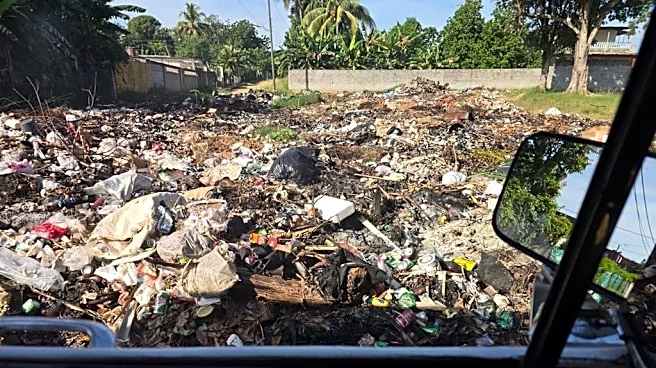
Y.J. said she saw mountains of trash everywhere because the garbage trucks aren't running without fuel. A video showed piles of trash lining one side of the streets for blocks. Another video showed a mountain of garbage piled high inside a vacant building.
People are getting sick from disease spread by insects eating the trash, she said. The pharmacies and hospitals have run out of many types of medicine, she said.
"That's why there is so much dengue fever. There are so many diseases, there are so many viruses that we don't even know what it is, that people die because they don't have treatment, they don't have a medication," Y.J. said.
Who is to blame for the dire conditions in Cuba?
Most people also can't afford to buy food, Y.J. said. A carton of 30 eggs costs $6,000 pesos, more than many Cubans earn in a month, she said.
Some people are surviving eating only fruit that is plentiful in Cuba, Y.J. said.
"People practically don't eat. There are people who eat only once a day," Y.J. said. "Cuba is a country where there is a lot of fruit and generally all people have fruit planted in their yard. But if not, they starve to death because they have nowhere to get food. Rice, beans, everything is getting more expensive every day."
Y.J. said she was able to buy food at stores because she traveled to Cuba with American dollars. Many Cubans survive on remittances sent to them from relatives in the U.S. But U.S. sanctions have made it impossible to wire money to relatives to Cuba.
So people in the United States are paying people traveling to Cuba to hand deliver dollars to relatives in Cuba, Y.J. said.
Y.J. blames the Cuban government for the misery and suffering she saw the Cuban people experiencing. People in power in Cuba remain insulated from the fuel shortages and blackouts, she said.
She said most people she spoke to in Cuba want the U.S. government to "liberate" the country from Communist rule, but "not with bombs."
"I would not want to see them drop bombs in Cuba," Y.J. said. "If a bomb drops there, Cuba will completely disappear, right? I don't know what others say but I’d prefer a different approach. For example, that the president himself hands over power because he just can't manage anymore, since the country is ruined and he's reached his limit. The way I see it, I really think he should step down."
Will US pressure campaign on Cuba work? Scholar doesn't believe so
Mora, the Florida International University professor, does not see the Cuban regime collapsing anytime soon despite the Trump administration's pressure campaign.
The Cuban leadership remains united, and the Cuban people are just trying to survive under the economic and humanitarian crises accelerated by the Trump administration's oil blockade and economic sanctions, said Mora, who served as the U.S. ambassador to the Organization of American States during the Biden administration.
"They don't have enough time, if you will, to conspire, to organize. There's not the conditions to do so. And the regime, as of the moment, remains pretty united and cohesive and unwilling to even give an inch of what the United States want," Mora said.
In the meantime, the Trump administration is escalating the pressure on Cuba in the hope that the next set of pressures "will be enough to push the regime off the cliff," Mora said. "I don't see either any evidence of that at the moment nor any historical empirical example that would confirm that theory."
The Cuban people have an expectation that the United States will "come in and solve the problem" possibly through military action, Mora said.
"So in some ways it's a disincentive" for the Cuban people to rising up in protest against the Cuban government and risk being jailed or killed under the repressive Cuban regime, Mora said.
"It is really risking your life because you could lose your life or go to jail for 15 years for just about anything in Cuba. Why am I going to do that, if the Americans are going to come and save the day?" Mora said.
At the same time, the Trump administration has blocked Cuban migrants from entering the United States, where for decades they have been allowed to seek permanent residency under the 1966 Cuban Adjustment Act.
Under the Trump administration's stricter border policies, Cuban migrants who arrive at the southern border are being detained, and jailed, said Delia Salvatierra, a Phoenix immigration lawyer. They are being "forced to fight their case from inside detention" rather than be released, she said.
"The focus of President Trump enforcement action on immigration is to stop all immigration, legal and illegal and so the Cubans would fall into the category of illegal despite the fact that Cubans have always been welcome to come to the United States" under the Cuban Adjustment Act, Salvatierra said.
From October through July, just 925 Cubans were encountered by the Border Patrol along the southern border, according to U.S. Customs and Border Protection data. In comparison, more than 150,000 Cubans were encountered in fiscal year 2024 during the final year of the Biden administration.
The Trump administration has deported thousands of Cubans to third countries, including Mexico and countries in Africa, "which only accentuates the suffering of the Cuban people," Mora said.
Meanwhile, tourists, which have helped prop up Cuba's economy in the past, have stopped traveling to Cuba because of the fuel shortages and blackouts in Cuba, said Y.J., the Phoenix resident who visited this summer.
Tourists "are afraid of the ongoing crisis and all the viruses going around," Y.J. said. "On top of that, they don't have transportation, and without it, they can't travel around. That’s exactly why there are no tourists."
This article originally appeared on Arizona Republic: Phoenix woman returns to Cuba and finds misery during US oil blockade | Exclusive