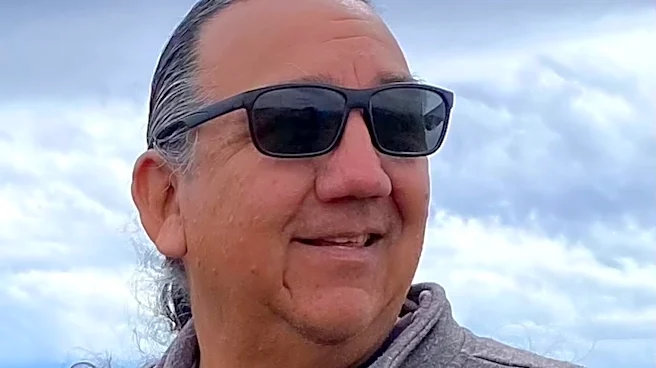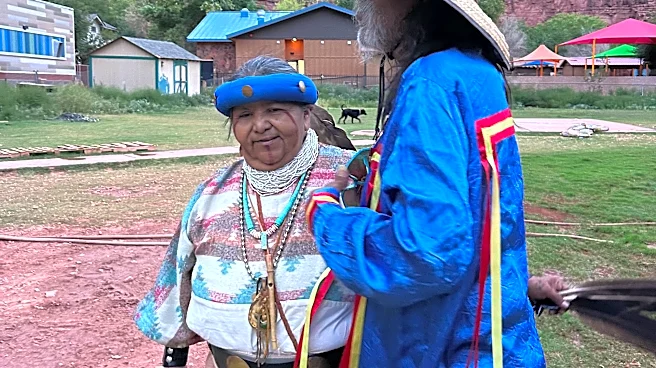





Ivan Bender, an elder and a member of the Hualapai Tribe, set out on a long and meaningful walk on Sept. 7 from Cholla Canyon in Wikieup. Over the course of a little more than a month, he will travel about 1,200 miles, visiting tribal communities along the way to listen to their experiences and raise awareness about the growing presence of companies extracting resources from Indigenous lands.
His journey seeks to highlight tribes' concerns that such activities will deplete natural resources while putting water, land and communities at risk, all in pursuit of profit or jobs. Those concerns are particularly personal for Bender, as his own tribe is fighting a proposed lithium mining project near its tribal lands, a mine that threatens the sacred
hot spring Ha'Kamwe' and the Hualapai Tribe-owned Cholla Canyon Ranch, where the hot spring is located.
The project involves an Australian-based mining company and the Navajo Nation’s own entity, Navajo Transition Energy Company.
"I believe in coming together as a people to voice our opinions on what’s happening to our land — especially Native lands that they’re starting to take, and destroying the water" Bender told The Arizona Republic. "We need to stand up and voice our opinion as a people...to unite. The most important thing about all this is about water, the land and the children."
The group had left Payson and was nearing Fort McDowell by the time The Republic spoke with Bender and DJ Portugal, an organizer with Protectors of Ha'Kamwe' and organizing director at Chispa AZ. From there, they planned to travel through Lehi and Superior before continuing on to Oak Flat, a site sacred to tribes where a mining company is preparing to extract copper.
The day before, the walkers received a send-off from the Yavapai-Apache Nation in Camp Verde, where the tribe provided lodging for the small group at its hotel. Bender is accompanied by his nephew, Ahmad Warbington, and another walker, 79-year-old Jose Cortez.
A small group with a huge message

Bender said he's never done a walk like this before, and described it as being "just like life. It's a struggle."
Portugal said Bender, who is the leader of the Protectors of Ha'Kamwe', wanted to do a prayer run in a traditional Indigenous way of connecting with different communities. They walked from Wikieup to Kingman, then down Route 66 to Peach Springs. From there, they went into the Grand Canyon and through Havasupai lands.
"The purpose of the run was to travel through our neighboring Indigenous communities, hear what they’re fighting for, and share what we’re fighting for as well," Portugal said. "We wanted to share the different ways we’re doing that work and why we’re doing it — to build solidarity among our communities."
Across Arizona, as well as neighboring states, tribes have found themselves defending their sovereignty and homelands amid actions by the Trump administration that tribal leaders and advocates say undermine tribal sovereignty and threaten Indigenous lands.
Those concerns include efforts that make it easier for corporations to pursue coal, uranium, copper, oil and gas, that reduce buffer zones around Chaco Canyon, and an order that revoked protections for Bears Ears National Monument meant to limit development, among other things. Farther south, tribes are alarmed at the construction of a border wall segment through Tohono O'odham tribal lands.
"(Ivan) says he's seeing as if the knob has been turned up — the stakes have gotten higher, and the timeline is faster and everything's more drastic," said Portugal of the administration's impact on tribes trying to protect their lands. "He says as much as we try to hold on and make this fight consistent, it does feel more dire now, because all of our relatives are seeing their lands being under attack."
Looking for patterns in both the impacts of these projects and in how communities persevere, and how to hold on to their ways of life is what Protectors of Ha'Kamwe' is interested in. They visited with Havasupai elders, who shared their fight against Energy Fuel's Pinyon Plain uranium mine. The next major project the group planned to visit was the Oak Flat copper mine site, where people have been resisting Resolution Copper.
"The pattern here is that these mining projects destroy the land, and in the process they also waste and pollute the water," said Portugal. "Mining is a very water intensive process. Water is not a resource that we can use so haphazardly. We see it as being crucial to our way of life. Not just in our day to day, but even in out ceremonial ways, its not just important to us humans but also to the plants and the animals. We have a responsibility to take care of the land and the water."

Portugal said Bender is keeping his fight rooted in Hualapai spiritual and cultural traditions, while tribal leaders take on the legal battles in court and navigate the political process. Portugal said these battles aren't new, and along the way of this journey they have stopped at various tribal communities to hear what they are up against.
"We have to think about our children," Bender said. "We need to wake up and stand up to what we have done and see if we can correct it. One way or another, how can we correct it? I believe we can bring people together and somehow be able to say something that, at least, somebody somewhere will share what we’re doing, and it would open the eyes of the politicians or whoever is responsible. That’s the most important part that I believe: that we need to come together that way.”
Bender encourages anyone to join them in whatever way they can. He said it can be through prayer, through a song, a visit, any type of support would help and be appreciated. He also hopes that people can take the time to walk with them, even if it's for a short distance.
"Come walk a mile with us, or take a couple of steps and go home, but you're always welcome to come back," said Bender. "We're not asking for you to commit yourself to the entire walk. Come as you are."
Lithium mining project could grow
The small but mighty group calls themselves the Protectors of Ha'Kamwe', using the Hualapai name for what is known as Cofer Hot Spring in Wikieup, northwest of Phoenix. The proposed open-pit lithium mining operation, the Big Sandy Lithium Project, was being pursued by the Australian-owned company Arizona Lithium, formerly known as Hawkstone Mining.
"The lithium mine could affect the aquifer in the area, which eventually feeds into the Colorado River," Portugal said. "That aquifer also supplies the hot spring, which is considered sacred by many of the tribes in the region."
Bender said Arizona Lithium was able to get the tribal-owned NTEC involved. Recently, the Office of Surface Mining Reclamation and Enforcement approved NTEC's controversial permit application to add approximately 11,526 acres to the Navajo Mine permit area, known as the No Name Permit Area. The application would also allow mining at the Navajo Mine in New Mexico to continue through 2136, with permit renewals occurring in five-year increments. Community members in Burnham have fought against the surface strip coal mine.
"Instead of (Arizona Lithium/ Hawkstone) filling out all the necessary paper work that they needed to do, they went out and found a company called Navajo Transitional Energy Company," Bender said. "To me that is like taking your brother and having him fight his own brother."
Bender said a day or two after they had set out for their journey, he was informed of the site being surveyed by NTEC.
Developers say the Big Sandy Lithium Project could meet 15% demand for lithium in the United States, positioning the Navajo Nation for economic growth and energy independence. Through shallow surface mining, continuous reclamation and new mineral extraction processes, Big Sandy's developers say the proposal promises to produce much-needed lithium for clean energy technologies while minimizing impact to the environment, according to NTEC's website.
"NTEC acquired Arizona Lithium's interest in the Big Sandy Lithium deposit through one of its subsidiaries. AZL is no longer a partner in this project," said Andy Hawkins, NTEC's community relations senior manager, in an email to The Republic. "The Big Sandy Lithium Project is currently in the exploration stage, which is expected to last several years. During this time, NTEC will evaluate the resource and the project's economic viability."
Hawkins said NTEC is a diversified energy company that includes lithium in its portfolio. NTEC actively works to expand into different projects and assets as part of its long-term strategy.
"This expansion reflects NTEC's commitment to the Navajo Nation and its contribution to national energy independence," Hawkins said. "NTEC is committed to achieving multi-generational energy solutions that ensure the continued prosperity and economic sovereignty of the Navajo Nation and its people, while providing essential power to the entire Southwest and beyond."

NTEC will evaluate the resource and the project's economic viability. As part of that evaluation, NTEC has conducted extensive (and non-invasive) hydrologic survey work across the entire deposit.
"This work confirms and conclusively establishes that there is no risk to the neighboring aquifers or hot springs," Hawkins said. "Although no field activities are taking place at the moment, NTEC is actively preparing to start its own drilling program after taking over responsibility for the project."
NTEC has conducted required studies, including cultural surveys, with all 13 tribal nations connected to the area invited to participate. NTEC says it remains in consultation with government agencies and tribal nations and will continue engaging affected communities as the Big Sandy Lithium Project moves forward.
Arlyssa D. Becenti covers Indigenous affairs for The Arizona Republic and azcentral.com. Send ideas and tips to arlyssa.becenti@arizonarepublic.com. Follow her on Bluesky at @abecenti.bsky.social.
This article originally appeared on Arizona Republic: Hualapai protest walk targets mines on Arizona tribal lands