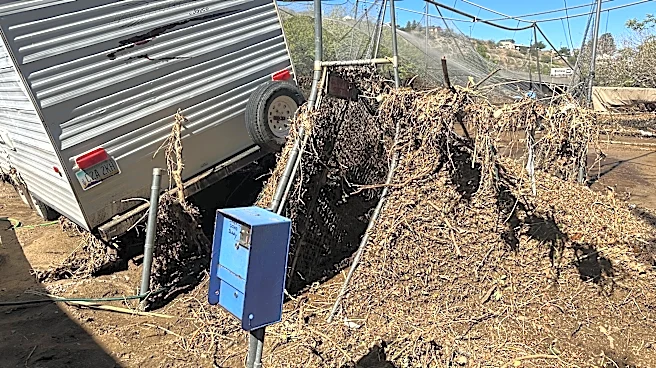







Last September, three Arizonans lost their lives when floodwaters swept through Globe and Miami. Across Gila and Mohave counties, 312 homes were damaged and 64 were destroyed. Nearly a year later, FEMA has closed the door on recovery. Arizona's request for a Major Disaster Declaration has been denied, with no further appeal available, leaving communities to rebuild without the full federal support that would have accompanied approval.
The cost now falls on Arizona. The communities will rebuild with a 75 percent state cost share instead of the 90 percent federal cost share that would have accompanied a declaration. Meanwhile, Miami Mayor Gil Madrid has said local flood mitigation resources currently cover only 30 to 40 percent of what the community
needs.
Much of the reaction has centered on one question: Did Globe meet FEMA’s threshold? Gov. Katie Hobbs says yes. FEMA says no. But both sides are answering a question the law does not actually ask.
Here is what much of the public discussion misses. The per capita damage figure that many people treat as a requirement is not a requirement. Federal regulations identify it as an indicator, and FEMA has long maintained that it is not determinative. The Stafford Act asks a different question: whether a disaster exceeds the capabilities of the state.
Arizona's initial estimate of $33.5 million in public infrastructure damage increased to approximately $96 million after additional assessments. A bipartisan congressional delegation argued that the revised estimate exceeded FEMA's own indicators. FEMA denied the request anyway, concluding in its December decision letter that the damage was not beyond the capabilities of the state.
The indicator was never the final test. Capability was.
So what exactly is the capability standard?
That is the unanswered question. I cannot find a published methodology, benchmark, worked example or formula that states can use to understand how this determination is made. Arizona could not clearly see what it failed to prove, and neither can the next state facing a similar disaster.
This is not a partisan story, and Arizona demonstrates why. Arizona voted for the President in 2024 and was denied federal disaster assistance. Republican-led Vermont faced a similar denial after its own flooding disaster. The unanswered question is not which party controls the governor’s office, but what standard FEMA applies when determining whether a disaster exceeds a state's capabilities.
A quieter concern sits beneath the politics. Three Arizonans lost their lives in last year's floods. Yet the Public Assistance declaration process that determined Arizona's request is primarily designed around infrastructure damage, fiscal impacts and a state's ability to recover. It does not explicitly weigh fatalities as a deciding factor. Those are necessary considerations, but they do not capture the full consequences communities experience after a disaster. FEMA's Individual Assistance program serves a different purpose by addressing certain needs of individuals and households, while Public Assistance remains focused on the recovery of public infrastructure and government services.
That gap is bigger than Globe. If capability determines whether federal assistance is available, every state carries a financial exposure it cannot easily predict. Rural communities often feel this burden most acutely because a state's overall fiscal capacity can become evidence that it should have been able to absorb the costs, even when the affected communities themselves cannot.
Arizona does not have to wait for Washington to address this challenge.
One important step would be creating a dedicated state disaster account with a protected revenue source that cannot be redirected during difficult budget years. North Carolina maintains a State Emergency Response and Disaster Relief Fund that provides a standing resource for disaster recovery needs before federal assistance arrives, if it arrives at all. A permanent state fund transforms fiscal capacity from a factor used against communities into a resource available when they need it most.
Arizona can also establish a revolving loan fund under the federal STORM Act, allowing state resources to support local mitigation projects and replenish over time through repayment. FEMA's FY2024 Safeguarding Tomorrow Revolving Loan Fund program received more than $293 million in requests for $150 million available, demonstrating the demand for these tools.
FEMA still owes communities two things: a transparent explanation of the capability standard it applies and a clear identification of the factors that determine each denial.
The lesson from Globe is larger than one community. The states that recover best are not those that assume federal assistance will always arrive. They are the ones that build the financial and institutional capacity to act before the next disaster.
Globe cannot appeal again. Arizona can decide it will not be caught flat-footed by the next flood and lead the way for every town that will someday stand where Globe stands now.
Carlos Santos-Rivera is principal at Santos & Schupick, LLC.
This article originally appeared on Arizona Republic: Arizona deserves to know why FEMA denied Globe | Opinion