



Arizona State University officials have not responded to demands to let outside law enforcement agencies take over the investigation of a near-fatal workout involving a hockey player, a lawyer representing his family said.
The family of 21-year-old Matthew Mayich has no faith the university can lead an impartial investigation and has asked officials to turn over the case to Phoenix Police Department, the Arizona Attorney General's Office or the state police, lawyer Robert Carey said.
Mayich, 21, collapsed during an outdoor training exercise led by an ex-Green Beret on Aug. 20 and weeks later remains incapacitated at Barrow Neurological Institute with "zero chance of recovery," Carey said.
"ASUPD is a department of the University. It is overseen
by the same administration whose athletic department, coaches, staff, and outside instructor are the subjects of the inquiry," he said in a Sept. 4 letter to the university.
Carey asked ASU to respond by Sept. 11. He said he still has not heard anything from the university or any law enforcement agency.
ASU did not respond to questions about the letter on Sept. 15.
The Attorney General's Office confirmed it had received and reviewed the letter. Spokesperson Richie Taylor declined to say what, if any, action the office intended to take.
Phoenix police and the Arizona Department of Public Safety did not respond to multiple interview requests on Sept. 15 and would not confirm receiving the letter.
An investigation by The Arizona Republic has found multiple potential policy violations connected to the workout and Mayich's collapse. The school did not appear to follow its own rules designed to protect students from exertional heat illness before, during and after the workout.
The Republic also found the volunteer trainer did not go through the required vetting process or sign standard forms before starting drills on the first day of the 2026 semester. Ex-Green Beret Tim Ziesel was allowed to lead a planned three-day workout based on a handshake agreement with the head hockey coach and other staff members, his attorney said.
The ASU Police Department began investigating the circumstances of Mayich's collapse after getting the 911 call. Administrators also have promised a separate review of everything surrounding the workout.
Carey has accused ASU of mishandling the investigation. Coaches and team staff have continued overseeing players, who fear retaliation such as the loss of scholarships or positions if they speak out, he said.
No effort was made to sequester the hockey players from the coaching staff overseeing the workout, he said.
"Even a flawless investigation by ASUPD would be met with the objection that the University investigated itself," Carey said in his letter, which was copied to Phoenix Police Chief Matthew Giordano, Arizona Attorney General Kris Mayes and Department of Public Safety Director Col. Jeffrey Glover.
What happened when Matthew Mayich collapsed at ASU hockey practice
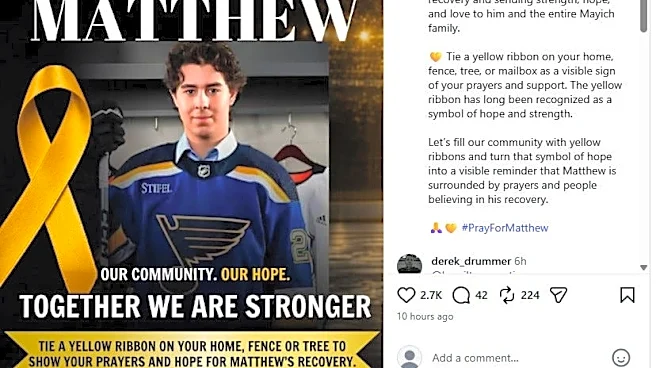
Tempe Fire Medical Rescue crews responded at 8:30 a.m. to ASU's Joe Selleh Track for calls of a heat-related illness. Mayich was rushed to a hospital and later transferred to Barrow. His family has maintained a daily prayer vigil that has drawn hundreds of people from all over the world. Mayich's condition has not changed in almost four weeks.
Mayich, a sophomore from Stoney Creek, Ontario, was in his first year at ASU. He was part of a 2026 transfer portal class that ranked first in the country. He appeared in 34 games, tallying seven goals and eight assists, in his freshman season at Clarkson University in Potsdam, New York.
He was drafted by the St. Louis Blues of the National Hockey League in 2023. Drafted players retain their college status while NHL teams hold their exclusive signing rights.
Carey said Mayich was in the Phoenix metro area five days before participating in the drill and suffering exertional heatstroke.
Athletes are supposed to be exposed to heat gradually over seven to 14 days by steadily increasing the intensity and duration of activity in the sun, according to Sun Devil Athletics policies.
The first choice for treating heat illness "is with immediate cold water immersion." The policy calls for "a cold tub half-filled with water" and three to four coolers of ice ready for immediate use.
Mayich was not rushed to a cooling station or dunked in an ice bath; he was instead left on the ground for several minutes while he was treated, Carey said.
Ziesel's lawyer, Buddy Rake of Phoenix, denied the workout was extreme and said it resembled a military exercise only in cadence and team-building. He said Ziesel left before Mayich collapsed near the end of the workout.
Ziesel ran the players through 45-50 minutes of sprints, push-ups and flutter kicks. He also had them lift and carry teammates, Rake said. Later exercises included running with medicine balls, he said.
Ziesel, who has led similar exercises for years at Arizona Christian University, said he is willing to meet with Mayich's parents. He believes officials should "investigate everything and they should tell the parents everything," Rake said.
ASU silent on whether heat policies were followed at hockey practice
While ASU officials have acknowledged having heat illness and contract policies in place, they have not said if they were followed.
Head hockey coach Greg Powers and a team trainer have not responded to requests for comment.
ASU Athletic Director Graham Rossini has discussed — and downplayed — the university's investigation during regular appearances on the Burns and Gambo Show on Arizona Sports 98.7 FM. He said officials were trying to understand why a military veteran was brought in for training.
Carey said interviews he's conducted with hockey players and others have convinced him coaches wanted to see how much players could endure in the heat. And they wanted to set a tone of toughness for the season, he said.
"We take the University at its word that a criminal inquiry is appropriate. The only remaining question is which agency should conduct it," Carey wrote in the Sept. 4 letter to ASU. "The family’s goal is simple: To learn the truth about what happened to their son."
Robert Anglen is an investigative reporter for The Republic. Reach him at robert.anglen@arizonarepublic.com. Follow him on X @robertanglen.
Rey Covarrubias Jr. is a reporter for The Arizona Republic and azcentral.com. Email him at: rcovarrubias@azcentral.com, and connect with him on Instagram, Threads, Bluesky and X at @ReyCJrAZ.
This article originally appeared on Arizona Republic: ASU silent on family demands for outside investigation of hockey practice