






A rising number Arizona patients without health insurance and the money to pay for their medical care has inspired the Society of St. Vincent de Paul to open its second free clinic in metro Phoenix.
The new 10,100-square-foot health clinic, set to open its doors Oct. 7, is in a renovated St. Vincent de Paul thrift store at 2352 W. Main St. in Mesa near Dobson Road and close to Tempe.
The eventual vision is to have four free clinics situated throughout the Valley, St. Vincent de Paul Phoenix CEO Shannon Clancy said during a recent walk-through of the space.
The Mesa clinic has support from several community partners: Mayo Clinic, Arizona State University, Banner Health and Creighton University. The first clinic's primary partnership is with Dignity
St. Joseph's Medical Center in Phoenix, which is expected to work with the second clinic, too.
As an independent clinic that provides care for free, nonprofit St. Vincent de Paul does not get federal funding for its operational costs and does not bill insurers, which is what makes it different from federally qualified health centers.
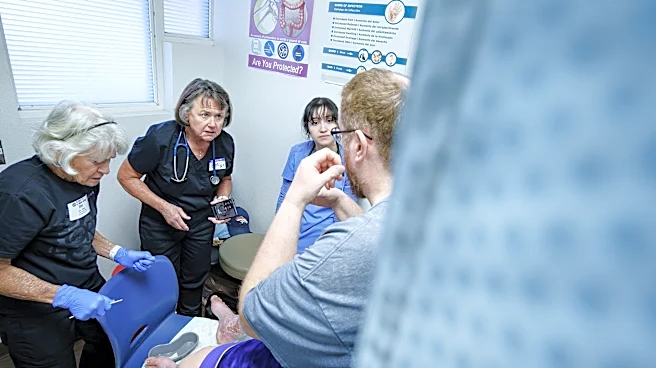
Instead, it relies on donations, health provider volunteers and partnerships, including academic liaisons to help staff the clinic with medical students. The $5 million clinic renovation was paid for by an anonymous donor, Clancy said.
Without the constraints of insurance billing, providers at the free clinic can spend a longer time with patients when they need it, leaders said.
One of the key pieces of the model is the clinic's connection to more than 30 Valley specialists who do pro bono work. The clinic, which will treat both adults and children, does not treat patients indefinitely. The aim is to get them well, get them health coverage if they qualify, and "launch" them to other providers. The clinic helps with food and shelter, too, which are also essential pieces in getting people healthy enough to have productive lives, leaders say.
"We're keeping patients out of emergency departments," Clancy said. "It's no-barrier care. There's no money, there's no insurance. If you need 30 physical therapy visits to help you walk, we will find someone who is happy to do that. In the meantime we are also training people."
The clinic "won't solve" the pervasive problem of Arizonans who can't afford medical care, but it is helping to mitigate it, Clancy said. St. Vincent de Paul Phoenix, which also operates a network of neighborhood food pantries, shelters, and family support services, already is one of the largest providers of free medical care in the Valley.
The organization's flagship clinic sees about 2,500 new patients per year and the new clinic is expected to see 3,500 new patients per year. Between the two clinics, St. Vincent de Paul will more than double the organization's free health care reach.
'Not really having long-term stable insurance,' worker went untreated
The original clinic at 420 W. Watkins St. south of downtown Phoenix has been seeing a growing number of patients with either no health insurance or inadequate coverage, and no way to pay for their medical care, said Dr. John Anwar, the chief medical officer for both St. Vincent de Paul clinics.
Among recent new patients, Anwar said, are individuals and families who say they can no longer afford "Obamacare" Affordable Care Act health insurance from the federal marketplace, which soared in cost after Congress failed to renew enhanced federal subsidies to help pay for the insurance.
Others are patients such as Kirk Patton, 45, who works between 30 hours and 40 hours per week and is trying to get more hours.
He does not have coverage through his job at a field center for a Valley grocery store and earns too much to qualify for Medicaid, which is government health insurance primarily for people who are low income. Patton said he considers the free care he's getting at St. Vincent de Paul as a stopgap measure and he that hopes to get insurance through his job for 2027.
Patton has had leg wounds for several years and he's always relied on short-term fixes. But when his wounds and his pain worsened in September, he said, he realized he needed to get some help. The physician he saw told Patton he required treatment twice per week. But at $105 per visit, Patton couldn't afford it. That's when an employee at the doctor's office told him about St. Vincent de Paul's free care.
Patton, who doesn't drive, has been making the trek to St. Vincent de Paul's Virginia G. Piper Medical and Dental Clinic twice per week and does not pay for any of his care. Because he lives in Mesa, the trip to the Phoenix clinic typically takes 90 minutes to two hours and he does part of the trip by bicycle. He's looking forward to the East Valley clinic opening because of the commute time he'll save.
Even with the long trip, Patton said it's been more than worth it. The free care has given him hope for getting better. Patton does not have diabetes and doesn't know what is causing his leg wounds, but St. Vincent de Paul is connecting him with a wound care specialist and has taken cultures to try to identify the source of his problem.
"Typically people would go to a primary care doctor for this, but not really having long-term stable insurance, I never went to a primary care provider and I don't have one," Patton said. "I've never had annual checkups outside of when I was a child."
'The hospitals right now are very much under stress'
St. Vincent de Paul leaders anticipate another wave of uninsured patients because of major changes to the federal Medicaid program, most of which take effect Jan. 1, 2027. The first wave affected legal U.S. immigrants, including thousands of Arizona asylees and refugees who lost their full Medicaid coverage on Oct. 1.
The changes were part of the Republican-backed One Big Beautiful Bill Act, also known as HR 1, which President Donald Trump signed into law on July 4, 2025.
Proponents say the changes are a way of cutting down on fraud and abuse and getting Medicaid only to the people who truly need it. Critics say it will exacerbate the number of uninsured people in the United States and result in people skipping preventive health care and only seeking care in emergency rooms.
About 10% of Arizonans, or 760,000 people, do not have health insurance, according to estimates from Dr. Daniel Derksen, a University of Arizona public health professor and health policy expert. That number is likely to increase because of the Medicaid changes, Derksen and other experts have said.
"The hospitals right now are very much under stress, certainly in the Valley but even more in the rural areas," Clancy said. "If you are sick and you don't have any money and you don't have any insurance, even if you just needed a medication, you are going to go to the ER because they have laws that they say they have to see you."
Leaders of the new East Valley Clinic asked for hospital system support to build a "different type of cost sharing model so that all partners could benefit from the clinic's work," Clancy said.
The clinic will be a partner to help provide comprehensive care to people without health insurance to reduce the burden of uncompensated care and keep hospital beds open for the patients who most need them, she explained.
Among health systems giving support is Mayo Clinic in Arizona, which made a five-year financial commitment, said Dr. Richard Gray, who is the CEO of Mayo Clinic in Arizona.
Gray said part of Mayo Clinic's confidence in the new location is the effectiveness of St. Vincent de Paul's first location, including measurable patient outcomes.
"There are a few of us, including Mayo Clinic, that St. Vincent de Paul considers foundational supporters," said Gray, who did not disclose the amount Mayo Clinic in Arizona has contributed to the project.
"We are allowing them to be confident that they can continue to function for years ahead in this new clinic. ... We've seen the effectiveness of what they've done in their existing clinic and the number of patients they are able to serve and even the outcomes they are able to achieve with low hospital readmission rates."
Mayo Clinic in Arizona is providing faculty, medical students and trainees, as it has also done with the first St. Vincent de Paul Clinic. Having the right kind of care to achieve community health takes a lot of different forms, Gray explained.
"If any one of us tried to act independently of others to provide all of those forms and angles to improve health in our community, we wouldn't get very far," Gray said. "We consider it important to work collaboratively."
The new clinic asks that patients make appointments. It will be open 8 a.m. to 4:30 p.m. Monday to Friday, with the possibility of Saturday and nighttime hours in the future, which the Watkins clinic offers. The phone number for clinical appointments at both clinics is 602-261-6825.
Reach health-care reporter Stephanie Innes at stephanie.innes@usatodayco.com or follow her on X: @stephanieinnes or on Bluesky: @stephanieinnes.bsky.social.
This article originally appeared on Arizona Republic: St. Vincent de Paul doubling free health care capacity as demand grows