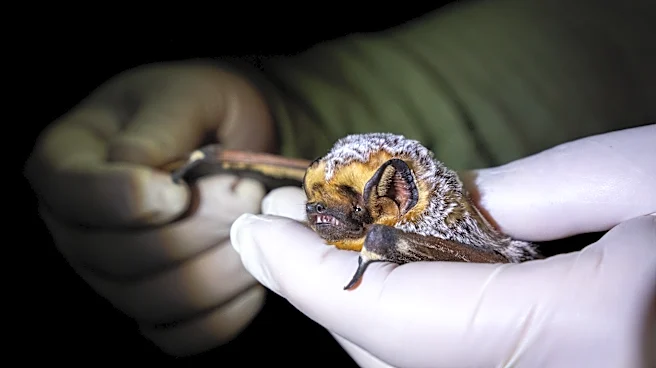








There are facts about bats that most everyone seems to know: They’re the only flying mammals in the animal kingdom; they sleep upside down, an evolutionary trick that’s effortless for them; their ultrasonic shrills help them navigate in the night.
But cultural myths and urban legends have also stereotyped them into Halloween mascots, demonic beings and carriers of diseases. Many of these portrayals are untrue or overblown.
Despite their vampiric reputation and misunderstood nature, bats are unsung heroes in propping up the health of ecosystems and the economy. They help pollinate over 300 types of fruit, including mangoes and bananas. They are natural predators to many kinds of insects that U.S. farmers consider pests, providing a free pest control
service that saves the agricultural industry as much as $53 billion per year.
International Bat Night falls on the last weekend of August, an observance aimed at raising awareness of the ecological importance of bats and celebrating these oft-feared creatures of the night.
“Bats are really not anything to be afraid of,” said Angie Stingelin, a statewide bat biologist at the Arizona Department of Game and Fish. She debunks the myth that bats like to chase after people, saying that these fliers are actually clumsier than people realize.
But that only highlights the need for the public to give them ample space to avoid these jarring encounters, just like with any other wildlife.
“So long as people don't pick them up with their bare hands,” she adds, “then bats can be enjoyed and appreciated.”
Arizona’s parade of bats
As a state, Arizona ranks second to Texas in bat diversity. Arizona enjoys such an assortment of bats because of its proximity to the tropics, where bats migrate from. Arizona also boasts diverse landscapes and a variety of ecosystems, from alpine forests to deserts, all of which different kinds of bats have fashioned a home.
Bats come as varied as the landscapes they inhabit. For example, the little brown Arizona myotis is an insect specialist that lives among the high-elevation ponderosa pine forests, whereas the Mexican long-tongued and the lesser long-nosed bats sip on nectar from saguaros and other cacti in the Sonoran Desert.
“The bats that we have are some of the most interesting ones in the U.S.” Stingelin said. This also includes the largest American variant, the western mastiff, with a wingspan of nearly two feet, and the smallest, the thumb-sized, nickel-weighing western pipistrelle, also called the canyon bat. “Arizona is special.”
Bats have even found ways to coexist in the hearts of cities. Every summer after sunset, spectators gather outside of the flood-control tunnel along the Arizona Canal on Phoenix’s Camelback Road to watch the swirl of Mexican free-tailed bats emerge for their nightly hunt.
Arizona uncovered its 29th and latest bat species last year, the nectar-feeding Mexican long-nosed bat.
The discovery came out of a community science project in the Chiricahuas, in which researchers detected bat DNA in homeowners’ hummingbird feeders. Every year, the females of these endangered animals migrate north from Mexico to breed, crossing into Texas and New Mexico. For the first time, scientists confirmed they also made their way into Arizona.
“For people who are bat fans, having another bat in Arizona is a really cool thing,” said Faith Walker, a bat biologist at Northern Arizona University who led the discovery. Her team is currently trying to map out the migration corridors of this endangered species.
Aside from the long-nosed bat, another one of Walker's favorites is the spotted bat, a charming creature with soft pink ears as long as its body, and three white spots on its back that pop against its black fur.
“They're probably the most attractive bat in the U.S.,” she said.
Their range spans northern Mexico to southern Canada, but northern Arizona is a hotspot — the bats have taken to roosting on the walls of the Grand Canyon.
Arizona's bat research takes flight
The numbers, movement and behavior of Arizona’s bats are still largely a mystery to science. That’s because these aerial acrobats are challenging to catch and observe in the first place.
“It's really hard to study a little animal that flies around in the dark, and can fly long distances,” Walker said. “We're still trying to learn the basic biology for a lot of these species.”
Catching bats is no easy feat. Roosts can be hard to access, and as these fleet flitters can also dodge nets, not to mention breezily detect them using their echolocation capabilities. Many a time while working in the field, Walker and her team saw their target species frolicking above their heads, yet their nets remained frustratingly empty at the end of the night.
Acoustic recordings can help scientists detect the presence of bats, but Walker cautions that bat calls from different species may sound the same.
The latest innovation in bat surveys is to read the DNA detritus that bats scatter in the environment wherever they wander. Like a forensics expert, scientists have swabbed the flowers, feeders and even feces to detect which species are present and what they feed on.
In recent years, scientists have even found ways to sniff for a bat’s genetic material from the air.
Walker runs the Species-from-Feces project, an initiative that invites the public to submit samples of bat guano from around the world to learn more about their bat neighbors.
In one of the findings, bat houses — artificial roosts in urban environments, similar to nest boxes for birds — were doing their job helping to suppress pests on pecan farms in Texas. Walker’s team found that the poop of evening and Mexican free-tailed bats in those bat houses contained traces of casebearer moths, whose larvae burrow into nuts and can tank yields by 70%.
Thanks to all these survey techniques, Arizona scientists are making inroads in illuminating the secret lives of these nocturnal critters. It's important to track bat numbers consistently across the years to get a hold of trends, Stingelin said.
A 2024 study reported that over half of North America’s bat species are at risk of extinction. Like most other animals, bats are vulnerable to climate pressures. They're also susceptible to collisions with wind turbines.
Last year, Stingelin’s team recorded thousands of deaths among the urban colonies of Mexican free-tailed bats. She suspects that the heat wave was behind this die-off, and the emaciated carcasses hinted at mass starvation possibly due to the drought.
Across the country, a devastating fungus is wreaking havoc among hibernating bats, especially on the U.S. East Coast and Midwest. The resulting white-nose syndrome has killed off as many as 90% of bat populations over 10 years. Although the pathogen has been detected in Arizona, official reports have yet to find a single bat death here so far.
Bat surveys are important to get ahead of the fungus if they turn deadly, Stingelin said.
Some bat species are so mysterious that scientists are still in the dark about their population status at all.
Stingelin is going batty — in a good way — over attempts to investigate the elusive western mastiff. Zipping up to 60 miles per hour, they’re hard to snag.
But she’s undeterred — she’s planning to tag the bats and record their calls to answer the most basic questions about these baffling behemoths, including how many live in Arizona and where. It’s a crucial starting point in tracking their health and developing policies that would ensure Arizona’s largest bats are here to stay.
“Ten years from now, that'll be really important information,” she said. “You only get trend information after doing things on a regular basis for at least five to 10 years, and beyond.”
Shi En Kim covers environmental issues for The Arizona Republic and azcentral. Send tips or questions to shien.kim@arizonarepublic.com.
Environmental coverage on azcentral.com and in The Arizona Republic is supported by a grant from the Nina Mason Pulliam Charitable Trust.
Follow The Republic environmental reporting team at environment.azcentral.com and @azcenvironment on Facebook and Instagram.
This article originally appeared on Arizona Republic: Forget the myths about bats. These flying mammals are good for Arizona