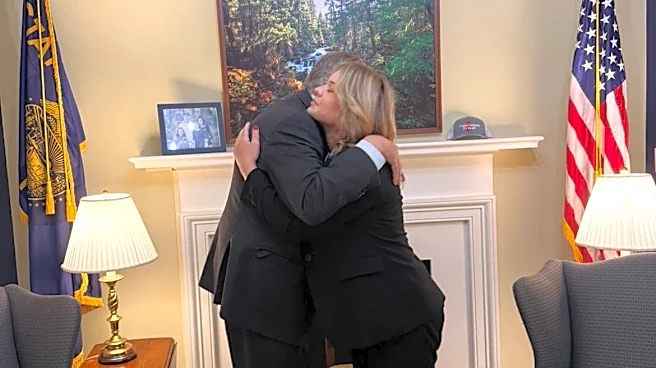




Elizabeth Gallup says the helicopter crash that killed her two younger sisters and two other relatives left her with two choices.
“I can lay in bed and be sad about it, or I can get up and go do something and make sure it’s not happening to another family,” she said.
Gallup chose to act. Within seven months after the crash, she was in Washington, D.C., where she carried a federal aviation safety bill to the office where it would be submitted for introduction to Congress. She paused before handing it over and prayed.
The bill bears the names of the McCarty and Heideman families. Gallup’s sisters, Rachel and Faith McCarty, died Jan. 2 with their cousin, Katelyn Heideman, and their uncle, pilot David McCarty, in a helicopter crash in Telegraph Canyon
south of Superior. David was supposed to get married that day.
Now, Gallup's efforts have helped form bipartisan legislation introduced in July, with support from three members of Arizona’s Congressional delegation and a focus on how temporary hazards are marked and communicated to pilots.
The bill would direct the Federal Aviation Administration to review its policies for temporary low altitude hazards if it is passed. The bill is awaiting action in the House Transportation and Infrastructure Committee.
What happened in the Telegraph Canyon crash
The MD 369FF helicopter departed Pegasus Airpark in Queen Creek before flying into Telegraph Canyon on Jan. 2. David McCarty, 59, was piloting the aircraft with Rachel McCarty, 23, Faith McCarty, 21, and Heideman, 22, aboard.
People were drawing suspended lines across the canyon as the helicopter approached, the National Transportation Safety Board’s preliminary findings said. The helicopter struck the lines and crashed.
The NTSB has not issued a final report determining the probable cause of the crash.
A Notice to Airmen or NOTAM warned pilots of a flagged and lighted “tight rope” obstruction within a one-nautical-mile radius and about 600 feet above ground, according to federal aviation records. It's not known if McCarty saw the notice before the flight.
Another helicopter flew about 10 feet beneath a remaining line roughly an hour after the crash, the preliminary report said.
Grief becomes full-time advocacy
Gallup, then still Elizabeth McCarty, had left full-time teaching after getting married and moving to southern Oregon in October 2025. She planned to spend the year substitute teaching. The helicopter crash changed that.
She now treats aviation safety advocacy as her full-time work. She contacts lawmakers, travels to Washington and presses officials to act before another pilot encounters a line that is difficult to see from the air.
Gallup began contacting lawmakers within days of the crash. Her early campaign centered on temporary flight restrictions and clearer digital warnings for highlines and other temporary obstructions.
She traveled to Arizona in March and said Sen. Mark Kelly’s office, D-Ariz., helped arrange meetings as she sought state and federal support.
“This is not a blame game situation,” Gallup said. “This is, how can we make this safer for everybody? Slackliners included.”
She also asked Congressional offices to treat her as a participant in the policy process, not only as a grieving relative. “Talk to me like anybody else,” Gallup said.
She did not want officials to offer false hope to spare her feelings. “Nothing can be worse than the accident,” she said.
Sens. Ron Wyden and Jeff Merkley, both D-Ore., pressed the FAA in February to consider immediate action, including stronger markings and possible temporary flight restrictions while the federal investigation continued.
Gallup later worked on a coalition letter focused on physical markings, digital charting and FAA outreach to people outside aviation. All 37 national and regional aviation groups invited to sign the letter agreed, she said.
Lawmakers used the coalition’s recommendations as a guide while developing the bill, Gallup said. Aviation organizations reviewed the proposal because she did not want new rules to create unintended problems.
Arizona lawmakers join the effort
Rep. Eli Crane’s office, R-Ariz., worked with the offices of both Kelly and Oregon Rep. Cliff Bentz, R-Ore., on the legislation, Crane spokesperson Greg Smith said.
The measure built on an April letter that Crane, Kelly and Sen. Ruben Gallego, D-Ariz., sent to the FAA, Smith said.
Bentz introduced the McCarty and Heideman Air Safety Enhancement Act, H.R. 9695, on July 15. Crane and Oregon Rep. Val Hoyle, D-Ore., became original cosponsors.
“The next step would be a Legislative hearing,” Smith said.
Kelly said he had met with the family and supported requiring the FAA to move quickly.
“David, Katelyn, Rachel, and Faith lost their lives in an Arizona helicopter crash that never should have happened,” Kelly said in a July statement. “No one should have to go through what they’ve been through.”
What pilots could see differently
Although there was a warning, it has not been established if David McCarty saw it or whether it adequately alerted him to the lines.
Michael Mower, executive director and chief pilot of Southern Utah University’s aviation program, said thin lines can remain difficult to detect even when pilots know they are present. Southern Utah University Aviation is among the organizations supporting the legislation.
“When you’re flying low, wires and lines are like spiderwebs,” Mower told The Arizona Republic in the days after the crash. “Even when you know they’re there, they’re still really hard to see," he said.
The McCarty-Heideman bill would require the FAA to review when slacklines, highlines, wires and similar temporary hazards should be marked or lighted. It also would examine how warnings appear in tablets, cockpit systems and flight planning software.
Pilots have largely moved from paper charts to digital systems, Mower said in a follow-up interview in August. Notices about temporary obstructions do not always appear clearly in those systems, and a hazard can emerge after a pilot begins a flight.
“If it shows up on my software, suddenly it’s right in front of my face, because that’s what I’m looking at,” Mower said.
‘A good first step’
The bill would give the FAA six months after enactment to review its low altitude airspace policies.
The agency would consider a standardized format for a hazard’s coordinates, height, active dates and times, responsible party and required markings. The system should also make clear who must report an obstruction and which agency receives that report, Mower said.
The FAA would consult helicopter pilots, air medical operators, agricultural aviators, drone operators and other experts who regularly operate at low altitudes.
Mower described that approach as cautious but worthwhile.
“A good first step, a very safe first step,” Mower said. “But until something happens, I mean, it’s going to continue to happen.”
Some challenges could be on the table, however. Mower noted that the measure would begin with a review rather than an immediate safety change. He also noted that the bill includes no funding. The FAA faces staffing and workload limits, and any resulting changes will require people and money, he said.
‘Government is slow’
The FAA declined to comment on the pending legislation.
“Speaking generally, the FAA closely supports the NTSB in accident investigations and takes any necessary safety actions based on the evidence,” FAA Senior Advisor Ian Gregor said in an emailed statement.
Gallup plans to return to Washington after Congress returns from its August recess, she said. She wants lawmakers to act before the session ends. If the bill does not pass, she said the family would seek its reintroduction in the next Congress.
She describes the campaign as a product of work and faith. During her Washington trips, one or two scheduled meetings often doubled or tripled as officials connected her with other offices.
“I think God’s definitely played a role in putting me in front of the right people at the right time,” Gallup said.
Still, she understands what stands between her family and a vote. “Government is slow,” she said. But Gallup keeps calling anyway.
Rey Covarrubias Jr. is a reporter for The Arizona Republic and azcentral.com. Email him at: rcovarrubias@azcentral.com, and connect with him on Instagram, Threads, Bluesky and X (formerly Twitter) at @ReyCJrAZ.
This article originally appeared on Arizona Republic: After AZ helicopter crash, she acted. 'I can get up and do something'