


There is a hidden jewel in the First Amendment to the U.S. Constitution. This gem rests in the shadow of our better-known freedoms of religion, speech and press. With elections just around the corner, let us now praise the First Amendment "right of the people peaceably to assemble."
Authoritarians fear this right. Cynics dismiss it. And courts seldom see it as anything more than another form of freedom of expression. But now, when people are questioning whether our constitutional system still works, we should recognize this neglected First Amendment right and exercise its power of presence ― of showing up.
The Founders recognized a special benefit to our democracy when they enshrined in the First Amendment the people's right to assemble peaceably.
Now, groups of citizens could not be prosecuted for treason merely by coming together in common concern, nonviolently and without causing a great disturbance. By allowing the people to form and nurture social bonds, this right of peaceable assembly enables individuals to build new communities and alliances.
Constitutional scholars are beginning to give this right of assembly the dignity it deserves. "[B]eing together physically and socially as citizens contributes to democracy. . . differently from talking and arguing with one another," as Tabatha Abu El-Haj, a professor of law at Drexel University, has written. It fosters social solidarity and a sense of civic inclusion and recognition ― agency. "Assembly is a politics of presence," she writes, and its protection under the First Amendment should apply to demonstrations, protests, marches and parades.
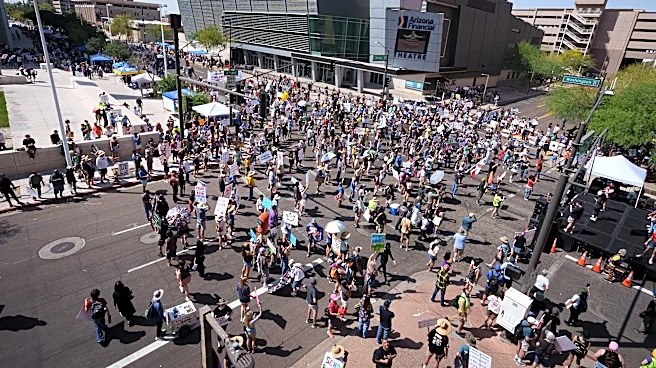
In that tradition, a "nationwide day of action" is scheduled for Saturday, Oct. 17. It’s described as "a day of nonpartisan voter participation, being in community with each other, and making sure every eligible voter has a plan, knows their options, and is ready to make their voice count." Participating communities and locations can be found at nokings.org.
The website notes that a "core principle behind all No Kings events is a commitment to nonviolent action and no civil disobedience." In support of that commitment, it offers "organizers trained in de-escalation, safety coordinators on site, and actions that are lawful, disciplined, and rooted in the strength of our communities."
Nearly a century ago and a continent away, Gandhi devised a protest method of showing up that required the self-discipline to respond, nonviolently and without reply, even to insults and unjust arrests. Gandhi's protest method later took root in America, enabled by the right of peaceable assembly. For it was a massive March on Washington in 1963 that fueled the Civil Rights Movement. And it was the late Congressman John Lewis who titled his autobiographical trilogy March, for his story involved a series of marches throughout the American South to secure civil rights for people of color in this country.
Since then, we have witnessed numerous other marches and gatherings — from campus anti-war demonstrations to the Occupy Wall Street Movement, from the Dakota Access Pipeline protests to a recent "Walk for Peace" that concluded earlier this year when a group of Buddhist monks walked from Fort Worth, Texas to Washington, D.C. "They offered the generosity of their presence," as Rod Meade Sperry noted in Lion’s Roar magazine. "Even when face-to-face with those who found their presence challenging or even offensive, they were a model of open-heartedness, wisdom, and calm."
In A Philosophy of Walking, Frédéric Gros compares the military march of authoritarian regimes ("the expression of proud and unconditional obedience") with "the spontaneous harmony of a celebration." The military march, he says, is a lesson in power. The ruler essentially declares: "it's either me or chaos. Only I, the state, can bring you unity and cohesiveness. If I weren't here. . . it would be perpetual civil war, blood-soaked anarchy." Gros continues: "Social divisions persist as long as they provide us with an inferior to humiliate or a superior to venerate. . . Regimes simultaneously divide and unite."
In contrast, Gros explains, "the true opposite of public order imposed by arms is not wild disorder or destructive anarchy but rather the spontaneous harmony of a celebration." And that is precisely what a supreme leader fears: "that a people will discover the sheer joy of being together, that they will rediscover their shared humanity through their power in numbers, and that they will experience in their embracing of a cause the pleasure of solidarity and of acting in their common interest."
Having broken free of the King's rule, the Founders understood that gatherings of the people are a fundamental right — and that this right must be preserved and protected, so long as these assemblies remain nonviolent, not riotous and not deeply disruptive.
This right to assemble is not an absolute right, but it does reflect different democratic values that deserve protection right alongside our sacred freedoms of speech and of the press. A "No Kings Day" event that commits itself to nonviolence falls squarely within this constitutional space, especially one dedicated to the protection of our voting rights. Now is the time to stand up, literally, for what we believe in, and the First Amendment gives us this right.
Whether it be on Oct. 17 or some other date, let us remember our agency and the power of showing up. And let us gather the courage to assemble and celebrate our common humanity in public, lawfully and peaceably. The celebration of our democracy ― and the power of the people to choose our own leaders ― is nothing to be censored.
David J. Bodney is Senior Counsel in the Phoenix, Arizona office of Ballard Spahr LLP and a Professor of Practice at the James E. Rogers College of Law at the University of Arizona.
This article originally appeared on Arizona Republic: Why the right to assemble still matters | Opinion