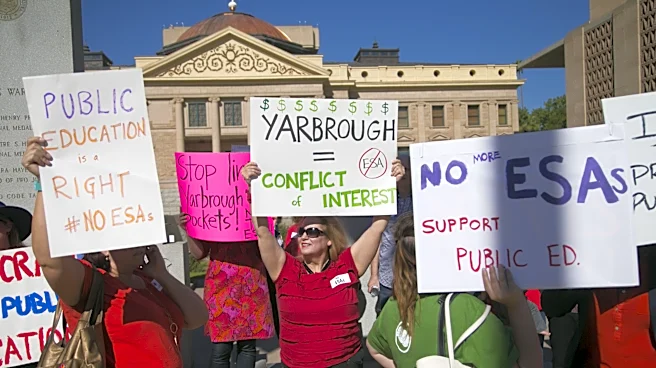




Sweeping school voucher reforms will likely no longer go to Arizona voters this November after a legal challenge and other reviews disqualified thousands of signatures needed to make the ballot.
An Aug. 18 Arizona Supreme Court ruling ruled against the group backing the voucher reforms on a key issue. Attorneys who sued the group backing the Protect Education now claim there are not enough signatures to make the ballot.
The Supreme Court decision does not determine whether the measure will appear on the ballot. That calculation will be made by the trial court. The effort needs 255,949 signatures in total.
The ballot measure would have implemented an income cap and several other restrictions on the universal school voucher program if passed by voters.
The program, also known as the Empowerment Scholarship Account program, has grown to include more than 100,000 students and costs more than $1 billion a year. Republican leaders and proponents of the voucher program fought aggressively to challenge the measure.
The legal challenge is also running up against the clock. State officials notified the court that the printing deadline for the general election ballots and publicity pamphlets is Aug. 20.
The so-called "Protect Education Act" was challenged in court in July by the Goldwater Institute, a conservative think tank. Its attorneys accused more than 100 circulators of collecting invalid signatures. Those challenges ranged widely, with some petition circulators accused of making mistakes in their registration forms and others questioned over previous criminal convictions.
Petition circulators must be able to meet the requirements for voter registration in Arizona, meaning they cannot have felony convictions on their record without having civil rights restored.
A Maricopa County judge tossed out more than a dozen petition circulators involved in the effort on Aug. 14, resulting in the loss of thousands of signatures for the Protect Education campaign. One circulator was disqualified after a video showed him telling potential signers that the measure would help low-income students attend college. The measure does not relate to college expenses. The judge ruled in favor of several petition circulators who listed temporary addresses on their petitions.
The remainder of the signatures were checked by county recorders across the state through random sampling. Maricopa County reviewed the largest batch of petitions, finding that roughly 27% of the signatures it reviewed were from people not registered to vote in Arizona, rendering them invalid.
The measure is at the center of a debate over Arizona's longstanding school voucher program. The program, called the Empowerment Scholarship Account program, expanded significantly in 2022 after it opened up to all Arizona students. The now billion-dollar program has grown to serve more than 100,000 students, allowing them to use public dollars on private school tuition and other expenses. Critics of the program have pointed to recent reports showing unchecked spending on luxury goods and other expenses unrelated to education.
The ballot measure would have sought to implement a $150,000 household income cap for the ESA program, excluding children with disabilities. The Arizona Department of Education would have also been required to publish how much voucher funding each school receives.
All educators and school staff working at voucher-funded schools would have needed to pass a background check under the ballot measure. Fingerprint clearance cards would have been issued for staff members that have unsupervised contact with children.
More than 400,000 signatures were turned into the Secretary of State's Office in July, even when advocates only needed to submit 255,949 signatures to qualify for the ballot. Campaign spokesperson Olivia Fierro said supporters of the ballot measure knew they were submitting far more signatures than were needed.
“Signature collection for this campaign began in mid-March, and the total number gathered in such a short time reflects the tremendous statewide enthusiasm to bring meaningful reforms to the highly flawed and wasteful private school voucher program that our leaders have refused to take action on," Fierro said at the time.
Several petition circulators for the Protect Education campaign were called to testify in the August lawsuit. Some responded to questions regarding previous criminal convictions, with others clarifying mistakes in their addresses and other details in their circulator registrations.
Both county recorders and the Secretary of State's Office have worked to verify thousands of signatures submitted in support of the voucher reforms. That process uncovered tens of thousands of duplicate signatures, which both parties admitted were typical in statewide ballot measure campaigns.
Helen Rummel covers state politics and higher education for The Arizona Republic. Reach her at hrummel@azcentral.com. Follow her on X, formerly Twitter: @helenrummel.
This article originally appeared on Arizona Republic: Arizona school voucher reform measure likely won't reach voters