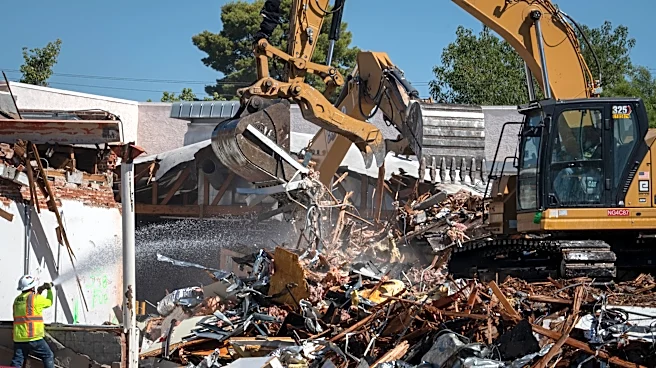

A shuttered Food City along the light rail line in Tempe has been demolished to make way for a mixed-use development that will include a new grocery store and affordable housing.
The site, on Apache Boulevard
and Dorsey Lane, will be developed into a 400-unit apartment complex, with 90% of the units designated as affordable housing. The units will be available to people earning between 30% and 80% of the area median income, meaning a two-person household earning between $27,000 and $71,950 could rent there, according to data from Tempe. Housing is generally considered affordable if a family spends one-third or less of its monthly income on it.
The Food City grocery store closed in 2021, and a few months later Tempe bought the roughly eight-acre site for $10.6 million, according to real estate database Vizzda. Tempe Mayor Corey Woods said the city was motivated to buy the site after hearing resident concerns about the closure of the grocery store.
“Overnight it became a food desert,” he said, adding that residents were also concerned that the site could be bought by a private developer that could build luxury housing or something else that would not benefit the community.
Tempe solicited proposals from developers for a project that included affordable housing and a grocery store to replace the Food City. Tempe picked Dorsey Development Partners and Palindrome to redevelop the site, now called Dorsey Station. Dorsey Development Partners is led by Charles Huellmantel and Todd Marshall.
The developers are required to build a new grocery store as part of the project, which will be a minimum of 10,000 square feet. Woods said the development team is willing to build a larger store if the selected grocer requires a larger footprint. So far, no grocery operator has been announced for the site.
Woods said the store will be a brand offering food at a price point that is affordable to a wide range of residents.
When discussing the project in 2025, Huellmantel said he was interested in the site because he lives in the area and had witnessed the strip retail center fall into disrepair.
Woods said the development will be done in phases, with the first residents expected to occupy the first phase in 2028, followed by future phases in 2029 and 2030.
Affordable housing tactic subject to lawsuit in Phoenix
The development was selected through a request for proposals process, which included requiring affordable housing on the site.
The tactic has been called into question by the Goldwater Institute, which sued Phoenix over a development. It claimed the mandate for affordable housing violated Arizona law. Arizona is one of few states that does not allow inclusionary zoning, meaning a city cannot require that a project include affordable housing as a condition of its approval.
Woods said he was aware of the lawsuit, but the city has not been contacted by the Goldwater Institute over such deals.
Tempe has other similar deals in the works, he said. The deals are one of the few mechanisms Arizona municipalities have for requiring affordable housing in new developments.
Woods said the city is constantly on the lookout for new sites to buy for affordable housing developments. When he drives past commercial properties that are for sale, he has called brokers or owners to inquire if sites for sale would be suitable for such development.
“We are very serious, myself and the other members of the council, that our teachers, our service workers can afford to live here. The Valley is becoming unaffordable at a very rapid pace.”
Corina Vanek covers development for The Arizona Republic. Reach her at cvanek@arizonarepublic.com. Follow her on X @CorinaVanek.
Like this story? Get more East Valley news straight into your email inbox by signing up for our free weekly East Valley Newsletter, which comes out on Wednesdays.
This article originally appeared on Arizona Republic: Tempe replaces shuttered Food City with housing, grocery store