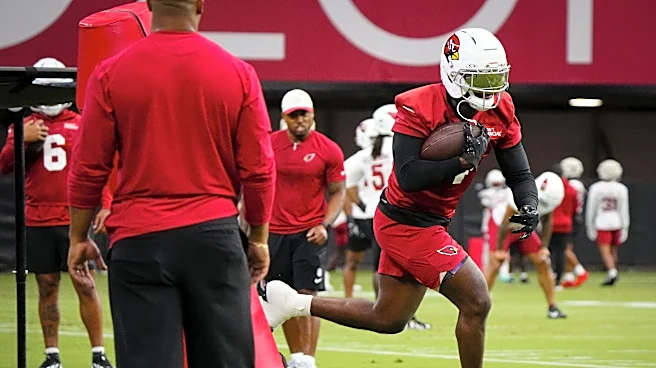


At the outset of training camp, Arizona Cardinals head coach Mike LaFleur outlined a clear expectation.
Spring practices had been used to “build the foundations,” learning what his players are capable of. This, he explained, was different.
“At this point, we as coaches have to make a decision,” LaFleur said. “No, this is what he can do. We need to put him in these spots.”
From there, it’s on the players to execute. These practice reps are no longer experimental; they’re foundational.
With that in mind, here’s what we have learned from the first week of Cardinals training camp. They have conducted five full practices and two jog-throughs, including four 11-on-11 sessions open to reporters.
Clarity at wide receiver (kind of)
The main lesson at wide receiver is that Marvin Harrison Jr.
is the starting ‘X’ receiver, while Michael Wilson is the starting ‘Z.’
That means Harrison is typically split out wide, often isolated to his side of the field — albeit with heavy use of motions (more on that later). Wilson is more of a move piece. He’s still an outside wide receiver, but he often aligns closer to the formation.
As such, he has important responsibilities as a blocker in the run game and is a key part of the confusion LaFleur wants to create for opposing defenses. On one play last week, Wilson took a surprise handoff on a jet motion. On one play this week, he aligned at tight end in a heavy formation. He was used as a run blocker, but it’s not hard to envision how that could marry up with a play-action look that springs Wilson for a big gain.
But I know what you’re thinking: ‘That’s great, but who’s going to lead the wide receiver room in targets?’
That’s a trickier question to answer.
This is not, Wilson has explained, a system where the ‘X’ receiver is the first read on 80% of passing concepts. When asked who the first read is more often between himself and Harrison, Wilson was unsure.
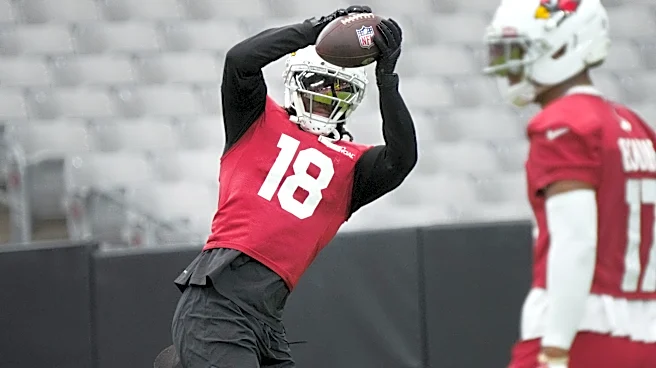
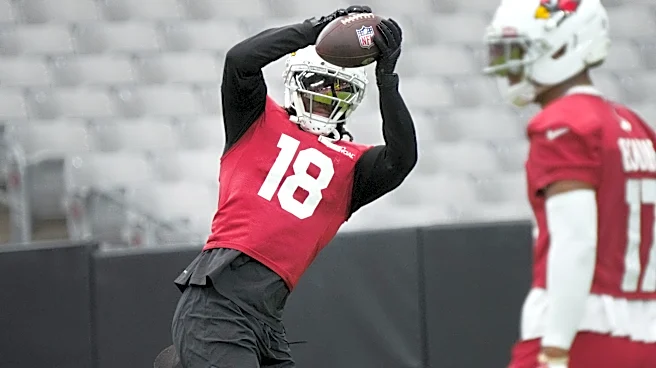
But here’s what we’ve seen in camp: Harrison is typically the lone wide receiver on the field when the Cardinals are in three tight-end sets. And Harrison has earned more targets than Wilson so far, with 17 to Wilson’s 12. But Wilson has generally looked better, hauling in multiple diving catches while Harrison has struggled for consistency.
Make of that what you will.
Running back committee emerging
When the Cardinals drafted Jeremiyah Love with the No. 3 overall pick, it seemed inevitable that he would quickly become their featured running back.
Not so fast.
In every day of 11-on-11 work, Allgeier has taken the first snaps with the first-team offense before Love rotates in. The two have been neck and neck in total carries, with Allgeier currently leading, 21-18.
That also aligns with what the coaching staff has said. When asked who he sees as the Cardinals’ starting running back, offensive coordinator Nathaniel Hackett danced around the question. Later, he was asked about Love’s progression and said, “He’s definitely a rookie.”
Plus, Allgeier said that LaFleur called him after the draft, assuring him that the Cardinals viewed him and Love as a “really good tandem.”
“It wasn't, ‘We're gonna (expletive) bench you now,’” Allgeier said. “It wasn't that. It was really good communication from him.”
That doesn’t mean the Cardinals have no plans for Love. He’s already been used in creative ways as a receiver, both lined up out wide and motioning into those spots. But the backfield does not yet belong to him.
LaFleur’s offense is fun
Speaking of motion: Man, there’s been a lot of it.
When describing this offense, players repeatedly emphasize the marriage of the run and pass. The Cardinals want to be able to do multiple things from any look, to keep defenses guessing.
This is, largely, where LaFleur’s use of motion comes in.
For example, last week, the Cardinals used Wilson on a jet sweep — the same type of motion off which he has inserted as a blocker in the run game. They’ve used return motion with Trey McBride, bringing him toward the line of scrimmage to create the illusion of a run before sending him back into an empty flat. They’ve lined Jeremiyah Love in the backfield, before having him motion wide, then run an angle route back over the middle of the field. Marvin Harrison Jr. has been used on plenty of motions as well, manipulating the defense to improve his leverage.
The result has been an abundance of open receivers downfield. The Cardinals offense has often been sloppy — with pre-snap penalties, protection issues, poor passes and drops — but the biggest positive has been the ability to scheme up easy completions through the use of motion.
Perhaps that shouldn’t be a surprise. Here’s an excellent stat, courtesy of The Athletic Football Show: Last season, the Rams (where LaFleur was the offensive coordinator) threw to a wide receiver in motion 133 times. The Cardinals, under Drew Petzing, did so just 18 times.
Cardinals think highly of Isaiah Adams
No matter where you go at Cardinals’ camp, someone is praising third-year right guard Isaiah Adams.
Adams has struggled at times in his career, but he found a groove late last season and played his best football after returning to the starting lineup in Week 13.
“He's a strong and sturdy dude on the inside,” LaFleur said. “You think about his journey from Canada to Illinois, getting that next-level education of football a little bit later than some of these other guys. So you knew there was a developmental aspect of him when he was coming out.”
On the flip side, offensive line coach Justin Frye was asked about second-round rookie Chase Bisontis and spent four minutes discussing the schematic challenges of adjusting to the NFL.
“You'll be the guy again (like in college) and how fast do we get you back to that?” Frye said. “Because there's a process to that.”
Right now it seems that process will feature Adams starting in Week 1. The next question is whether he can elevate an offensive line that has struggled early in camp.
Secondary experiencing early issues
As with anything in training camp, the success of the Cardinals’ downfield passing game can be viewed through two lenses. Viewed one way, it’s a reflection of LaFleur’s creative new offensive scheme. Viewed another way, it suggests that the Cardinals' secondary is struggling.
The reality is, it might be a little bit of both. At times, receivers have come open due to play calls that vacate large swaths of space. At other times, Harrison and Wilson have simply gotten away from cornerbacks like Will Johnson and Max Melton in coverage.
It’s not all bad for the secondary, though. Dadrion Taylor-Demerson had a nice interception last week, and Budda Baker has gotten his hand in for a few pass breakups. Johnson had an excellent showing in one-on-one red zone drills earlier this week. And Melton has earned praise from the coaching staff for his improved schematic understanding, as he rotates with Denzel Burke at CB2.
But overall, it’s been a weak start to camp for that group.
This article originally appeared on Arizona Republic: 5 key takeaways from 1st week of Arizona Cardinals training camp