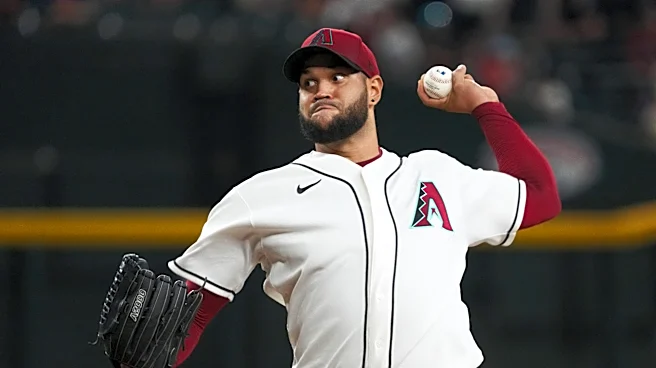




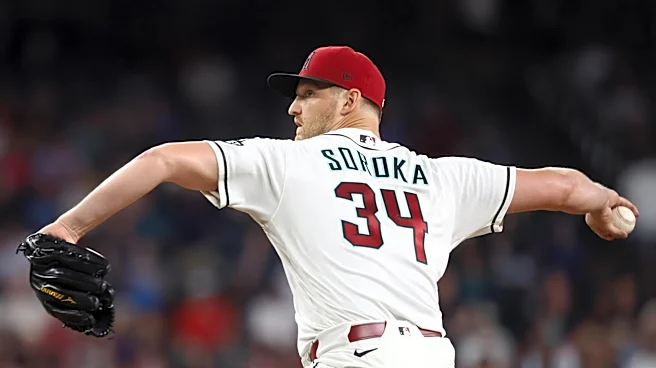
Eduardo Rodriguez wanted to go back to the fastball. Pitching for Venezuela in the World Baseball Classic last March, he had just blown one past the Dominican Republic’s Juan Soto, and when his catcher called for something offspeed, Rodriguez remembers shaking it off. The heater felt like the right pitch.
What ended up happening might have changed the course of Rodriguez’s season — and, as a result, the Diamondbacks’ fortunes, as well. Rodriguez threw a 94 mph fastball and Soto destroyed it, blasting it 409 feet to center field for a home run.
“I would say,” Rodriguez said recently, “that was where everything started.”
At 33, Rodriguez is enjoying the best season of his career. His 2.62 ERA entering Friday, Sept. 20, ranks fourth among qualified
starters in the National League. He has been a reliable source of innings — both quantity and quality — for a Diamondbacks team pushing for a playoff spot, a stunning reversal for a pitcher who disappointed in his first two seasons in Arizona.
There are a variety of reasons for his newfound success. He shed weight from where he was in previous years. He is moving better and, maybe as a result, locating his pitches more consistently. His changeup and curveball have become bigger parts of his repertoire.
But what Rodriguez points to first is a change that came about as a result of that home run Soto hit. He came to realize he needed to stop getting in his own way, stop giving in to his emotions in the moment. He needed to trust his catchers, trust the game plan. He has been doing that this season, he said. He thinks it is as responsible as anything for his success.
“With the catcher, you have a plan, and sometimes I run away from that plan and I end up paying for my mistake,” Rodriguez said. “I’ve tried to stay away from that feeling as much as I can and just execute my pitches. I’ve done well to execute my pitches.”
Embracing coaching and taking tips from Salvador Perez
After the Dominican Republic game, Rodriguez met with Johan Santana, the former New York Mets ace who was a pitching coach for Venezuela, and catcher Salvador Perez. It was not Perez who was behind the plate for the Soto pitch — it was William Contreras — but Perez was there to help talk through strategy for Rodriguez's next start.
“Johan Santana and Salvy had the conversation,” said Diamondbacks coach Rolando Valles, who was a coach on the Venezuelan team. “They had a good conversation. He went over the reasons why he went fastball in that sequence. They listened to him. They explained what they were thinking.
“It was a great conversation. I wish sometimes us, as coaches, that we would take that approach more often than just being (firm) with it. Everything starts with where the player’s head is at.”
Rodriguez came away convinced. Before starting the championship game against Team USA the following week, Rodriguez told Perez what he planned to do.
“He came to me and told me, ‘Hey, I’m not going to shake you today,’” Perez said. “I was like, ‘OK, I agree with that. But I want you to have conviction with every pitch you’re going to throw. I’m going to do my homework, but every pitch I call, I want you to be 100 percent that you want to throw that pitch, OK?’ He said, ‘OK.’”
True to his word, Rodriguez did not shake off Perez the entire night. He tossed 4 1/3 scoreless innings of one-hit ball, and Venezuela went on to beat Team USA, 3-2.
“He pitched amazing,” Perez said. “I think the WBC helped him a lot. I’m not talking about physically or with his arm. It’s more about mentality.”
Said Rodriguez: “Those two games made me change my mentality. One game, I didn’t follow the plan the way I was supposed to and I ended up giving it up. The next game I followed it the whole time and we had a good result. That pushed me into the season this way.”
These days, Rodriguez says that in his better starts he will shake maybe two or three times. When he does, it is less about pushing his own plan of attack and more to move off a pitch he doesn’t feel good about on that particular day.
Diamondbacks' Rodriguez 'mixing,' succeeding
At this stage in his career, Rodriguez cannot rely on pure stuff to have success. His fastball sits in the low-90s. His secondary pitches are effective but not overpowering. He has to locate, keep hitters off balance and stay off the barrel.
He has been able to do this in part because of his game plan. He is using his changeup and curveball more than last year. He is throwing his four-seam fastball less frequently — and getting better results with it.
“He’s just mixing,” pitching coach Brian Kaplan said. “That was a big piece. He was a little too one-dimensional last year. The fastball was a big piece of what he’s always done, but it was too big a piece of the puzzle and now he’s got a lot of different things to complement it.”
At one point last year, Rodriguez said he weighed somewhere north of 260 pounds. He started to drop weight during the year and continued to do so in the offseason. He is down to 232. He also got his arm in better conditioning with an offseason throwing program and a shoulder program, Kaplan said.
Rodriguez’s velocity is virtually identical to last year, but Kaplan sees the improved conditioning manifesting itself deep in games, noting that Rodriguez has been more effective later in outings (1.29 ERA in innings four through six) than at the start (3.73 ERA in innings one through three).
“Because he’s in better shape, it’s easier to throw 92-93 mph at 80-90 percent rather than that be your max-effort pitch,” Kaplan said. “I think he’s more efficient with his delivery, his physicality, all of that, which allows him to locate — even if it’s a similar velocity — locate more consistently to the spots he wants to go to.
"He doesn’t have to reach back for more and feel like he has to overdo it.”
Rodriguez’s consistency has been startling, particularly since he had an ERA above 5.00 in each of his first two seasons with the Diamondbacks. He has worked into the sixth inning in 24 of his 30 starts entering Saturday and has allowed three or fewer earned runs 25 times.
It is hard to say Rodriguez has come out of nowhere — he had been good enough earlier in his career that the Diamondbacks felt comfortable giving him a four-year, $80 million deal in December 2023 — but he has never had a season anywhere close to this one.
“He’s a stopper,” manager Torey Lovullo said. “Every fifth day, you’ve got a really, really good chance of winning a baseball game. That’s nice to know.
“It’s just been a really, really consistent year. He fills up the strike zone. He gets big outs. Doesn’t get too excited. He never gets rattled or jangled. He’s always ready to go and compete.”
Rodriguez doesn’t know whether this would be possible were it not for his WBC experience. He gives credit to Perez, whom he says has been a friend for more than a decade, but he also points to the job his Diamondbacks catchers have done during the season. He has been trusting what they have been calling. And, he says, he has been better because of it.
“I will say I wish I had this mentality when I first got to the big leagues and was throwing hard,” Rodriguez said. “Mentally, body-wise, the way I pitch, the way I think on the mound, I think this is the best that I’ve been; from those perspectives, the best I’ve ever been.”
This article originally appeared on Arizona Republic: How 1 HR turned Eduardo Rodriguez into Diamondbacks' ace | Exclusive