

SANTA CLARA, CA — Matched up against a superior NFC West opponent, the Arizona Cardinals put up a fight this time. They whittled a 17-point second-half deficit down to three, then to two before their comeback attempt slipped away. It was a marked improvement on last week’s insipid loss to Seattle.
But in a division filled with Super Bowl contenders, the Cardinals were reminded again of their limitations. Again, their offense struggled to produce explosive plays until the end. Again, their defense appeared overwhelmed in every facet.
And again, they dropped a division game. This version was a 36-30 loss to the San Francisco 49ers, making it eight straight defeats to NFC West opponents.
Here are five takeaways from the afternoon.
Cardinals defense outmatched
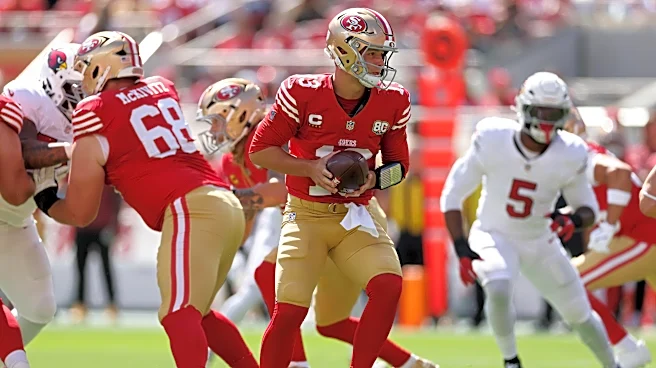
Against the 49ers,
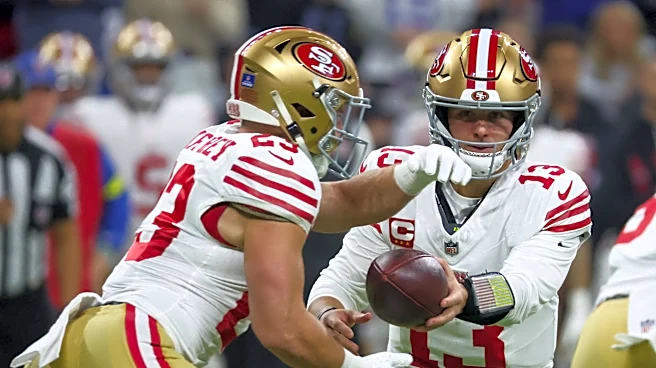
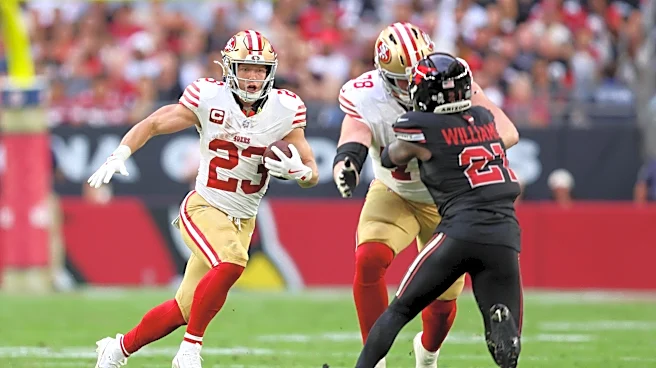
the Cardinals could not generate consistent pressure on Brock Purdy. They allowed Christian McCaffrey 5.0 yards per carry. And they struggled to cover a crop of backup wide receivers on the back end.
“When you play this offense, you better be on your Ps and Qs at the highest level,” head coach Mike LaFleur said. “Not an effort thing by any means, but we've gotta clean some stuff up, obviously.”
The struggles were best summed up at the end of the first half, when the Cardinals allowed Jordan Watkins to get wide open for a 34-yard completion, moving the 49ers into field goal range with under 10 seconds left.
Then there was the final meaningful drive of the game. Down by two, the Cardinals needed one stop to give their offense another chance. Instead, they gave up a series of easy first downs.

Offense still struggles to find explosives
The Cardinals offense was better against the 49ers than it was when it failed to complete a single 10-yard pass against the Seahawks.
But until the fourth quarter, this performance felt thematically familiar — just against a more beatable defense.
They had some success underneath, largely to Michael Wilson, who finished with 11 catches on 17 targets for 89 yards and a touchdown. And the run game was better, as they leaned on Jeremiyah Love for 21 carries, turning them into 90 yards.
But the Cardinals could not unlock their downfield passing game, as Jacoby Brissett averaged 5.4 yards per attempt. Marvin Harrison Jr., in particular, had another quiet day — whether because of his own struggles or the offense’s inability to get the ball to him. He finished with three catches for 40 yards on five targets.
And with Harrison largely out of the equation, Arizona did not produce a pass play of 20 yards until the middle of the fourth quarter. Their longest run, meanwhile, was for eight yards.

It’s not impossible to score without chunk plays, but it creates a narrow margin for error. The Cardinals have learned that lesson the hard way over the past two weeks.
“That's something I've gotta go back and take a look at,” LaFleur said. “Because it's really hard in this league … (if) we’re not getting explosives.”
LaFleur not fulfilling pre-snap promise
In his first press conference as Cardinals head coach, LaFleur emphasized the importance of a clean pre-snap operation. It was, he said, “the one thing that always stood out” in his years with Kyle Shanahan and Sean McVay. And it requires no talent, a refrain of LaFleur’s throughout the spring and summer.
And yet, since training camp began, the Cardinals have consistently struggled with their pre-snap operation.
Those issues came to a head on one first-half drive, when they committed two false starts and an illegal shift. On that same drive, their offensive line had a miscommunication after the snap, failing to assign a blocker to star linebacker Fred Warner, who blew up a run for a loss of two.

They overcame the penalties with a few key downfield passes, but the self-inflicted mistakes eventually proved too much and a promising drive ended in a field goal.
By halftime, the Cardinals had nine penalties for 80 yards. The second half was better, though edge rusher Josh Sweat extended a 49ers drive with a crucial roughing-the-passer penalty on third down.
It’s the exact opposite of what LaFleur promised to instill. If the lack of explosive plays narrows the Cardinals' margin for error, their penchant for penalties eliminates it entirely.
“Penalties, that's the story of the game,” LaFleur said. “We couldn't overcome the penalties.”
Cardinals unleash Jeremiyah Love
For two weeks, the Cardinals backfield was a timeshare. Love had 20 carries and seven targets; Tyler Allgeier had 22 carries and four targets. The two were treated as equals, despite the disproportionate resources spent on Love.
That all changed against the 49ers. Allgeier was still involved, particularly in the passing game, but the Cardinals largely turned to the highly touted rookie.
Despite the loss, Love delivered. His 4.3 yards per carry may not jump off the stat sheet, but he found extra yardage where little was available, overcoming another inconsistent day from the Cardinals’ offensive line.

The Cardinals have slow-played Love’s introduction to the NFL, but he looks every bit the star they hoped to find with the No. 3 pick. Now, it’s a matter of surrounding him with the requisite talent to unlock his full potential.
“We don't have a clicker in our hand on Sundays,” LaFleur said. “These guys gotta go and play their game and see it and play fast. And I thought he did that.”
LaFleur, though, did not commit to a larger role for Love going forward.
“We’ll do what we think is necessary each week,” LaFleur said.
He added that Love’s increased workload was because “he got in a groove right there.”
Another difficult day in the trenches
Per Pro Football Focus, Brissett was pressured on just 18.5% of his dropbacks, a season low. That’s about where the good news ended for the Cardinals in the trenches.
On the offensive side, there were still far too many miscommunications and blown assignments. Love was hit in the backfield on 28.6% of his runs, per Next Gen Stats, and averaged 1.7 yards before contact per attempt. That’s an improvement, but still subpar against a banged-up 49ers defensive line.
The larger concern, though, is on the defensive side.
The Cardinals pressured Purdy just four times on 27 dropbacks, per Next Gen Stats. They did not have a single player with more than one pressure. And in the run game, they consistently got bullied off the ball.
Two years ago, defensive coordinator Nick Rallis helped the Cardinals overcome a lack of pass-rush talent by utilizing the league’s fourth-highest blitz rate. Over the past two seasons, they have ranked 27th in blitz rate.
“Yeah, I miss blitzing, obviously,” linebacker Mack Wilson Sr. said. “But at the end of the day, we play whatever coach calls, and we believe in the plan he puts in every week.”
This article originally appeared on Arizona Republic: 5 key takeaways as Cardinals extend NFC West losing streak