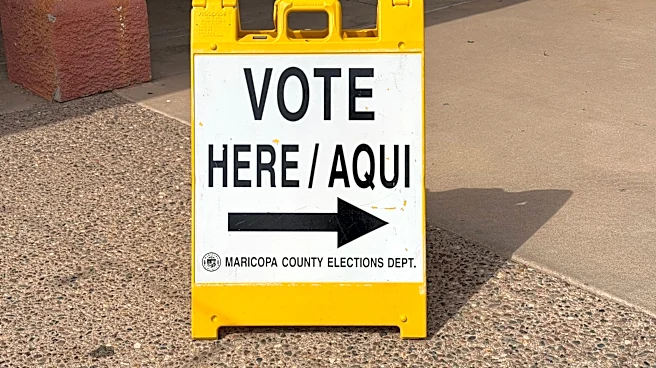




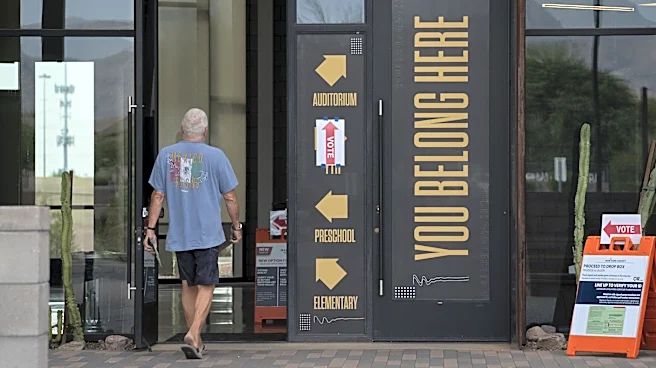

With Election Day just weeks away, eye-catching campaign advertisements are hard to avoid.
Some are sensational or provocative. Others, straight up untrue. If you've found yourself wondering, "How is that legal? Is it even legal?" you're not alone.
The "Democrats for Biggs" signs, funded by the Republican supporting Turning Point PAC, raised eyebrows and led to multiple complaints
filed with the Arizona Secretary of State.An image of Democratic Rep. Lorena Austin of Mesa posing with one of those signs also caused a stir after it was quickly recognized on social media as a deepfake. And former state Republican Rep. Joseph Chaplik of Scottsdale even sued a conservative super PAC for defamation this year, claiming the group's attack ads lied about
his voting history and violated some of Arizona's newer laws regulating impersonation and artificial intelligence.
The Arizona Republic spoke with Ashken Kazaryan, a First Amendment fellow at the Freedom Forum, a First Amendment advocacy organization, about some of the legal questions surrounding campaign advertisements. (The Arizona Republic receives grant funding from the Freedom Forum, but the organization does not provide editorial input.)
Here's what to know.
Why is it legal to mislead or even lie on campaign advertisements?
The key case is United States v. Alvarez from 2012, in which the U.S. Supreme Court said lying alone doesn't lose First Amendment protection.
Xavier Alvarez was a public official in California who lied to the public about serving in the military and receiving a Congressional Medal of Honor. After he pled guilty to violating the Stolen Valor Act, which forbade falsely claiming military honors, Alvarez challenged the law as unconstitutional.
The Supreme Court sided with him, under the premise that "giving the government broad authority to adjudicate truth would chill legitimate criticism and invite partisan enforcement," Kazaryan said. As a result, campaign speech and political speech "receives protection even when it is misleading, unfair or inaccurate," Kazaryan said.
Another key case is the famous New York Times v. Sullivan from 1964. The Times had published an ad that included several minor inaccuracies, and a public safety commissioner sued the paper under Alabama's libel law because he thought the information made him look him bad, although it didn't mention him.
The high court said the libel law was unconstitutional because the person or entity being sued has to have known the information was false and acted recklessly or with disregard for the truth. The rationale was that robust debate inevitably includes errors, and so to preserve debate, the courts needed to leave breathing room for errors.
The best response to false speech, under First Amendment and free speech culture in the United States, is counter speech, Kazaryan said.
So does lying ever lose protections if the First Amendment protects lies?
Kazaryan: Yes, when it fits a specific category:
- Defamation of a public figure with actual malice, which means knowing the information was untrue and acting with "reckless disregard" in publishing the information anyway. (It's a high threshold to meet.)
- Fraud that induces harm.
- Perjury.
- Right to publicity (different state to state).
- Obscenity.
- True threats.
- Incitement to imminent lawless violence.
- False statements to officials.
- Impersonating government officials.
- Knowingly false statements about when, where or how to vote also are not allowed. Federal law also punishes fraudulent misrepresentation of campaign authority.
Was Turning Point PAC's deepfake of Arizona Rep. Lorena Austin illegal?
At least two AI laws in Arizona could make the deepfake of Austin illegal. But First Amendment experts say the laws are vulnerable to First Amendment challenges, meaning they might violate free speech protections.
One law, ARS 16-1024, makes it illegal to create and share deepfakes of political candidates on the ballot within 90 days of an election unless the media was satire or parody, or unless it includes a disclosure that it was generated by artificial intelligence.
The other, ARS 16-1023, says a political candidate can sue another person for digital impersonation but only if the deepfake was realistic looking and didn't include a disclosure that it was fake.
Austin could possibly sue under the second law or file a police report based on the first. If Austin filed a civil lawsuit, the only realistic remedy under the law would be "declaratory relief," which would mean a judge formally ruling in Austin's favor. The law doesn't allow for damages or an injunction in Austin's case.
Pursuing charges for the first law could be challenging because the state would have to prove who created the deepfake, not just who posted it. The law also requires proof of intent to damage Austin's reputation and knowledge of its falsity.
The poster of the deepfake could say they meant to boost Biggs, not hurt Austin, Kazaryan said. And the notion that an image showing a Democrat backing a Republican would hurt the Democrat's reputation could be debated, so it's unclear how the courts would rule, she said.
Even if Austin were successful under either of these laws, the defendant could appeal and challenge the laws as unconstitutional.
Kazaryan said ARS 16-1023 is particularly weak because "it can reach people who repost a fake in good faith with no knowledge" of its inauthenticity. That could raise questions about the law serving as a "prior restraint on core political speech. ... If anyone were to challenge it, I think it would crumble in court," she said.
The second law might be harder to find First Amendment flaws because it targets only creators who knowingly make deepfakes to injure a candidate and it requires a disclosure label.
"Usually disclosure labels, when they're narrowly required, they will survive First Amendment scrutiny," Kazaryan said.
In campaign finance regulation, for example, where the U.S. Supreme Court has accepted campaign spending as speech, spending limits were rejected while disclosure requirements for spending were upheld. That's because the courts have viewed disclosure requirements as balancing transparency in the public interest and the right to speak.
Still, Kazaryan said ARS 16-1024 could raise concerns about "compelled speech," which the First Amendment forbids, because it requires people to label their political speech as fake.
Until either of these Arizona laws are challenged in court, however, the public won't have a definitive answer on whether they're constitutional.
Laws similarly aimed at clamping down on deepfakes during election seasons in Hawaii and California were struck down by federal judges, but they weren't identical to Arizona's.
How about Chaplik's defamation lawsuit against a super PAC?
In July, Chaplik, then-candidate for Arizona's 1st Congressional District, sued a Virginia-based super PAC for allegedly violating the above AI laws, plus defamation.
Chaplik said "Conservatives for Effective Government" placed "street signs with an unflattering AI-generated image of him "and stating that he is a job killer." He also complained the signs falsely stated or implied that he voted against protecting kids "without a full and accurate description of his vote history."
The case has since been slated for dismissal, but if it had moved forward, Chaplik would've faced an uphill battle.
That's because calling someone a "job killer" is just a political judgement or impression, not a verifiable fact that could actually be proven false. While a specific accusation about someone's voting record is verifiable, omitting their later votes "does not automatically establish defamation," Kazaryan said.
Taylor Seely's role covering First Amendment issues at The Arizona Republic/azcentral.com is made possible by a collaboration among Freedom Forum, Journalism Funding Partners and the USA TODAY Network. Freedom Forum does not provide editorial input.
Do you have a story about the government infringing on your freedoms? Reach her at tseely@arizonarepublic.com or by phone at 480-476-6116. She can be reached on Instagram at @taylor.azc.
This article originally appeared on Arizona Republic: Is it legal for political campaign ads to lie or mislead?