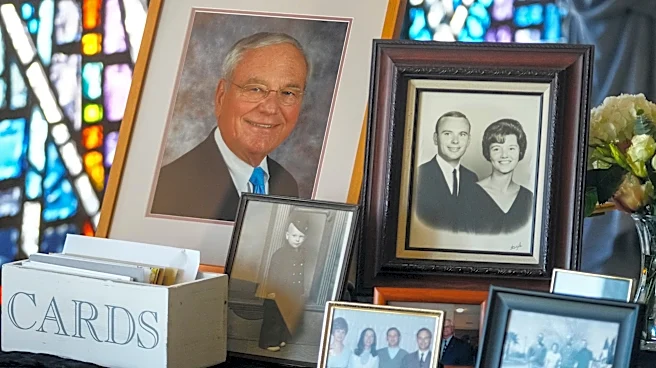





Arizona politicians and community members gathered to say goodbye to former Tempe Mayor and Democratic Congressman Harry Mitchell, who helped transform the city’s landscape and economy.
Mitchell died July 29 at age 86.
"He helped shape the community, and he gave so many of us a powerful pair of shoulders to stand on," Mitchell's son, former Tempe Mayor Mark Mitchell, said during a reception at Tempe Mission Palms hotel following Mass at Our Lady of Mount Carmel Catholic Church on Aug. 15. "Dad really was the quintessential public servant."
Harry Mitchell was a beloved civics teacher and coach at Tempe High School when voters first elected him to the City Council. He continued teaching government to students after becoming mayor in 1978.
Mitchell
served as Tempe’s mayor for 16 years before representing the area in the Arizona Senate from 1999 to 2006. In 2006, he defeated Republican Congressman J.D. Hayworth in a swing district and went on to serve two terms in Congress beginning in 2007. He also chaired the Arizona Democratic Party from 2005 to 2006.
Mitchell's wife, Marianne, died in 2019 after years of suffering from Alzheimer's disease. His son followed his father into politics and served as Tempe mayor from 2012 to 2020. Mitchell is also survived by his daughter, Amy Hartley, five grandchildren and one great-grandchild.
"No one was busier" than Mitchell during his years in public service, his son said. Beyond his public service, Mitchell helped lead the Tempe Sister Cities program and served as an officer for 19 local nonprofits over the years. Although he knew thousands of people personally, he always made time for his family. He would slip away from City Hall to attend events with his children, Mark and Amy, while they were in high school. Even during his time in Congress, he typically flew home for the weekends, his son Mark Mitchell said.
"Somehow, he did all this without neglecting the city and especially his family," Mark Mitchell said.
"He was very generous and kind with his time. He was very open," Hartley told The Arizona Republic. "It's amazing how many people he touched."
One of Mitchell’s approaches to understanding what people wanted from government was simple: He listened. His response was often positive, with a simple, “You may be right,” his friend Father Nathan Castle told the crowd.
The Mass drew local politicians, including Gov. Katie Hobbs, Phoenix Mayor Kate Gallego, and Cindy McCain.
"He was a wonderful mentor to a whole generation," said Gallego, who volunteered on Mitchell's congressional campaign. "He was always willing to offer time to young people and people who were interested in public service."
Hobbs, who's running for reelection, declined comment about Mitchell.
Legacy of transformation
After Arizona voters rejected a proposed 28-mile Rio Salado project in 1987, Mitchell announced that Tempe would pursue a smaller version of the project, which became Tempe Town Lake.
The lake opened to the public in 1999, transforming the Salt River bed, which makes up about 10% of Tempe, into a destination for multistory hotels, luxury apartments, businesses and miles of recreational space.
Tempe Town Lake became the centerpiece of a long-term downtown revitalization effort — one that remains ongoing and in which Mitchell played a significant role.
A prominent piece of public art installed in downtown Tempe in 1998, Above the Crowd, depicts Mitchell as a 35-foot-tall stilt walker, symbolizing the ambitious vision and determination that defined his legacy.
Mitchell used his ability to connect with people from all walks of life to help shape and improve his world. It became a sort of calling card at times, including to powerful people in Washington, D.C.
One of the dignitaries at the event, Dennis Burke, a former U.S. attorney for Arizona and aide to Gov. Janet Napolitano, recalled receiving a call from Rahm Emanuel during Mitchell’s congressional campaign. Emanuel, then chairman of the Democratic Congressional Campaign Committee and a former chief of staff to Barack Obama, asked Burke why he believed the former mayor would be a star player in Congress.
"He's still alive and there's a statue of him," Burke said to Emanuel, who was satisfied at the answer.
Former Vice President Dick Cheney remarked on it to Mitchell during one of his White House visits, Mark Mitchell said during his eulogy.
In Congress, Mitchell further established his legacy by voting to support the Patient Protection and Affordable Care Act, the health care reform law championed by former President Barack Obama that helped tens of thousands of Arizonans gain access to health insurance.
Mitchell's former aide, Robbie Sherwood, said he and his staff knew the vote would hurt his reelection chances, but the congressman believed "it was the right thing to do for the country."
Mitchell received death threats over the vote and lost his seat in Congress to Republican David Schweikert in 2010.
During his two terms on Capitol Hill, Mitchell championed and sponsored the Post-9/11 Veterans Educational Assistance Act of 2008, commonly known as the new GI Bill of Rights, which President George W. Bush signed into law.
Tempe Mayor Corey Woods told The Republic that Mitchell was one of his “political heroes” and a model for his own career.
"I don't think there's a piece of this city that Harry Mitchell didn't touch and didn't have his fingerprints on," Woods said. "He was truly one of a kind."
"He was just a real person," said Elizabeth Higgins, who got her first job in politics when Mitchell hired her as his assistant in the state Senate. She's currently the general counsel and senior policy adviser to Democrats in the state Senate. "He was very funny. Even when he was upset, you could kind of give him a little nudge and he would perk right up."
Reach the reporter at rstern@arizonarepublic.com or 480-276-3237. Follow him on X @raystern.
This article originally appeared on Arizona Republic: Family, community say goodbye to ‘quintessential public servant’ Harry Mitchell