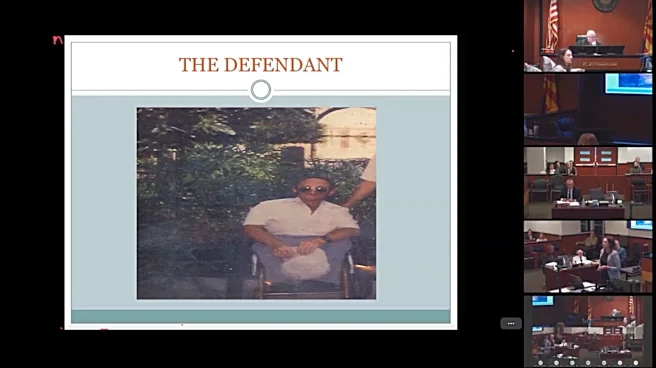







David Booker Kizziar, convicted more than four decades after a 22-year-old woman was killed inside an abandoned Phoenix mortuary, called his sentence "irrelevant” Monday because of his age.
Kizziar, 73, was sentenced Aug. 10 to life in prison for the 1984 murder of Aimee See. Kizziar was sentenced under the law in effect at the time of the killing. He would be eligible for parole after serving 25 calendar years. Arizona abolished parole for most crimes committed on or after Jan. 1, 1994.
Maricopa County Superior Court Judge Mark Brain gave Kizziar credit for 2,107 days already spent in custody. With the credit, Kizziar could be considered for release in roughly 19 years, when he would be about 92.
When Brain asked Kizziar whether he wanted to say
anything before he was sentenced, Kizziar initially raised an issue involving a lost wheelchair before turning to his punishment.
“As far as the sentencing, I think it’s kind of irrelevant. I’m 73 years old,” Kizziar said.
“I tend to agree with that,” Brain replied.
No family members of See attended the sentencing. Phoenix police detectives Kevin Ham and Michelle Cervantes, who worked on the case, were present but did not speak.
How police found Aimee See's killer after several decades
A jury found Kizziar guilty of first-degree murder July 13, ending a cold case that stretched back 42 years.
Phoenix police found See on Feb. 17, 1984, inside the vacant Henry Foreman Mortuary near Third Avenue and McDowell Road. See was hit six times in the head, sexually assaulted and strangled.
It was unclear if See was living on the street at the time of her death. Prosecutors said she had previously stayed with a Phoenix family but was likely no longer living with them when she was killed.
The case remained unsolved for decades.
DNA testing eventually produced a male profile from semen found on a sleeping bag beneath See’s body. Investigators partially matched the DNA to one of Kizziar’s relatives. They later obtained a cheek swab from Kizziar which they said matched the DNA found at the crime scene.
Kizziar represented himself during the trial and denied killing or sexually assaulting See. His defense centered mainly on his physical condition.
Kizziar has osteogenesis imperfecta, commonly called brittle bone disease, and uses a wheelchair. He argued that his height, limited reach and difficulty walking made it physically impossible for him to have carried out the attack.
He questioned how he could have repeatedly struck a 5-foot-5 woman in the head and moved her body. He also pointed to the absence of wheelchair tracks or other marks at the dusty crime scene.
He argued that his DNA may have already been on the used sleeping bag before See’s body was moved over it. At the time Kizziar did not have a stable living arrangement and sometimes slept at a YMCA in downtown Phoenix, blocks away from the mortuary. He said that he could have used the sleeping bag at some point and someone else may have taken and used it in the mortuary.
Prosecutors countered with testimony describing Kizziar as strong and independent when he was younger.
Jurors also watched a video tape of Kizziar telling investigators that he had once been able to drag his wheelchair up stairs, climb through a window and “get around pretty good” outside the chair.
The jury ultimately found him guilty.
This article originally appeared on Arizona Republic: Man convicted in grisly mortuary murder calls punishment 'irrelevant'