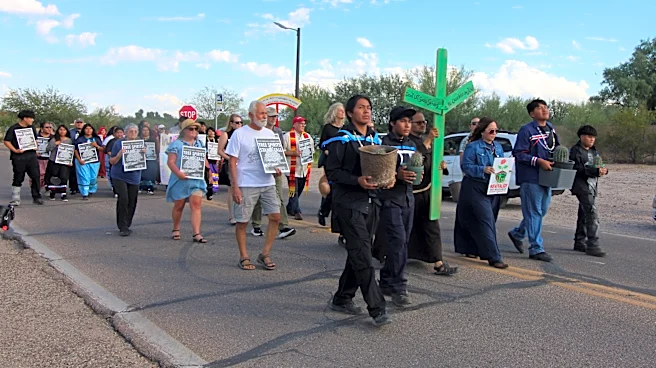




Tohono O’odham Nation Chairman Verlon Jose became emotional as he addressed a crowd gathered at the San Xavier Community Center Oct. 7 for a multi-faith rally opposing the Trump administration's second border wall on tribal lands.
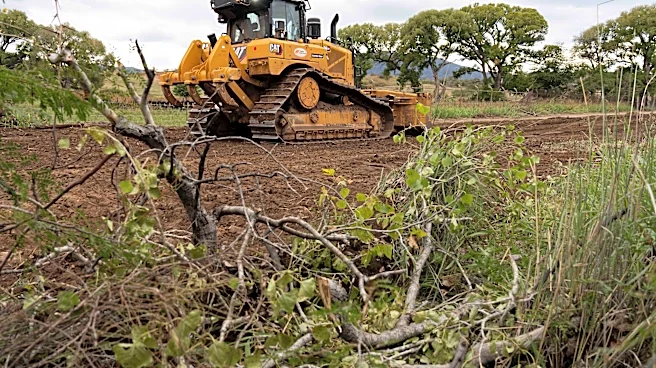
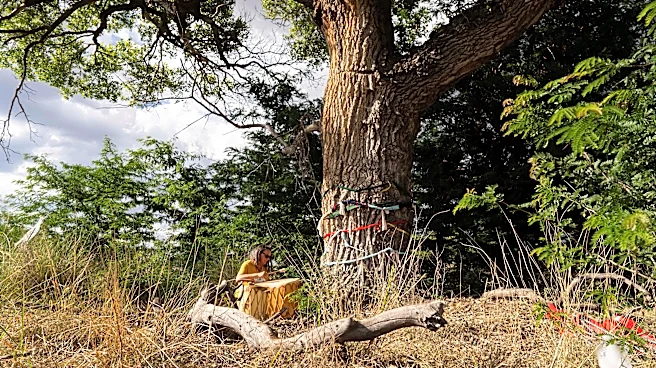
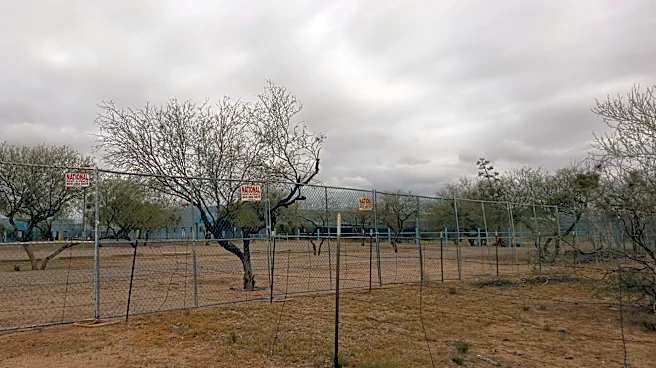
In the past week, the construction on the second wall accelerated when the final of four “Grandmother” trees in Lochiel—a tiny community in southern Arizona’s San Rafael Valley—was desecrated to make way for the 30-foot barrier.
For 71 days, land protectors stood in opposition to Border Patrol agents and contractors, fighting to protect the trees. which are thought to be over a century old. Videos on social media showed the violence masked and heavily armed federal agents have inflicted on unarmed land protectors, who
can be heard screaming as hired contractors brought down the tree.
"My heart was heavy," Jose told The Republic. "My tears were rolling, because it is in our culture and our tradition everything is sacred. That tree was alive. That tree was murdered. It was sad to see the grandmother tree knocked down when people were there trying to protect her with everything they had, and all they had was themselves."
The destruction of the land and the violence inflicted on land protectors by federal agents and contractors were among the reasons for the multi-faith gathering. The event brought together people of different faiths to pray for the recent turmoil and the ongoing struggle the Tohono O’odham Nation has faced for decades—a struggle that has intensified in recent years. Becoming emotional as he addressed the crowd, Jose said, “A lot of elders who stood against this are not here anymore.”"We must acknowledge their spirit," he said. "We must acknowledge their wish to never see a wall there."
Construction has destroyed sacred places
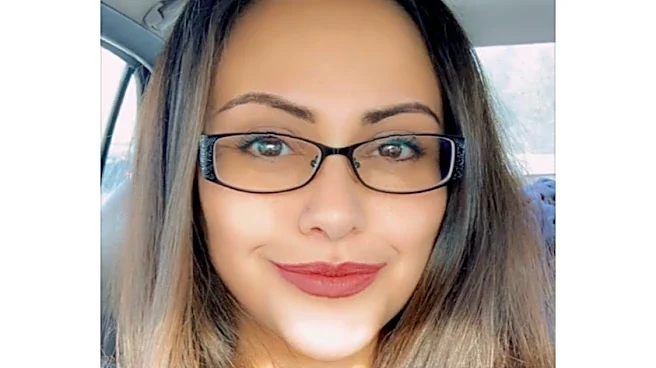
Rep. Adelita S. Grijalva, D-Ariz., addressed the crowd before prayers were offered by various faith and church leaders.
She said the struggle should matter to everyone, regardless of their faith, because everyone has a responsibility to protect and honor the places entrusted to them. For the Tohono O’odham, she said, the border is not simply a line on a map. It is the ancestral homeland where generations have lived, traveled, gathered, prayed and practiced their traditions.

“It is sacred," said Grijalva, who also said what is currently happening is alarming. "We must always remember that the border crossed us, not the other way around."
She pointed to sacred places that have already been damaged by border wall construction, including the Las Playas Intaglio.
In late April, contractors destroyed an ancient site in the Cabeza Prieta National Wildlife Refuge. Federal officials acknowledged the damage to the huge intaglio, a carving in the ground about 30 feet from the border, and said undamaged areas of the site have been contained.
A recent study found that the intaglio is more than 6,500 years old. Yet in a single act of destruction this spring, contractors damaged the ancient sitein the course of border wall construction.
“This discovery makes an already devastating loss even more profound. It’s a cultural and historical atrocity,” said Russ McSpadden, Southwest conservation advocate at the Center for Biological Diversity. “The Trump administration’s destruction of this 6,500-year-old site is a wound to the deep history of Indigenous communities and impoverishes all of humanity. No administration has the moral authority to bulldoze an irreplaceable piece of the human story.”
Its estimated age places its creation roughly 2,000 years before Egypt’s first pyramid, 4,000 years before Peru’s Nazca Lines and 1,500 years before the first construction of Stonehenge.
"The Department of Homeland Security should be ashamed," said Grijalva. "And every member of Congress who voted to approve the fund that made this possible should be ashamed."
'Why isn't Tohono O'odham land protected?'
Jose said he believes a higher power brought the group together with a message that something needed to be done. “It’s not just one person,” he told The Republic. “I believe the direction came from a higher power, bringing individuals together to unite here and say, ‘We should organize this.’”
He said people have been reaching out to the tribe, asking what they can do and how they can help. “Sometimes people say, ‘All we have is our prayers,’” he said. From those conversations, the gathering was organized as a way to bring people together in unity and offer their prayers.
Grijalva said she had the opportunity to visit Quitobaquito Springs with Jose and Vice Chairwoman Carla Johnson, and she heard from elders about what the land means to the community. The experience, she said, helped her better understand what the struggle is truly about.
"It’s about culture, it’s about history, and it’s about faith," said Grijalva. "During that visit, Chairman Jose said something that really stuck with the me, and I repeated it several times. He said, 'This country is supposed to protect the protection of freedom of religion.' So why is it the sacred land that the Tohono O’odham people and indigenous people across the country protected? Why isn't the land where we pray protected?"
Pastor Alison Harrington of Southside Presbyterian Church said there was a diverse group of religious and faith-based leaders and followers at the prayer event. She said there were several brothers from the Franciscan tradition, along with others from the Methodist, Mennonite, United Church of Christ and the Quaker faith.

Harrington, who has been serving as pastor for 20 years, was given time to address the audience and lead a prayer.
"My main message was, that too often, the religious freedom of some people are protected and not others," she told The Republic. "It's primarily Christians, whose religious freedom is protected."
In her address, Harrington said, it seems appropriate that as "maregan — a white settler Christian religious leader," she should begin with a word of confession because it is her religion that has laid the foundation for the desecration of sacred lands and the trampling of tribal sovereignty.
"We could begin by speaking of the Doctrine of Discovery established by Papal Bulls in the 15th Century which gave Christian explorers the right to claim lands they discovered for their Christian Monarchs," Harrington said. "Today the spirit of the Doctrine of Discovery is alive and well in the plan to violate the sacredness of this land by planned border walls. We could also speak of the way in which our faith and our holy texts have been manipulated and used as a deadly weapon against this earth and against native peoples."
She went on to highlight the ongoing fight over religious freedom, noting that the beliefs of some are treated as sacred and protected, while Native religious traditions are too often dismissed, denigrated or appropriated for the benefit and entertainment of others.
"The reality is that there is a stark difference between the way the holy space where I worship is regarded and the way in which the holy places of the Tohono O’odham are regarded, and it is nothing less than a vestige of a colonial mentality that privileges and protects Christian religiosity above other religious practices and traditions," Harrington said.
She told The Republic that the approach to border security is simply wrong and reprehensible.
"We’ve seen it become a failed project in the name of national security, and it’s particularly troubling when that project runs through tribal lands," she said. "Tribal sovereignty must be protected, yet it is being trampled.”
Jose: 95% reduction in illegal border entries
Jose never fails to point out that the Tohono O’odham Nation’s cooperation with Border Patrol has contributed to a 95% reduction in illegal border entries. He has also highlighted the resources the tribe has provided to support border security, including $3 million from the tribal budget, land for a checkpoint and forward operating bases and sites for integrated fixed towers that facilitate critical electronic surveillance efforts.
The tribe filed suit in June to halt any border wall construction on its lands. In August, a federal judge refused to grant a preliminary injunction to stop the bulldozers while the suit winds its way through the courts. Jose said the litigation will continue.
"Why are we allowing this to happen? Why are we allowing for our tax dollars to be wasted on something that is unnecessary," said Jose. " When we indicate that their apprehension are down by 95%, it is unnecessary for millions of dollars to be spent on a wall."
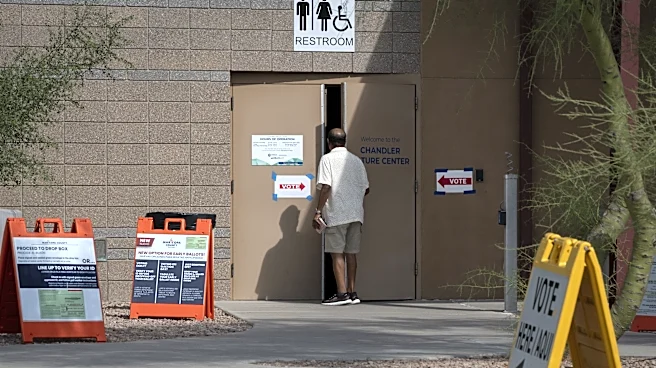
The destruction will continue, Jose said. They were told that on Oct. 12 vegetation will be removed, that clearing everything—the trees, the oaks and every plant in the path—to make way for construction for the border wall would take place. He noted that the upcoming midterm elections are especially important and encouraged people to vote.
"I believe that through prayer, we will find direction for our next steps," said Jose. "The American people must wake up. We've seen the destruction of this administration and what they're doing not only here in America, but around this world. When is it going to stop? People come here for the American dream. We've been here since time immemorial. This is our heaven. This is our place, and this destruction must stop. And my message to the American people, now is the time that we must come together and unite stronger than ever before. Like our life depends on it, because it does."
Arlyssa D. Becenti covers Indigenous affairs for The Arizona Republic and azcentral.com. Send ideas and tips to arlyssa.becenti@arizonarepublic.com.
This article originally appeared on Arizona Republic: Trump wall tramples Tohono O'odham religious freedoms, leaders say