




The Peoria Unified School District governing board is reconsidering controversial anti-diversity, equity and inclusion policy.
But the proposed rewrite, which would eliminate references to DEI, quickly exposed a divide among board members who originally supported the measure.
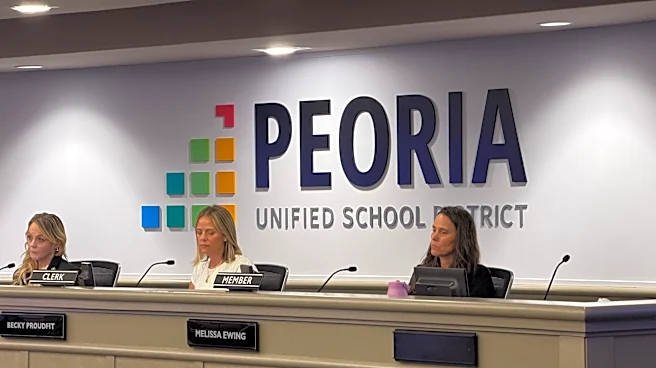
Board President Jeff Tobey proposed the revised policy at the board meeting on Aug. 27, which would be renamed the “Equal Opportunity and Merit-Based Decision-Making Policy.” Board members Heather Rooks and Janelle Bowles pushed back on the revisions, accusing Tobey and board member Becky Proudfit of abandoning the positions they took during their 2024 campaigns.
The board discussed the policy and has not yet voted on the proposed revisions.
Tobey proposed the revisions after
the district faced backlash for removing books from its middle school curriculum: “Summer of the Mariposas” by Guadalupe García McCall; “A Raisin in the Sun” by Lorraine Hansberry; and “Narrative of the Life of Frederick Douglass” by Frederick Douglass.
A spokesperson for the district told The Arizona Republic the books violated the district’s policies on curriculum adoption, controversial topics and diversity, equity and inclusion. At an Aug. 13 meeting, the district said the books were removed based on content deemed age-inappropriate, not the anti-DEI policy. Some of the books were still available at the high school level, and the subject matter is taught in history classes.
Rooks previously served as the board’s president and spearheaded the implementation of the anti-DEI policy. The board passed the policy 4-1 in late 2025.
Proposed policy removes DEI references
The board faced backlash for the policy, with some criticizing it as being too broad to effectively implement.
Tobey said the current version of the policy is too broad and is not backed by state law. His proposal cites an Arizona state law that prohibits some instruction based on race, ethnicity or sex, including teaching that one race, ethnic group or sex is “inherently morally or intellectually superior to another race, ethnic group, or sex.”
The revisions proposed by Tobey remove any language related to DEI, instead saying the district “shall not provide any benefit or impose any burden on individuals on the basis of race, sex, or ethnicity.” Decisions affecting students and employees like grading and hiring “shall be based on individual merit, demonstrated ability, academic performance, character, and other legitimate, non-discriminatory criteria,” according to the proposed revisions.
The policy also specifically states that it does not prohibit “the accurate, grade-appropriate teaching of history, literature, civics, or science, including primary sources and literary works that address race, ethnicity, sex, slavery, segregation, the Civil Rights Movement, or related historical events.”
Board members clash over revisions
Rooks criticized Tobey for removing any language related to DEI, accusing him of failing to implement the policies he discussed when he was campaigning.
“If that’s the stance that you took during candidate Jeff Tobey, why is that not the same stance today as President Jeff Tobey?” Rooks asked Tobey, referencing a 2024 campaign questionnaire in which Tobey referred to DEI as “Discrimination, Exclusion and non-Inclusivity.”
Tobey said he has not changed his stance and proposed the revisions to bring clarity to the policy.
“There is no consensus on what DEI is defined as. And we’re talking about policy, not a political campaign,” Tobey said.
Proudfit agreed with Tobey, maintaining her stance from the previous meeting that the policy was creating confusion. Proudfit said she agreed that race should not determine whether or not a student receives an opportunity and that “students should not be compelled to adopt political beliefs.”
Rooks accused Proudfit of flipping on a position she campaigned on. She noted Proudfit’s endorsement by the conservative 1776 Project PAC, which lists one of its priorities as abolishing DEI.
In turn, Proudfit said she did not fill out an application to be endorsed by the 1776 Project PAC and accused Rooks of bringing politics onto the board.
“Unless you’re willing to bring in someone from 1776 Project, you had no part of that process except trying to sabotage all of us,” Proudfit said to Rooks.
Bowles agreed with Rooks about maintaining the DEI references in the policy. She accused Tobey of letting special interest groups and the teachers' union “run the board meetings.” Bowles said the policy did not need to be changed at all and would only create more confusion for parents.
“I don’t know why we’re revisiting this. And I do think it’s a lame attempt to try to change something when we never needed to backpedal and do that,” Bowles said.
Board member Melissa Ewing, who was the lone board member to vote against the anti-DEI policy, expressed concern over the language in the policy differing from the language used in the district’s other equal opportunity policies. Because the district already has a policy on employment, Ewing suggested narrowing the policy.
“What does merit-based decision-making mean? Because we don't really define that — we say what is prohibited, but we don’t define that,” Ewing said.
Ewing also suggested adding a point to clarify that the policy does not prohibit the district from collecting data from different ethnic groups. Ewing said the district sends data to the federal government on things like absentee rates and proficiency rates.
Interim Superintendent Tahlya Visintainer said the district would conduct an overview to determine how the policy would impact data collection. Ewing also suggested hearing feedback from other departments about how the policy would affect them.
No vote was taken and the next step in the policy discussion was not announced.
This article originally appeared on Arizona Republic: Rewrite of Peoria's anti-DEI policy divides the board that passed it