

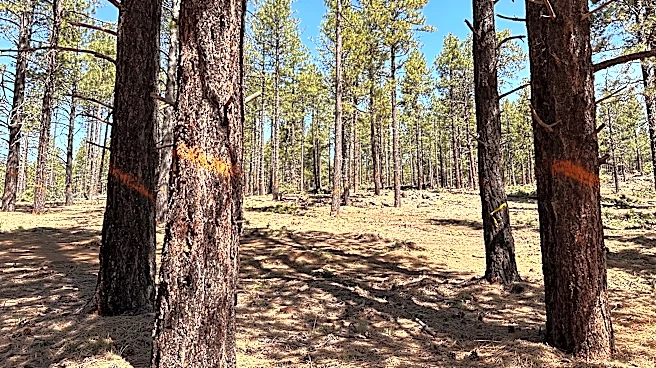

The bear was a refugee of sorts. He wandered around the outskirts of a quiet, forested neighborhood in south Flagstaff, nosing through pine needles and lounging beneath shady ponderosa canopies.
Blair Bunting and his 9-year-old daughter drove around their community, hoping to catch a glimpse. In the car, they recited verses from the children’s story “We’re Going on a Bear Hunt,” while his daughter held onto her stuffed animal: a bear aptly named Beary.
Bunting and his neighbors saw something of themselves in the visitor, who they suspect was displaced by a 27,000-acre wildfire that scorched the Coconino National Forest this summer. In June, the Pocket Fire ignited near Sedona and burned for over a month, sweeping across an area larger than the city
itself. Its plumes of smoke billowed over iconic red-rock formations and choked communities to the north.
“It was terrifying,” Bunting said. “We rented a U-Haul and packed essentially our whole house into it.”
Wild animals caught near fires do their best to avoid them, too, said Gavin Jones, an assistant professor of ecology in the School of Earth, Environment, and Sustainability at the University of Iowa. Many flee on foot — what he calls the “Bambi effect.” Others will hunker down or double back into the charred landscape to avoid the advancing flames. It's a method wildland firefighters also use to stay out of a fire’s way.
For four days the shaggy black bear lumbered around Bunting’s neighborhood. After receiving reports from residents, the Arizona Game and Fish Department attempted to scare the bear out of the area using a technique called hazing, said Stevie Kelso, a department public affairs community liaison for the agency, in a statement to The Arizona Republic.
Wildlife officials say the bear didn’t respond to their attempts to drive him off. That’s when the Game and Fish Department decided to euthanize him, to Bunting’s surprise. He and his neighbors say the bear had turned around and started heading back south when he was killed.
The state has a responsibility to protect people from wildlife that can cause harm as guided by its human-wildlife conflicts policy, Kelso said. Hanging around the neighborhood, the bear became a safety threat, she said; their only option was to kill him.
But in a debate over wildlife ethics and management that’s erupted before, some, like Bunting, wonder if the state’s decades-old policy should be reconsidered, especially as bigger and more severe wildfires brought on by drought, heat and a century of fire suppression are changing the landscape and forcing wildlife in closer proximity to the places where humans are sprawling out.
“We wanted the animal to find a place because it deserves it,” Bunting said. “His house got burnt up, and he was trying to find a place to call home.”
Worsening wildfire imperils wildlife
Fire has always played a role in forests.
“It’s a part of nature,” Jones said. It recycles nutrients, promotes plant growth and supports habitats.
The way fire behaves in a landscape is called its fire regime, and those regimes vary across the state. In northern Arizona, the landscape evolved with fire. Historically, the mixed conifer forests of northern Arizona’s Mogollon Rim burned at low intensity as frequently as every two to eight years, according to tree ring records dating back to the 1670s.
Just as Arizona’s northern forests have evolved with fire, so have the wildlife who inhabit them.
“The animals are fire-adapted,” Jones said. Not only can they survive fire, they can thrive in a post-fire landscape.
But the way wildfires burn is shifting.
”There are two coinciding forces that are changing our experience of fire,” he said.
On one hand climate change and a century of fire suppression are converging to make forests more flammable. Wildfires across the country were four times larger, three times as frequent and more widespread from 2000 to 2019 than from 1985 to 1999, according to a 2023 study Jones worked on in the aftermath of California’s megafires.
On the other, more people are moving into places that used to burn regularly. In Coconino County, the number of people living at the at the edge of developed land and wildland increased by 71% between 1990 and 2020, according to county data. For wildlife, that means fewer uninhabited areas for them to disperse into when fires spread.
Most animals survive wildfires, Jones said. In the aftermath, they begin exploring the altered landscape, looking for food, water and habitat, like the black bear in Flagstaff who was likely exhibiting “scoping” behavior. During that period of prospecting people are more likely to have unusual encounters with wildlife who’ve wandered into city limits.
“We're faced with all of these new interactions with the natural world as we are expanding our footprint and as nature itself is changing,” Jones said. “ We are going to see more animals be sort of immigrants."
Where do wild animals belong?
Bunting has lived in his Flagstaff neighborhood for only eight years but already he’s lived through two wildfire threats. In 2021, the Rafael Fire closed in around his family's home in the city’s wooded suburbs. Ash fell from the sky like snow as they packed cars to flee.
This year, he said, they got in real danger from the Pocket Fire, which moved quickly, swallowing thousands of acres a day in its first week.
”Having that anxiety, that feeling your house could be gone … you don’t sleep," he said. "It’s a miserable feeling.”
That’s why he felt a huge amount of sympathy for the black bear — a point of relation that Amanda Stronza hopes could help us better coexist with wildlife in the aftermath of fire.
When wildfires ignite, humans, bears, mountain lions, deer and other wildlife are all affected in similar ways, said Stronza, an anthropologist and professor in Texas A&M University’s Department of Ecology and Conservation Biology.
”We have this idea that wild animals belong in wild places and not in our backyards,” she said. “But even that distinction is something we've created in our minds.” That false divide breaks down when an eruptive event like wildfire pushes animals like bears into our neighborhoods. It reveals the whole social-ecological landscape that we share with wildlife.
Encounters like Bunting's force us to think about the ways we live with animals, she said. And the inevitability of climate change-fueled events like wildfire, asks us to contend with how we manage wildlife and those shared landscapes in an evolving world.
“Sometimes bears will come into neighborhoods, so then what’s the policy response?” she said. “What does it mean to coexist?”
The smoky story of 'Hotfoot'

The plight of the Flagstaff bear is not unlike the true origin story of the nation’s mascot for wildfire prevention: a black bear named Smokey.
In May 1950, two wildfires ignited in the Lincoln National Forest in New Mexico. The fires burned over 17,000 acres through Douglas fir and quaking aspen. It spread over the Capitan Mountains, into elk, bighorn sheep and American black bear habitat.
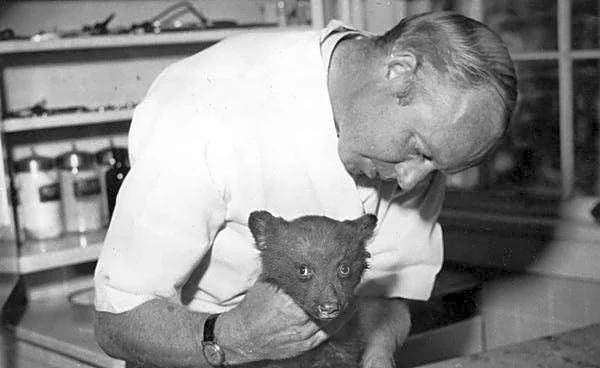
Caught in the blaze, a five pound bear cub was stranded from his mother. His paws were covered in blisters and his fur was singed. The fire crew on the scene, an indigenous volunteer group from Taos Pueblo, wrapped him in their own jackets and took him to safety. His rescuers called him “Hotfoot.”
”Smokey Bear spent all summer long with a veterinarian,” said Jane Croxen, a wildfire lookout near Pinetop, Arizona. In June of that year, the Forest Service moved him to the National Zoological Park in Washington D.C. “And that's where he spent the rest of his life,” she said.
Bunting wonders why the bear in his neighborhood couldn't have been relocated, too.
Sometimes wildlife officials do relocate bears. In the case of the Flagstaff bear, it wasn’t an option, Kelso said.
“First, adult male bears pose a significantly higher public safety risk than females or juveniles,” she said. “This is why our policy dictates that it must be removed in the interest of public safety. Second, relocation is very hard on bears and rarely solves the underlying issue as they will often return to areas of human development.”
That Game and Fish Department’s policy dates back to 1996 after a bear the department had relocated once before wandered onto a campground and attacked a 16-year-old girl near Tucson. The girl was injured, but survived. The bear was eventually killed.
A decade ago, outrage about the policy erupted online when wildlife officials euthanized a bear who wandered into a different Flagstaff neighborhood. A petition calling the department’s policy “outdated and reactionary” got over 2,000 signatures.
“We don’t want to kill anything,” Larry Phoenix, Game and Fish Regional Field Supervisor, told the Arizona Daily Star in 2016. “At the same time, we can't have a bear that finds itself in the middle of town, and has jumped fences and run through parking lots, being captured by us, being released, then having 1996 happen all over again."
In 2017, a study by researchers in Colorado found that bears who eat garbage do not become addicted — a finding that clashed with the state’s two-strike policy of euthanizing “food-conditioned" bears.
Between 1990 and 2024, there have been 16 bear attacks on people, according to the department. In three of those incidents the victims died. None of those attacks occurred in Flagstaff, according to past news reports.
”We can do better than this,” Bunting said. “ Flagstaff is a forward-thinking place and very pro-nature. This goes against everything that we kind of felt the community stood for.”
Kelso acknowledged that habitat destruction from wildfire often displaces wildlife, and that their are methods of preventing conflict from arising.
"Securing any attractants such as trash, bird feeders, and livestock helps to keep wildlife from becoming habituated to humans and human food sources, and allows wildlife to stay wild,” she said.
Because people are moving into wild places, and because wildfires are covering more ground, it’s likely there will be more human-wildlife interaction, Jones said. The key to reducing conflict is recognizing the things we can change and the things we have to adapt to.
Sarah Henry covers environmental issues for The Arizona Republic and azcentral. Send tips or questions to sarah.henry@arizonarepublic.com.
Environmental coverage on azcentral.com and in The Arizona Republic is supported by a grant from the Nina Mason Pulliam Charitable Trust.
Follow The Republic environmental reporting team at environment.azcentral.com and @azcenvironment on Facebook and Instagram.
This article originally appeared on Arizona Republic: Arizona kills a bear displaced by wildfire. Why that's the policy