





This is part of a monthly series highlighting Arizona's climate leaders and answering readers' climate-related questions. The stories aim to help connect and inspire Arizonans who care about protecting a livable climate. You can nominate an Arizona climate leader or ask a question by filling out the form at https://forms.gle/QCCxBPSHGy1bUJQ99 or by emailing climate reporter Joan Meiners at joan.meiners@arizonarepublic.com .
Spinning Shakespeare's famous line about the origins of greatness, British historian Maurice Flanagan once wrote that "some are born leaders, some achieve leadership, and some have leadership thrust upon them."
Margaret Wilson claims none of these when it comes to leading on climate solutions in Phoenix. And yet, she's at the helm
of one of the most sensible adaptations to a warming atmosphere in America's hottest big city.
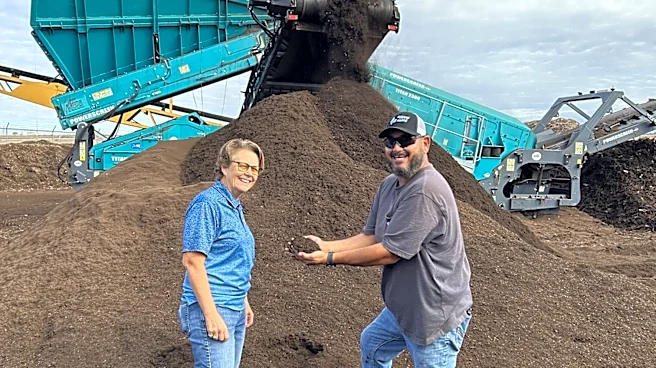
As the Four Corners region's general manager for Denali, a waste disposal and recycling company that contracts with Phoenix at its Resource Innovation Campus, Wilson oversees Arizona's largest municipal composting operation. The facility on Lower Buckeye Road and 27th Avenue opened in 2017 and can, under Wilson's guidance, produce 55,000 tons of reusable organic material each year with its efficient, large-scale turnover and aeration process.
It's a big and messy job transforming food waste that would otherwise rot in landfills into soil and mulch that can control dust and flooding, prevent erosion and weeds, and nourish plant growth against worsening heat and drought.
For Wilson, the work is not about preventing the methane biogas rising from landfills to heat the globe at a rate 86 times that of carbon dioxide over a 20-year period. And it's not really about addressing the Colorado River crisis with water-conserving soil, mitigating the impact of extreme heat in underserved neighborhoods or helping residents get back in touch with nature — all of which compost in Phoenix can do.
Mostly, she just thinks compost is cool as a scientific process and that it makes a lot of practical sense.
“I’m no tree hugger," Wilson, a civil engineer by training, told The Arizona Republic. "I’ll tell you right now, I’m the last person that says ‘let’s do this for Mother Nature.’ I’m more about ‘let’s do this because it costs less money.’"
Nonetheless, Wilson's composting mission ends up having a lot to do with trees. She had no trouble rattling off examples of how she's seen the 2-inch strain she produces on Lower Buckeye improve tree-planting success in metro Phoenix — a major long-term city endeavor that has struggled to hit past shade cover goals — by providing enough carbon and space between wood chips for roots to thrive.
Layering Denali's larger size of mulch on top helps shield new trees from high temperatures, evaporative water loss and competing weeds, she said, while their finest potting soil works wonders for the plants farmers and landscapers want growing underneath.
As part of the municipal contract, Phoenix is entitled to 500 cubic yards of this compost each year (around 200 tons, depending on the strain), which staff told The Republic is often spread at city parks but is not officially integrated into its tree-planting operations. The public can also purchase small amounts for home and garden use from the Arizona Worm Farm at 8430 S 19th Avenue, at $35 per cubic yard.
But Wilson said Phoenix rarely comes close to using its allotted amount, which the city has already paid for. She would like to see use goals sowed more broadly and piled much higher, even if that doesn't rake in extra profit. The local benefits of compost are too great to let it be hauled away for commercial use or stack up on 27th Avenue.
“We would be extremely interested in making it for the city basically at cost," Wilson said. "The city of Phoenix is our partner and we know that would be worth it.”
So far, Phoenix has seemed to view its compost program as primarily a landfill diversion project, Wilson said. And the focus of a city summary from June on the success of its 2025 Food Waste Collection Pilot Program, which distributed "food recycler devices" to 3,000 Phoenix households and office break rooms, supports this. The report highlights the 441 tons of food kept out of the landfill but makes no mention of where that organic material ended up.
“We’ve wanted to say, why don’t we do more so residents of Phoenix can come get some of the compost we’re generating at really reduced rates? Why doesn’t the city use it on roadsides or in tree planting? There’s a disconnect there and we haven’t been able to figure out that piece of the puzzle. The city of Phoenix should be all over this.”
When Wilson first got interested in composting — which happened decades ago when she learned about how "offal," a term for all the chicken parts humans don’t eat, can be repurposed as cat food or as a replacement for the water-intensive alfalfa crops used to replenish nitrogen in farmed soil — she, too, was excited about landfill diversion.
“I liked the fact of the circular environment," she said. "Instead of making and using a synthetic fertilizer product, you’re actually using scraps to make the next generation of food."
Compost has even more untapped potential, she now knows. In Texas, cities purchase large quantities of Denali's compost to use as erosion and flood control.
“But in Arizona, I don’t have hardly any customers for that and it just blows my mind," Wilson said. "We have all this concern about water in Arizona, but there is nothing in our mindset about trying to keep it where we want it. And that’s really going to be putting down some sort of soil amendment."
This works because, when there’s been a drought or lack of rain, "we can walk through the desert and Mother Nature has created a bit of a scab over the top of the ground," Wilson said. "That could be up at the Grand Canyon, that could be in your backyard, it could be along the road on your way up to Flagstaff. What happens then is that it rains and now that scab will not absorb water so it runs off and suddenly you have a flash flood."
Adding a layer of compost can also absorb toxins a city may be tasked with managing. In 2024, a Republic investigation found that Phoenix had failed to mitigate methane leeching from land where it had planned to build a homeless shelter before soil tests showed pollutant levels on par with those at oil drilling wells. The best and easiest solution, an Arizona State University scientist told The Republic, would be to simply apply some rich soil like compost to prevent this fossil gas responsible for 30% of human-caused warming from bubbling up into one of the U.S.'s hottest neighborhoods.
This city-owned site is located just five blocks from its compost facility, which could have supplied that material for free.
Helping Phoenix reach its composting potential, Wilson said, will require better educating residents about how to participate in the city's curbside pickup option. In 2014, Phoenix launched the first phase of its “Green Organics Curbside Collection” program. For a small extra fee per month (currently $10.85), residents sent their grass clippings, shrubs, branches and twigs to Wilson's pile via a separate tan bin.
More recently, the city expanded the operation to include additional types of waste.
“But I will say they really rolled it out poorly," Wilson said. “The people become unwilling to do it because it’s gross and they really don’t get any training on how to do it right.”
Food-based compost requires a nitrogen base and a carbon base, she explained after pausing to ask whether these technical details were really of interest to anyone but her. Adding water brings in the needed hydrogen and oxygen. That combination then breaks down to convert food waste back into a nutrient-rich soil.
“So many people miss the carbon aspect," she said. "They throw their food scraps into the compost bin the city of Phoenix provided them, and what you get is an organic food mess. It smells, it attracts bugs, roof rats. That’s because you haven’t added any carbon to it. You need to put your newspaper in there as well, maybe your cardboard box from your delivery. Then you get that reaction and the smell becomes non-existent."
Climate action, food sovereignty and air quality improvements weren't on Wilson's list of why Phoenix should get serious about compost. Mostly, she's just an engineer and "desert girl" who is deeply passionate about waste recycling.
But her work is accomplishing all of these things. Every shovelful of organic, locally produced compost that allows people to grow their own next generation of food or shade trees is a shovelful of synthetic fertilizer that didn't have to be mined as rare earth minerals, manufactured in polluting facilities and then trucked long distances to stores.
Besides, those artificial, specialized potting soil mixes can't hold a beeswax candle to the citrus trees, lemongrass and vegetables that Wilson is able to grow with Arizona compost in her Litchfield Park home garden.
“We always knock it out of the park on a cucumber test," she said, referencing a way to measure soil health by the quality of its curcubits. "Because it’s coming from food, from Mother Nature.”
Joan Meiners is the climate news and storytelling reporter at The Arizona Republic and azcentral.com. Send tips or questions to joan.meiners@arizonarepublic.com or follow her work on Instagram at @joan_bikes_arizona.
This article originally appeared on Arizona Republic: Margaret Wilson's no tree hugger, but she wants Phoenix to use compost