









Usually, when the buzz around a film involves words like love, lies, reality and the very nature of truth, it’s a crock, just self-important gobbledygook.
Usually.
As it turns out, “You Can See Everything,” about disgraced Theranos founder Elizabeth Holmes, is a film about love, lies, reality and the very nature of truth. Seriously. And not so seriously. It’s mind-bending in its cockeyed ambition, absurdly entertaining despite its nearly 3-hour length and without question the most intriguing movie of the year, or many years.
I loved it.
Holmes and her partner, Billy Evans, give directors Nathan Fielder (“The Curse,” “The Rehearsal”) and Lance Oppenheim (“Primetime,” “Some Kind of Heaven”) near-complete access to their lives and their family in the 34
days before she goes to prison.
And that’s only half of it.
What is 'You Can See Everything' about?
Why did they do this? Who knows? Holmes was famously convicted of fraud and is serving an 11-year sentence. She and her business and romantic partner, Ramesh “Sunny” Balwani, claimed to have invented technology that would revolutionize blood testing.
The problem with this technology was that it didn’t work.
Holmes has become the face of fake-it-till-you-make-it tech grifters. (At least one of the faces.) She was the youngest woman to become a self-made billionaire. She worshipped Steve Jobs and tried to emulate his success. She also seems to have at best a casual relationship with the truth ― remarkably casual, even in an age in which lies are basically political capital.
Her life was depicted in “The Dropout,” a Hulu series in which Amanda Seyfried won an Emmy for her portrayal of Holmes. The series looms large in the film; if you haven’t seen it, it wouldn’t hurt to give it a try. (Also, it’s just good.) Holmes and Evans say they haven’t seen it, so Fielder helpfully shows it to them. They believe that the portrayal of her in the series is what a lot of people believe is the truth about her.
What is the truth about her? That’s what Fielder, in his quirky way, tries to find out. His deadpan face, his awkward-yet-somehow-charming manner of asking questions, as well as his willingness in his shows to stage-manage reality, make him the perfect foil for Holmes, who seems congenitally unable to accept any responsibility for anything. What a combo.
Elizabeth Holmes seems nice. And delusional
Fielder, who lurks around the rented beachfront Del Mar cottage Holmes and Evans are renting like history’s goofiest vampire, is up front about his doubts about Holmes’ claims of innocence. And those claims are nearly pathological. She expresses no remorse, accepts no responsibility. Aside from maybe a white lie, she says, she’s never lied. Her façade never cracks. (The trailer for the film, which immediately went viral upon its release, is culled from this, with her large eyes staring into Fielder’s as she insists she did nothing wrong. It’s not true that she never blinks. She just doesn’t blink much.)
She seems so nice, so open, so welcoming, so woefully delusional.
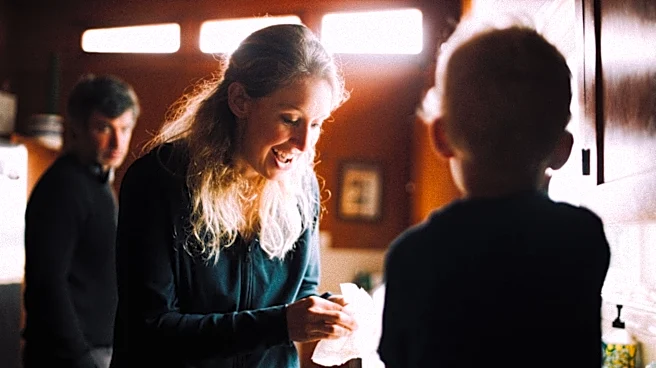
Meanwhile Holmes cares for her two children and swims in the ocean. If it’s all meant to humanize her in some way, it doesn’t. She seems more like someone trying to impersonate human behavior. Everything is off, either a little or a lot. It frustrates Fielder, who of course wears that frustration on his sleeve (and his face and everywhere else).
At one point, Holmes insists that the Theranos machine could do all of the tests she claimed it could. Fielder repeatedly reminds here that it couldn’t, and that’s why she’s going to prison. Their back-and-forth banter eventually reveals that she means the machine could do what she claims, if the required chemistry existed.
Flummoxed, Fielder shows her the famous Abbott and Costello “Who’s on First?” routine. She doesn’t get it, even after Fielder explains that Who is the name of the first baseman. Evans explains that her brain just works differently. He appears to mean it as a compliment, though with him, it’s never clear.
Indeed, for all her delusion, Holmes comes off better than Evans, who appears to be a controlling lunatic. At one point Holmes leisurely beats eggs in a bowl. Evans wordlessly walks over and takes the bowl from her and starts beating the eggs himself. Fielder, who misses nothing, calls him out on it. If you think Evans doesn’t clock the controlling nature he’s displaying here, just wait.
Holmes also works with Evans on their big idea: a new version of Theranos, using updated technology, which leaves Fielder (and the audience) incredulous.
The first half of the film is great. The second half is better
Fielder and Oppenheim count down the days till Holmes has to report to prison, so it’s with some curiosity that her freedom runs out with half the movie remaining. What now? Fielder can’t interview Holmes in prison, and to this point, his repeated interrogation of Holmes, flavored with what seems like genuine affection for her, is what makes the movie fascinating.
Then it gets great.
This is where the real questions of reality and truth come into play, of how performative getting inside a story, and inside someone’s head, can be. Anyone who reveals too much about the second half of the film ought to have their foot stepped on, so I’ll proceed with caution.
After a couple of years, Fielder returns, curious about some of the decisions Evans has made regarding Holmes, her image and her identity. If Evans seemed like a control freak before, now he seems to have lost it. He doesn’t have to ask his wife about calling friends at X to take control of her personal account, which he uses, among other things, to reply with obscenities to other users. They are so closely bonded, he says, that he knows she will approve.
Frankly, he seems crazy.
There is an overarching element to the entire second half of the film that twists the story inside-out. By the end of the film Holmes remains elusive. That’s probably inevitable; she doesn’t seem to know the truth about herself, even. But watching Fielder try to ferret it out in a manner reminiscent of someone driving a car down a hill without brakes is thrilling.
You’ve seen elements of “You Can See Everything” in documentaries before. But you’ve never seen them combined like this. It’s a true original.
'You Can See Everything' 5 stars
Great ★★★★★ Good ★★★★
Fair ★★★ Bad ★★ Bomb ★
Directors: Nathan Fielder, Lance Oppenheim.
Cast: Elizabeth Holmes, Nathan Fielder, Billy Evans.
Rating: R for language and some graphic nudity.
How to watch: In theaters Friday, Oct. 16.
Reach Goodykoontz at bill.goodykoontz@arizonarepublic.com. Facebook: facebook.com/GoodyOnFilm. Media commentary with a side of snark? Sign up for The Watchlist newsletter with Bill Goodykoontz.
This article originally appeared on Arizona Republic: 'You Can See Everything' is the most intriguing movie of 2026