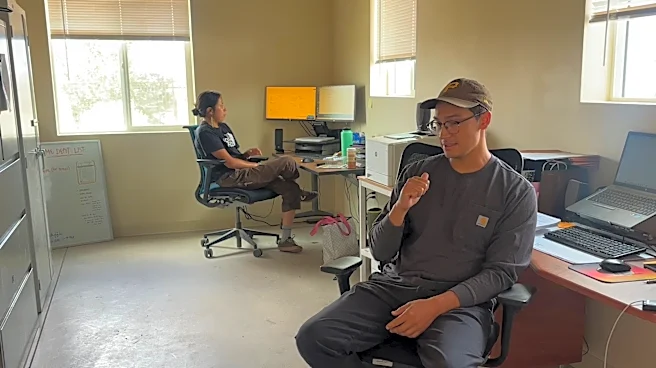





WINDOW ROCK — Tucked inside a small building in the Navajo capital is a seed bank where Diné botanist Jesse Mike and his small team with the Diné Native Plants Program are working to expand the availability of native plant materials across the Navajo Nation.
The program is a seed bank and includes a nursery in Fort Defiance, established around 2018, which is part of the Navajo Nation Department of Fish and Wildlife, but is completely grant-funded.
When Mike was brought on, the group visited about 21 chapters during their first year to introduce the Native Plants Program and gather feedback on whether it was needed. They also surveyed agencies, including the Navajo Department of Agriculture, about their need for native plants and seeds.
Together,
these community and agency surveys formed the program's feasibility assessment that developed its species priority list, on top of the group's own location-specific projects as well.
"Overwhelmingly everyone thought it was a great idea that native plants and seeds were needed for the Navajo Nation," said Mike of the Diné Native Plants Program, which also supports local gardening, food sovereignty and long-term land restoration efforts. "Specifically collected and grown here on the Nation for projects."
But the significance of the Diné Native Plants Program extends beyond strengthening land stewardship and cultural knowledge by collecting, preserving, and cultivating native plant species. Its deeper significance lies in the Navajo Nation’s claim to ownership and protection of the work the program does with Navajo seeds, as established by the Navajo Nation Genetics Research Policy Statement, which was adopted in 2024.
The policy marked the first time the Navajo Nation formally protected its intellectual property and other outcomes from genetic and genomic research involving Navajo "people, plants, animals, ecosystems," and it also affirmed the Nation’s authority to determine when and how genetic and genomic data are shared, ensuring that sharing benefits the Navajo Nation.
Getting ahead of advances in tech and data
At the first-ever Diné Data Sovereignty Symposium on Aug. 6, Mike discussed the Diné Native Plants Program, while other presenters spoke on the re-establishment of the Navajo Nation Genetics Policy Working Group.
The working group was created to develop a comprehensive genetic research policy for and with the Navajo Nation and recommend amendments to the Navajo Nation Human Research Code to guide both the nation and researchers conducting genetic research.
Other presentations explored a range of topics, including artificial intelligence, intellectual property, culture and governance, which together examined the issues shaping the future of Diné data. At its core, however, the symposium was about taking a proactive approach to Diné data sovereignty rather than waiting to react to challenges after they arise.
"I believed that a data sovereignty symposium was needed because there was a dire need to educate, inform, and empower our Navajo people on the technological and philosophical impacts of today's data concerns, issues, and challenges because, although Indigenous data sovereignty and governance conferences exist, there were no Navajo-specific ones to focus on our particular needs — until now," said Angelo Baca, professor at Rhode Island School of Design teaching in History, Philosophy, and Social Sciences, who organized the event.
"I think it's important to just get started before tech and data proliferation moves so fast that Navajos are already overwhelmed and unwilling to act."
This event was a natural extension of his research into protecting sensitive cultural data and addressing the representation of Native American, Indigenous and, specifially, Navajo peoples, said Baca.
"It is important to empower the Navajo people with data to protect themselves and their lands, knowing that the interest of this current administration is towards natural resource extraction, data center development and pushing aside tribal nation sovereignty in this political moment," said Baca. "These are not separate; it's all connected. I want our people to be ready for whatever is next and make good decisions that our elders and ancestors would be proud of with our data."
Baca described Diné data sovereignty as the ability to govern, steward and protect how data and knowledge are collected, owned and used—particularly information tied to Navajo lands, territories, financial resources and natural resources.
That means asking fundamental questions: Who owns our data? Where does it go? Who can access it? Where is it stored? Who profits from it? It also requires examining questions of privacy, extraction and control—not only over the data of individual Navajo and American citizens, but over how the Navajo Nation governs and makes policy around that data.
"Data is not just representative of software, numbers and text but represents our human and non-human relatives that live and exist sharing our world, including sacred beings who live in our shared world that we as Diné should also protect from plants and animals, to water and sacred lands," said Baca. "We are accountable and responsible to those who would also be impacted by our choices as Navajo citizens about data.,"
Guarding against abuse of Native data
The Navajo Nation in 2002 approved a moratorium on genetic research conducted within the Nation. The moratorium remained in effect until the Navajo Nation Health Research Code could be amended and approved by the Navajo Nation Council.
In 2018, the Naabik'iyati' Committee established the Navajo Nation Genetics Policy Working Group. This group was established to develop a comprehensive genetic research policy for, and with, the Navajo Nation and provide amendments to the Navajo Nation Human Research Code to guide the Navajo Nation and researchers in conducting genetic research.
"I think everyone is familiar with how traditional knowledge and maybe scientific knowledge extracted from Native people have been misused by either misidentifying information, presenting things in ways that harmful and inconsistent with who we are as a people," said Council Delegate Carl Slater, who is the chair of the Genetics Policy Work Group. "That has unfortunately taken place with our relatives in Arizona.
In 2004, the Havasupai Tribe filed a lawsuit against the Arizona Board of Regents and several Arizona State University professors after discovering that researchers had used tribal members’ blood samples, originally collected for type 2 diabetes research, in unrelated genetic studies.
Participants had not been informed that their samples would be used to study topics that are highly sensitive and taboo in Havasupai culture, including schizophrenia, ethnic migration and population inbreeding.
"A couple of ASU researchers came into their community and wanted to study diabetes...they collected hundreds of samples and they came in and never came back," said Renee Begay, a geneticist. "They went off and studied schizophrenia, inbreeding and so many other things that they didn't get consent for. Their consent forms were really broad, too. They said they 'we're gonna study medical and behavior health.' And the community just kept hearing diabetes, but when they signed the consent form it was very broad. I guess in the researchers' mind they were allowed to do whatever they wanted with the samples."
The samples were also shared among other colleagues at other institutions. The only reason the Havasupai Tribe found out about it was when a tribal member, who was enrolled at ASU, saw a presentation using that data collected.
Begay said that in the early 2000s, traditional Navajo healers, church leaders and science-trained individuals were concerned that adequate safeguards had not been put in place to address the rapid advancement of genetic research. In response to these concerns, a moratorium on genetic research was established.
Trying to add on another form of protection, the Naabik'iyati' Committee recently approved a position statement and established a Navajo Nation Artificial Intelligence Policy Working Group to protect Diné traditions and culture while strengthening data sovereignty.
The legislation formally establishes the Nation’s position that it will continue to pursue and defend its intellectual property and take measures to own, use, preserve and protect its traditional cultural knowledge and expressions. The legislation also creates the AI working group to help guide policies addressing the use and impact of artificial intelligence on the Nation’s people, culture and data sovereignty.
“As the use of artificial intelligence advances every day, it is important to protect our Diné language, culture, and traditions, especially against outside entities that seek to abuse or misuse our way of life,” said Delegate Andy Nez, sponsor of the legislation. “As a Nation, it is important to remind external agents not associated with the nation that our intellectual property is ours.”
Baca said work on the AI legislation has been underway for a long time and has included discussions with Navajo Nation council delegates and other leaders across the nation. The effort has brought together perspectives from members of the Diné Hataałii Association, the Navajo Supreme Court Emeritus, the Tribal Historic Preservation Office, as well as Navajo scientists, researchers and educators.
"This legislation is a win for the Navajo Nation because it gives us a solid stance from our own Diné culture, language, identity, teachings, and sacred knowledge to understand things like intellectual property, AI, and technological impacts, both good and bad, from our ancestors to future generations knowing we are as Navajo people," said Baca.

Seed bank protects species needed for food, cultural uses
The Doomsday Vault, formally known as the Svalbard Global Seed Vault, is a secure underground facility on the remote Norwegian island of Spitsbergen in the Arctic Svalbard archipelago. It stores duplicate samples of more than 1.4 million seeds from gene banks around the world.
But Mike said you won't find any of Navajo bank's seeds there.
"That type of storage of species is beyond our scope," said Mike. "Our seed bank is not for the end of the world, it's too actively use it. That's for another program to do, to think about the end of the world and what species we might need. But these seeds we collect, we actively grow them and try to increase the supply so we use them for our different projects that are actively happening."
Mike said the program has five primary goals: seed collecting and banking, data collection and documentation, nursery production and greenhouse cultivation, seed increase and ecological restoration, and community outreach and education.
"Right now we are focused on four main species for our seed increase projects," said Mike. "The idea is we are trying to get these priority species for use in large-scale vegetation."
In 2025, the program produced 19,700 native plants in its greenhouse facility and conducted 80 seed collection events for the DNPP seed bank. These efforts help preserve plant species that are essential for ecological restoration, traditional foods, and medicinal uses that have long been part of Diné culture. Aside from collecting seeds and building a seed bank, the program grows genetically appropriate plant materials that can be used to restore landscapes and strengthen ecosystems across the nation.
Inside the Diné Native Plants Program building, Mike explained how his crew collects, banks and documents Navajo seeds. While protecting these wild species may not seem urgent today, Mike said that could change in the future.
"I think it really is a problem right now for agricultural species. For us dealing with these wild species, I think it could be a problem in the future," said Mike on whether the need for this type of protection is necessary for his program. "I don't think anyone's trying to patent wild species right now, but I don't think it's a stretch of the imagination to see someone trying to do that."
The Navajo Department of Justice played an instrumental role in facilitating the symposium. Baca said the Navajo DOJ recognizes the need to educate, inform and empower Navajo citizens about intellectual property rights and AI policy development. That effort builds on lessons from past experiences, including the Navajo Nation’s case against Urban Outfitters and the 2009 Unauthorized Recording Act, which addressed the illegal duplication of media created by Navajo filmmakers and artists.
"This is the next natural step to protect, safeguard and develop data sovereignty needs as technology and data needs increasingly become more ingrained in our lives as Navajo citizens," said Baca.
"The lawyers helped to facilitate discussion on what our citizens want to see come out of these discussions and policies, reported back to the people current developments, and have been actively supporting Navajo-led efforts to engage data sovereignty broadly."
Arlyssa D. Becenti covers Indigenous affairs for The Arizona Republic and azcentral.com. Send ideas and tips to arlyssa.becenti@arizonarepublic.com.
This article originally appeared on Arizona Republic: Navajo data sovereignty has its roots in a native seed bank