




The federal government announced its plan to curb Arizona’s use of Colorado River water starting next year, leaving large and rapidly growing Valley cities wondering what the local impact will look like.
While the move to address the drought-stricken river has been long-awaited, Valley leaders continue to wait for details about anticipated reductions for the next two years.
Many maintained confidence that their cities are prepared for the looming water cuts. They’ve pointed to decades of planning, investing in new infrastructure, and conserving and storing water to bolster their supply. In recent local elections, most candidates said securing a reliable water supply was the biggest issue facing their communities.
Whether those efforts are enough
to replace the lost share of the river remains unclear, as several projects to handle the cuts are still in the works and years away from being completed.
Here’s how some cities across metro Phoenix are preparing:
What do the cuts mean for metro Phoenix communities?
The broad framework that the U.S. Department of the Interior released on July 31 allows for cuts of up to 3 million acre-feet a year among the states in the river’s Lower Basin — Arizona, California and Nevada.
That’s nearly twice what those states had previously offered to conserve.
Valley cities are still working to figure out what those planned cuts will mean for their supply of drinking water.
They’re waiting on the federal government to release those numbers in a two-year operating plan, which is expected in the coming days or weeks, as the new water year begins Oct. 1.
For Phoenix, the city is bracing to lose about 20% to 30% of its yearly allocation from the Colorado River, Water Resources Management Adviser Max Wilson said.
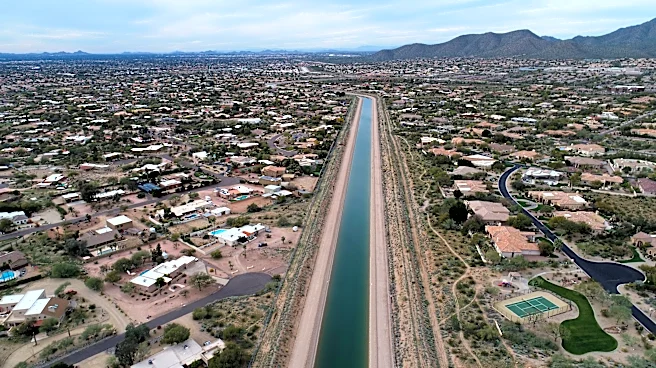
About 40% of Phoenix’s drinking water comes from the Central Arizona Project, or CAP — the 336-mile canal system that provides the river’s water to major Arizona communities. That’s about 120,000 to 130,000 acre-feet, according to Wilson.
An acre-foot of water is enough to sustain three Phoenix homes for one year on average, the city said.
Wilson noted that Phoenix stores a portion of its share underground to prepare for shortages. The anticipated cuts, he explained, will largely impact how much water the city can set aside moving forward.
“There likely will be little to no water available for additional storage underground,” Wilson said. “In fact, we will likely be in the beginning stages of recovering some of our previously stored water to be able to meet demands.”
The city has about 700,000 acre-feet of water reserves — enough to serve about 105,000 Phoenix homes a year for about 20 years, according to the city.
Wilson stressed, though, that the city has been planning for this moment for decades through conservation efforts and investments in other water resources.
“We’re going to put that into action for our customers to make sure that they get the level of service that they expect from us, which is clean, reliable and safe drinking water,” he said.
Over in Scottsdale, CAP supplies about 70% of the community’s drinking water.
In an internal memo to city leaders there, water officials said it’s too early to quantify the impacts of the cuts, namely because the federal government’s framework is expected to be renegotiated every two years.
"Scottsdale Water will continue reviewing additional documentation, monitoring future federal decisions and keep the mayor and City Council informed as more information becomes available," city staff and management wrote to the city council.
How are local officials reacting?
Some elected leaders have expressed frustration with the guidelines.
Mayors and officials from Phoenix, Scottsdale, Mesa and Tempe have lamented that the anticipated cuts are unfairly hitting the Lower Basin states the hardest.
They’ve argued that the four other states that rely on the Colorado River are not equitably sharing the burden.
“The federal (government) takes aim at Arizona and Lower Basin states even though we continue to do our part and conservation is a core part of our culture,” Phoenix Mayor Kate Gallego wrote on social media.
While noting that Phoenix “has spent decades planning for a moment like this” and is ready to endure the cuts, she added that the federal government “is wrong to lay a disproportionate share of the burden on Arizona.”
Tempe Councilmember Nikki Amberg blasted the move as a “failure to produce a truly equitable solution” to the drought.
Mesa Mayor Mark Freeman reiterated the point.
“Today’s federal action falls short of resolving the challenge,” he posted on Facebook, adding: “The Colorado River is Arizona’s lifeline, and protecting its future requires solutions that are equitable, sustainable, and grounded in sound science.”
Scottsdale Mayor Lisa Borowsky said in a phone call that Arizona is a leader in technological advancements and other key resources, and therefore more credit than it’s getting.
“I’d like to see the White House, the administration, step in and bolster our position,” she said. “We’re critical in terms of our participation in defense efforts, manufacturing, economic development for the country, agriculture. We really need some backup from the White House.”
Like Gallego, Borowsky also boasted about the city’s efforts over the years to invest in conservation, aquifer recharge and advanced water purification.
“These investments,” she stated in a press release, “have positioned our city to remain resilient even as the challenges facing the Colorado River grow.”
How have their cities been preparing?
To address the drought along the river, cities have relied on water conservation and resource management solutions. That has largely included rebate and educational programs, and setting aside water for future use.
In 2022, Mesa enacted a “water watch,” its first of four water shortage tiers. It holds no mandatory water restrictions and relies on voluntary water-saving practices.
Phase 1 sought to cut Mesa’s water use by 5%. The city stated it was holding off on any changes to its water management plan until future federal actions. Elected officials will have to sign off on additional water conservation stages.
Water conservation messaging to the public is also in play in Glendale, Peoria and Surprise, which offer rebates to residential and non-residential users.
And as part of a regional effort to help sustain the Colorado River system, cities have been voluntarily leaving a portion of their allocation in Lake Mead.
Communities have also been searching for alternative water sources other than the river.
One of Mesa’s most significant water projects is the 10.5-mile-long Central Mesa Reuse Pipeline. The city is expected to begin receiving an additional 8,000 acre-feet of water annually from the Gila River Indian Community when the pipeline begins operating, unlocking treated wastewater from the Northwest Water Reclamation Plant.
The city will exchange 20,000 acre-feet of effluent water annually for a total of 16,000 acre-feet of water from the Colorado River at the rate the tribe pays for it.
Peoria plans to build new groundwater wells to prepare for both population growth and possible Colorado River cuts. One $40 million project to build three in the city's northern region is underway, and the city has also worked to expand reclaimed water systems.
What about purifying recycled wastewater?
There’s also another key strategy major cities are pursuing to become self-sufficient and to offset the planned CAP cuts: deliver purified wastewater directly to customers’ taps.
Phoenix and Tucson are leading the charge by building new plants for that purpose, while Scottsdale’s plan to update its existing facility so it can do the same has stalled.
Scottsdale already produces purified water at its Advanced Water Treatment facility near Loop 101 and Pima Road. There, wastewater is treated, in part, by running it through reverse osmosis membranes and ultraviolet light, converting it into potable water.
It’s then recharged into aquifers, pumped out about a decade later for additional purification, and then sent to residents as an indirect source for drinking.
Amid uncertainties over construction costs and new environmental regulations from the state, the city has paused funding to the project.
Borowsky, though, expressed confidence that the project will get back on track next year.
“My understanding is it is going to resume,” she said, adding, “I expect we will have more certainty related to what that project will cost and then it will be plugged back in the budget.”
Other cities like Mesa, Glendale and Gilbert, along with the private water company Epcor Utilities Inc., have joined Phoenix to fund a feasibility study for the regional 91st Avenue Advanced Water Purification Facility. If built, the facility would purify 60 million gallons of water per day.
Phoenix has two other projects in the works.
First, construction is underway to revitalize the city’s existing Cave Creek Water Reclamation Plant, located along Cave Creek Road, just north of Loop 101. When complete — either by late 2028 or early 2029 — it’s expected to generate nearly 7 million gallons of pure water daily.
Then there’s the neighboring North Gateway Advanced Water Purification Facility, which is in the design phase, according to the city. That project received a $179 million investment from the federal government a year ago last month.
Can those projects offset the Colorado River cuts?
Phoenix boasted that over the next decade, the three planned and developing plants are expected to provide more than 50,000 acre-feet of renewable water annually.
In Scottsdale, officials said that should the proposed updates to the water campus proceed, it could produce between 11,200 acre-feet of water annually and 22,400 acre-feet. That’s enough to replace about 17% to 34% of Scottsdale’s current CAP use.
Whether those amounts of purified water will be sufficient to help cover the cities’ CAP losses remains unclear, as the federal guidelines have not yet been finalized.
Cynthia Campbell, the director of policy innovation at the Arizona Water Innovation Initiative at ASU, doesn’t believe so. She stressed that there’s not one solution, or a “silver bullet,” to replace the Colorado River water.
“The cities are looking at as many different options as they can," she noted, adding, “There’s nothing that would provide that much water, even advanced water purification. It's a good one though, and it'll take us pretty far compared to other things, but they're going to have to do more than that.”
Wilson of Phoenix’s water department echoed the sentiment, noting that the city is also working with other Valley entities to develop more storage in Bartlett Dam for the Verde River system and recently partnered with Tucson on a statewide water-sharing initiative.
“We’re not just doing three facilities,” he said, adding, “we anticipate that by doing those projects, we’ll be able to make sure that our customers have access to the same level of service that they’re used to today.”
Republic reporters Brandon Loomis, Maritza Dominguez and Elena Santa Cruz contributed to this report.
Shawn Raymundo covers Phoenix and Scottsdale. Reach him at sraymundo@gannett.com or follow him on X @ShawnzyTsunami.
This article originally appeared on Arizona Republic: How Metro Phoenix cities plan to cope with less Colorado River water